
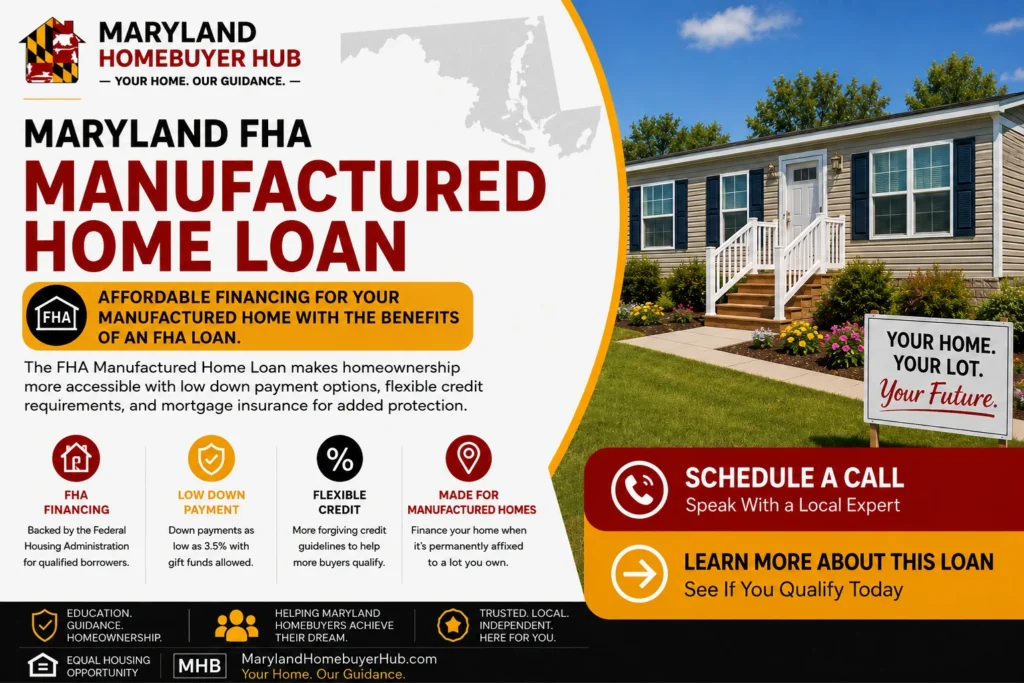
How FHA financing works on a manufactured home
An FHA manufactured home loan is an ordinary FHA mortgage — the same Section 203(b) program used to buy a site-built house in Maryland — applied to a factory-built home that has been permanently attached to land and converted into real property.
That last part is the whole game. Once the home and the land legally exist together as one piece of real estate, FHA treats the transaction very much like any other purchase: 3.5% down at a 580 credit score, a 30-year fixed rate, the same upfront and annual mortgage insurance, and the same FHA loan limit for the county you are buying in.
What makes these loans different is not the financing. It is the property side. A manufactured home has to clear a set of construction, foundation, title and appraisal requirements that simply do not exist for a site-built house — and in Maryland, converting the home to real property runs through the Motor Vehicle Administration, not the county land records office alone.
Most manufactured deals that fall apart do not fail on credit. They fail because somebody discovered a property problem after the buyer had already paid for an inspection and an appraisal. This page is organised to put those problems in front of you first.
The short version
If the home was built on or after June 15, 1976, sits on a permanent foundation an engineer can certify, was never moved from another site, and the home and land are legally one piece of real estate, FHA financing is usually available on standard FHA terms.
If any one of those four is missing, the answer changes — and it is worth knowing which one before you write an offer.
Title I and Title II are not the same program
This is the single most common source of bad information about manufactured home financing, and it is worth two minutes of your time because the two programs have different collateral, different terms and different limits.
- FHA Title II — the Section 203(b) mortgage. Secured by real estate: the home and the land together. This is what almost every Maryland buyer means when they say “FHA loan.” Thirty-year terms, FHA county loan limits, 3.5% down, standard FHA mortgage insurance.
- FHA Title I — a separate HUD insurance program for manufactured home loans, which can cover the home alone, a lot alone, or both, and which can work in some leased-land situations. It has its own statutory loan limits and its own shorter terms, and it is originated by relatively few lenders.
Do not mix the two sets of numbers
Title I loan limits are not FHA county loan limits. The 3.5% down payment, the 580 credit tier, the 2026 Maryland county limits and the mortgage insurance structure described on this page all belong to Title II.
If a guide quotes a manufactured home “FHA limit” that is a flat dollar figure with no county attached, you are almost certainly reading Title I numbers — and they do not apply to a Title II purchase of a home on land you own.
Everything below this point describes FHA Title II. If your situation is a genuine Title I fit — typically a home on leased land in a community — that is a different conversation, and a short one worth having before you go further.
What the home itself has to meet
HUD sets these in Handbook 4000.1. They are not lender preferences, and an FHA appraiser is required to report on each of them.
| Requirement | What it means in practice |
|---|---|
| Built on or after June 15, 1976 | The date the federal construction and safety standards took effect. Homes produced before it are ineligible for FHA insured financing — regardless of condition, upgrades or a new foundation. There is no exception and no workaround. |
| HUD Certification Label | A red metal plate on the exterior of each section. If the appraiser reports it missing, the lender must obtain a letter of label verification issued on behalf of HUD through the Institute for Building Technology and Safety. A missing label is a delay, not automatically a dead deal. |
| Data Plate | A paper document inside the home — usually near the electrical panel, in the utility room or inside a kitchen cabinet — listing manufacturer, serial number, model, build date and the wind, roof load and thermal zones. The appraiser reports it, and reports if it cannot be found. |
| Designed as a one-family dwelling | Single-section and multi-section homes both qualify. FHA sets no minimum number of sections. |
| At least 400 square feet | FHA’s published minimum floor area. Note that FHA itself sets no minimum width. |
| Permanent chassis, permanent foundation | The home is built on and remains on a permanent chassis, and sits on a foundation built to HUD’s Permanent Foundations Guide for Manufactured Housing. |
| Towing hitch and running gear removed | Wheels, axles and the towing tongue must be gone. An appraiser who finds them still attached must report a property deficiency. |
| Perimeter enclosure | The space beneath the home must be enclosed by a continuous wall secured to the perimeter that still allows crawl space ventilation. Lightweight skirting on its own is not a foundation. |
| Moved once, from factory or dealer to the site | FHA requires that the home was transported directly from the manufacturer or the dealership to its current site. A home that was installed somewhere, then relocated, is not eligible. |
| Classified as real estate | The home and the site must exist together as a real estate entity under state law. Notably, FHA does not require the home to be taxed as real property — the legal classification is what matters. |
| Principal residence | FHA financing is for a home you will live in. Second homes, vacation homes and rental property are not eligible. |
Two things you may have been told that are not FHA rules
“FHA does not finance single-wides.” FHA sets a 400-square-foot minimum floor area and no minimum width. A width floor — you will most often hear 12 feet — is a lender or investor requirement, not an FHA one. It is real, and it may well apply to your loan, but it is worth asking whose rule it is.
“A missing data plate kills the loan.” HUD’s own instruction is that the appraiser reports the data plate information, and reports if it is missing, and is not required to go find it elsewhere. Lenders and investors often want it anyway, and replacement documentation can usually be obtained — but it is not the categorical eligibility bar it is often described as.
The foundation and the engineer’s certification
This is the requirement that most often costs money and time, and the one most worth handling early.
FHA requires the home to sit on a permanent foundation built in accordance with HUD’s Permanent Foundations Guide for Manufactured Housing, and the appraisal is conditioned on a certification from an engineer or architect licensed in Maryland attesting that the foundation complies. The lender must obtain that certification; it is not optional and it is not something the appraiser can supply.
What the guide covers is structural: piers and footings, soil bearing, anchoring, frost depth, the perimeter enclosure and crawl space ventilation. Original installations that were never upgraded — block piers with no anchoring, vinyl skirting over open ground, footings above frost depth — commonly fail.
New construction and existing construction are judged differently
- New construction — a home permanently erected on the site less than one year before the case number is assigned. The space beneath must be enclosed by continuous foundation-type construction able to resist all forces without transmitting them to the home above, built of concrete, masonry or treated wood.
- Existing construction — installed one year or more before the case number date. If the perimeter enclosure is lightweight non-load-bearing skirting, its entire surface area must be permanently attached to backing made of concrete, masonry, treated wood or something of similar strength and durability.
An existing certification may be reusable — ask before you pay
If the home was previously financed with an FHA-insured mortgage, your lender may be able to use a copy of that earlier foundation certification, provided the foundation has not been altered and shows no observable damage since it was issued.
This is genuinely worth asking about on a resale. It is a documented HUD provision, and sellers of previously FHA-financed manufactured homes sometimes still have the paperwork.
Order it at contract acceptance, not at appraisal week
Scheduling a licensed engineer, completing the inspection and getting the signed certification delivered is routinely the longest lead-time item in a manufactured purchase. It is also the item most likely to surface a problem that needs remediation before closing.
Get it moving the day the contract is signed. Everything else on a manufactured file can usually absorb a delay; this one cannot.
Converting the home to real property in Maryland
A manufactured home starts life as a titled vehicle. Maryland issues it a certificate of title through the Motor Vehicle Administration, exactly as it would for a car. FHA cannot insure a mortgage against a vehicle — the home and the land have to become a single piece of real estate first.
Maryland has a specific statutory process for this, and it is worth understanding because it is the step most likely to hold up a closing.
What Maryland law requires
Under the Maryland Real Property Article, Title 8B, a manufactured home is converted to real property when all three of the following have happened:
- The home is attached to a permanent foundation.
- The ownership interests match. Whoever owns the home must be the same party that owns the parcel it sits on.
- An affidavit of affixation is recorded with the clerk of the circuit court for the county where the land is.
The affidavit itself has to describe the home — manufacturer, make, model name, model year, dimensions and serial number, and whether it is new or used — along with the street address and legal description of the parcel, a statement that the ownership interests are or will be identical, and a statement that the home is or will be attached to that parcel.
It also has to be accompanied by the original certificate of title, clearly marked surrendered, together with any and all lien releases — or, where that is not possible, a report from a licensed Maryland attorney or title insurance producer documenting the lien searches. The owner signs under penalty of perjury.
Maryland’s form for this is MVA Form VR-451, Affidavit Manufactured Home Converted to Real Property.
Filing the form is not the same as completing the conversion
This is the Maryland trap, and it catches experienced people.
The Maryland Mortgage Program’s own guidance to lenders is explicit: submitting Form VR-451 is insufficient. What is required is confirmation from the Maryland Motor Vehicle Administration that the conversion to real property is complete — the form on its own is not accepted as proof.
MMP describes this documentation as the most difficult item to obtain on a manufactured home file, and warns that without it the loan will not be purchased by the program’s master servicer.
If you are buying a home that has already been converted, ask the seller for the completed conversion confirmation, not just a copy of the affidavit. If the home has not been converted yet, start the process early — it involves the MVA, the circuit court land records and the title company together.
One clarification that saves confusion at closing: FHA requires good and marketable title showing the home and land are classified as real estate at the time of closing, and requires that any chattel title be properly purged under state and local rules. FHA does not require the home to be taxed as real property. Those are two different things, and Maryland jurisdictions do not all handle assessment the same way.
Maryland law also requires the MVA to make manufactured home records available to attorneys, title insurance producers and others authorised to conduct a title search — which is how a title company confirms whether a conversion actually happened and whether any old liens are still sitting on the vehicle title.
Owned land, leased lots and manufactured home communities
The practical answer for almost every Maryland buyer is: you need to own the land. But the reason is more specific than “FHA does not allow leases,” and the distinction occasionally matters.
FHA can insure a mortgage on a leasehold estate. What it requires is a renewable lease with a term of not less than 99 years, or a lease that extends at least 10 years beyond the maturity date of the mortgage. On a 30-year loan, that second option means a lease with at least about 40 years left on it.
Now apply that to a real Maryland manufactured home community. Lot leases in those communities are typically annual or month-to-month, sometimes with a modest term, and they are not renewable on anything approaching a 99-year basis. A standard park lot lease cannot meet FHA’s leasehold test — which is why, in practice, FHA financing is not available for a home on a rented lot.
What that leaves for leased-lot buyers
If your home will sit on a lot you rent, the financing product built for that situation is a chattel loan — a personal property loan secured by the home itself, closer in structure to a vehicle loan than a mortgage. Terms are shorter and rates are generally higher than a real-estate mortgage.
FHA’s Title I program can also reach some leased-land scenarios where the lease meets HUD’s requirements, but relatively few lenders originate Title I loans.
Neither of those is a bad outcome. They are just a different product, and it is far better to know which one you are shopping for before you fall in love with a specific home.
The other thing worth confirming early is the zoning and the acreage. Manufactured homes on owned land are common in Maryland’s Eastern Shore counties, in Western Maryland, and in the rural parts of Southern Maryland, but placement is governed by county and municipal zoning, and some jurisdictions restrict where a manufactured home may be sited. Confirm with the county planning office before you buy a vacant parcel intending to place a home on it.
Credit, down payment and qualifying
On the borrower side, an FHA manufactured home loan is an FHA loan. The published tiers are the same ones that apply to a site-built house in Maryland.
- 580 or higher — 3.5% minimum down payment. This is FHA’s standard tier and the path most manufactured buyers use.
- 500 to 579 — 10% minimum down payment. The tier exists, and many lenders will not work in it.
- Below 500 — not eligible for FHA financing at any down payment.
- Gift funds — the entire minimum required investment can come from a documented gift, with a signed gift letter and a traceable paper trail from the donor to your account or to escrow.
- Bankruptcy — two years from a Chapter 7 discharge with re-established credit; a Chapter 13 can work after 12 months of on-time payments into the plan with court approval.
Where the manufactured overlay usually shows up
Many lenders set their own manufactured-home credit floor well above FHA’s 580 — 620 and 640 are both common — and some decline manufactured collateral entirely. That is an overlay: a lender or investor rule layered on top of FHA’s, not an FHA requirement.
It is worth asking directly: “Is that number FHA’s, or yours?” The answer determines whether shopping the loan would change anything.
Debt-to-income
FHA does not publish one universal DTI ceiling. What it publishes is a table of maximum qualifying ratios for manually underwritten loans, tied to credit score and to documented compensating factors. Files that receive an Approve from FHA’s automated scorecard are evaluated differently and can carry higher ratios than the manual table allows.
| Credit score | Maximum ratios | What is required |
|---|---|---|
| 500–579, or no score | 31 / 43 | No compensating factors available. This is the ceiling. |
| 580 and above | 31 / 43 | No compensating factors required. |
| 580 and above | 37 / 47 | One of: documented cash reserves, a minimal increase in housing payment, or residual income. |
| 580 and above | 40 / 40 | No discretionary debt. |
| 580 and above | 40 / 50 | Two of the qualifying compensating factors. |
The first number is your housing payment as a share of gross monthly income; the second is your total monthly debt. Energy efficient homes may use slightly stretched ratios.
Non-occupying co-borrowers
FHA allows a co-borrower who will not live in the home — commonly a parent. There is a limit most summaries leave out: on a non-occupying borrower transaction the maximum loan-to-value is 75%, which rises to 96.5% when the borrowers are family members, and that increase does not apply where a family member is selling to a family member who will be a non-occupying co-borrower, or on a two- to four-unit property.
In other words: a parent co-signing on your purchase generally keeps you at 3.5% down. A parent co-signing on a purchase from another family member does not.
Mortgage insurance
FHA mortgage insurance works the same way on a manufactured home as on any other FHA loan. There are two pieces.
| Premium | Amount | How long it lasts |
|---|---|---|
| Upfront premium | 1.75% of the base loan amount | Paid once, and normally financed into the loan rather than paid in cash |
| Annual premium, more than 5% down | 0.50% per year, billed monthly | 11 years if you put at least 10% down; otherwise the life of the loan |
| Annual premium, less than 5% down | 0.55% per year, billed monthly | The life of the loan |
The practical consequence: at 3.5% down, FHA mortgage insurance does not fall off. The route out is a refinance once you have enough equity — which is a real option, and one worth revisiting rather than treating as permanent.
2026 Maryland FHA loan limits
FHA sets a maximum loan amount by county, and it applies to manufactured homes exactly as it does to site-built ones. For 2026 the nationwide one-unit floor is $541,287 and the ceiling is $1,249,125.
Maryland’s twenty-four jurisdictions fall into four groups.
| 2026 limit | Maryland jurisdictions |
|---|---|
| $1,249,125 | Charles, Frederick, Montgomery, Prince George’s |
| $747,500 | Anne Arundel, Baltimore City, Baltimore County, Carroll, Harford, Howard, Queen Anne’s |
| $630,200 | Cecil |
| $541,287 | Allegany, Calvert, Caroline, Dorchester, Garrett, Kent, St. Mary’s, Somerset, Talbot, Washington, Wicomico, Worcester |
For most Maryland manufactured purchases these limits are not the binding constraint — typical prices sit well below even the floor. They matter mainly if you are buying a large multi-section home on acreage in one of the higher-limit counties.
Limits are set for each calendar year and apply based on when the FHA case number is assigned, so confirm the current figure rather than relying on a number you saw last year.
What to confirm before you write an offer
Almost every manufactured deal that collapses does so at the appraisal, when somebody discovers the HUD label is gone, the foundation is not certifiable, the home was moved, or the title was never converted. By then the buyer has typically paid for a home inspection and an appraisal and has to renegotiate, walk away, or scramble for a different kind of loan.
Every item below can be checked before you are under contract, and most of them can be checked at the showing.
- The build date. On or after June 15, 1976. The data plate tells you. This is the one with no workaround, so check it first.
- The HUD certification label. A red metal plate on the exterior of each section, roughly a foot up from the floor. Walk the outside of the home and look.
- The data plate. Inside — near the electrical panel, in the utility room, or in a kitchen cabinet. Photograph it.
- Whether the home has ever been moved. Ask directly, and ask the title company to look at the title history. FHA needs it to have gone from factory or dealer straight to this site.
- Who owns the land. Owned in fee simple, not a rented lot. A preliminary title search settles it.
- Whether the title was actually converted. Not “the form was filed” — confirmation from the MVA that the conversion is complete, plus any lien releases.
- The foundation. Look for a continuous perimeter enclosure, not loose skirting over open ground. If you can see daylight under the home between piers, budget for a conversation.
- Whether the hitch, wheels and axles are gone. Original installations often left them in place.
- Additions and alterations. Enclosed porches, room additions, carports attached to the home — each one triggers an extra inspection requirement.
- The flood zone. Especially anywhere near tidal water on the Eastern Shore or in Southern Maryland.
- Zoning. Confirm with the county that a manufactured home is a permitted use on that parcel.
- Order the engineer’s foundation certification at contract acceptance. Not at appraisal week.
Twelve items, most of them answerable in an afternoon. It is the cheapest due diligence in the entire transaction.
Have the property checked before you spend money on it
Build date, HUD label, foundation, title conversion and flood zone can all be reviewed before you are under contract — and they are far cheaper to check now than to discover at the appraisal.
This is not a commitment to lend. All loans subject to credit approval.
Flood zones and Maryland’s tidal counties
Maryland has more than four thousand miles of tidal shoreline, and manufactured homes are common in exactly the low-lying areas where that matters. FHA has a manufactured-specific flood rule that is stricter than what applies to a site-built house, and it catches people.
The requirement: the finished grade beneath the manufactured home must be at or above the 100-year return frequency flood elevation.
If any part of the home, related structures or essential equipment sits inside a Special Flood Hazard Area, the property is not eligible for FHA insurance unless the lender obtains one of the following:
- A FEMA Letter of Map Amendment or Letter of Map Revision removing the property from the flood hazard area; or
- A FEMA National Flood Insurance Program Elevation Certificate, prepared by a licensed engineer or surveyor, stating that the finished grade beneath the home is at or above the 100-year flood elevation — together with NFIP flood insurance.
An FHA appraiser who determines a manufactured home is in Flood Zone A or V is required to stop work and contact the lender before continuing. That is a real pause in your timeline, and the fix — a surveyed elevation certificate — takes time to obtain.
Where this bites in Maryland
Dorchester, Somerset, Wicomico, Worcester, Talbot, Queen Anne’s, Caroline and Kent counties on the Eastern Shore, and St. Mary’s, Calvert, Charles and Anne Arundel on the western shore, all contain substantial mapped flood hazard area — and all of them have manufactured housing stock.
Check the FEMA flood map for the specific parcel before you make an offer. If it is in a mapped zone, raise it with your lender immediately rather than waiting for the appraiser to find it.
Where flood insurance is required, FHA requires it to be maintained for the life of the loan.
How the appraisal works — and what additions do to it
A manufactured home is appraised on a different form from a site-built house, using a different comparable-sales standard.
- The form. The appraiser reports on the Manufactured Home Appraisal Report, not the standard residential form.
- At least two manufactured comparables. FHA requires the appraiser to include a minimum of two manufactured homes in the comparable sales grid, and enough sales overall to produce a credible value. In thinly traded Maryland submarkets this is occasionally the hardest part of the appraisal.
- Measurement rules. Living area is calculated on the overall length, including projections at least seven feet high. Bay windows, roof overhangs, drawbars, couplings and hitches are excluded from the length and width.
- Cost approach on new construction. The appraiser must apply the cost approach where the home is new construction.
- Manufactured units in condominium projects are eligible for FHA insurance, but they cannot be processed as site condominiums.
Additions and structural changes
If the appraiser observes an addition or a structural change to the original home, the appraisal must be conditioned on an inspection by the state agency that inspects manufactured housing for compliance, or, where a state does not employ inspectors, a report on structural integrity from a licensed structural engineer.
Maryland does have that agency. The Maryland Department of Labor, Division of Labor and Industry, Building Codes Administration is the state administrative agency for the federal manufactured housing program, and local enforcement agencies are responsible for inspecting manufactured home alterations and add-ons to confirm they do not cause the home to fall out of conformance with the federal standards.
There is a related trap on the foundation side. If additions or alterations were not addressed in the foundation certification, the lender has to go back and obtain that inspection or engineer’s report separately. A sunroom somebody added ten years ago is a genuine underwriting item, not a cosmetic detail — and it is much better identified at the showing than at the appraisal.
Down payment assistance on a Maryland manufactured home
The 3.5% down payment can come from a gift or from a down payment assistance program, and buyers of manufactured homes use both. Maryland’s assistance landscape is broader than any one program — you can see the range on our Maryland down payment assistance page — but the manufactured-home rules are narrower than the site-built ones, and it is worth being precise about why.
The Maryland Mortgage Program
The state’s flagship program, the Maryland Mortgage Program, added manufactured housing as an acceptable property type in December 2020. Two things about how it works matter to you:
- MMP does not impose its own manufactured-housing overlays. The program aligns with its master servicer and with the mortgage insurer, so the binding rules come from those parties rather than from the state.
- The real-property conversion documentation is the gate. MMP’s guidance identifies it as the hardest document to obtain on this property type, and the master servicer requires confirmation from the MVA that the conversion is complete — the VR-451 form alone is not accepted.
The practical sequence MMP describes: obtain the approved conversion documentation first, then make the program reservation, then have the specific property address reviewed by the master servicer. Because assistance amounts, income limits and credit requirements are revised regularly, confirm the current terms rather than relying on any published summary.
Assistance programs frequently exclude manufactured homes — ask early
County, municipal, employer and lender-specific assistance programs each set their own property rules, and manufactured homes are a common exclusion. Some programs also restrict single-section homes specifically, or set a higher minimum credit score for manufactured collateral than for site-built.
None of that is an FHA rule. It is the individual program’s rule — which means the right question is not “can I get assistance?” but “which assistance programs accept this property type?” Ask before you build a cash-to-close plan around a specific program.
Renovation financing on a manufactured home
FHA’s 203(k) program rolls a purchase price and the cost of repairs into one mortgage. Manufactured homes are eligible for it, with one restriction stated plainly in HUD’s handbook: 203(k) may be used on manufactured housing only where the rehabilitation does not affect the structural components that were designed and built to the federal construction and safety standards.
In practical terms that permits a lot — kitchens, bathrooms, flooring, windows, non-structural roofing, plumbing and electrical updates, health and safety repairs, wells and septic systems — and rules out anything that touches the structural envelope: structural additions, foundation reconstruction, or demolition and rebuild.
The property also has to have been completed for at least one year before the case number date, and has to satisfy every other manufactured-home requirement on this page.
On renovation dollar caps
You will find published claims that FHA caps manufactured-home renovation funds at a specific dollar figure or a percentage of the completed value. We could not locate such a manufactured-specific cap in HUD’s handbook, and we are not going to repeat a number we cannot verify.
What is true is that lenders and investors commonly impose their own limits on manufactured renovation lending, and those limits vary. If you are quoted a cap, ask whether it is FHA’s or the lender’s — the answer tells you whether shopping the loan would change it.
Refinancing an FHA manufactured home loan
If you already own a Maryland manufactured home with FHA financing, three refinance paths are available. Each one still requires the property to meet the manufactured-home requirements on this page.
- FHA Streamline Refinance — for existing FHA borrowers. Reduced documentation, frequently no new appraisal, no cash out. Your current loan must be FHA-insured, your payments current, and the refinance must produce a net tangible benefit. This is the path when rates fall.
- FHA Rate-and-Term Refinance — full underwriting, new appraisal, and it works whether your existing loan is FHA, VA, USDA or conventional. Use it to change loan types or restructure the loan.
- FHA Cash-Out Refinance — limited to 80% loan-to-value, and you must have owned and occupied the property as your principal residence for at least 12 months. The 80% ceiling is FHA-wide, not a manufactured-home penalty — but because manufactured appraised values tend to be lower, 80% of a smaller number often does not free up much.
For a small cash-out target, the closing costs on a full refinance frequently consume most of the proceeds. A home equity line or second mortgage is often the cheaper answer — worth pricing both before you commit. Our Maryland refinance options page covers the wider picture.
Maryland transfer and recordation taxes
Once the home is real property, the purchase is taxed as a real estate transfer — which for a Maryland buyer means two separate line items, not one.
- State transfer tax — 0.5% of the consideration. For a first-time Maryland home buyer purchasing improved residential property as a principal residence, the rate drops to 0.25% and the state transfer tax is paid entirely by the seller. You must be an individual who has never owned residential real property in Maryland as a principal residence, and you sign a sworn statement to that effect.
- County transfer tax — set separately by each Maryland county, and the rates differ substantially. Some jurisdictions offer their own first-time buyer relief.
- Recordation tax — also county-set, generally charged per $500 of consideration.
Who pays what is negotiable and is set by your contract. On a purchase directly from a dealer or builder, read the tax allocation clause carefully — a builder’s own contract form may allocate costs differently from the standard residential contract used in most Maryland resales.
Because county rates and exemptions change, get a written estimate for the specific county rather than working from a general figure.
How FHA compares to the other manufactured-home paths
FHA is not the only way to finance a manufactured home in Maryland, and it is not always the best one. The short version: if you served, look at VA first. If the lot is rented, FHA is not on the table at all.
| Path | Minimum down | Rented lot | Single section |
|---|---|---|---|
| FHA Title II | 3.5% at 580, or 10% at 500–579 | No | Yes, at 400 sq ft or more |
| VA | 0% with entitlement | No | Yes, subject to VA property rules |
| USDA | 0% in eligible rural areas | No | Yes, subject to USDA property rules |
| Conventional | Commonly 5%, lower on some programs | No | Yes, for a principal residence |
| Chattel | Varies by lender | Yes — this is the path for rented lots | Yes |
Each of those programs sets its own property rules on top of the shared basics, and they are not interchangeable. USDA in particular has a narrower position on existing manufactured homes than on new ones, and conventional financing draws a sharper line between single-section and multi-section homes depending on occupancy. If you are weighing two of them, price both rather than assuming.
Compare this option with other Maryland manufactured home loan programs.
You can compare the underlying loan types on our Maryland loan programs page, and read the general FHA rules on the Maryland FHA loans page.
When FHA is not the right path
An honest page has to include this section. These are the situations where FHA manufactured financing does not work, and what to look at instead.
- The home was built before June 15, 1976. There is no FHA path, at any down payment, in any condition, on any foundation. Chattel financing from a portfolio lender, seller financing or cash are the remaining options — or using the land for a new home placement and financing that instead.
- The lot is rented. FHA’s leasehold test requires a 99-year renewable lease or one extending at least 10 years past the mortgage maturity. Park lot leases do not qualify. Chattel financing is the product for this.
- The home has been moved from a prior installation site. FHA requires transport directly from factory or dealer to the site. Conventional financing may still be available in some cases.
- You are buying a second home or a rental. FHA is principal-residence financing. Conventional manufactured financing covers second homes in some circumstances; investment property generally requires another route entirely.
- You are an eligible veteran with solid credit. VA financing offers no down payment and no monthly mortgage insurance. On the same purchase that is usually a materially better outcome than 3.5% down with FHA mortgage insurance for the life of the loan.
- The foundation cannot be brought into compliance economically. If an engineer’s report lists deficiencies that cost more to fix than the home is worth, the honest answer is to look at a different property.
- You want a small cash-out refinance. Closing costs on a full FHA refinance usually consume most of a modest cash-out target. Price a home equity line first.
What the process actually looks like
A Maryland FHA manufactured purchase runs on a similar clock to a site-built FHA purchase, with two extra steps that are worth planning around.
- Get pre-approved before you shop. Credit, income and the down payment plan, so you know what you can actually do.
- Screen the property. Build date, HUD label, data plate, foundation, whether it was moved, whether the land is owned, whether the title was converted, and the flood zone.
- Go under contract with the tax and cost allocations you understand.
- Order the engineer’s foundation certification immediately. This is the long pole. Ask whether a prior FHA certification exists and can be reused.
- Title work and conversion review. The title company confirms whether the MVA conversion is complete and whether any old liens remain on the vehicle title.
- FHA appraisal on the manufactured home form, with the manufactured comparables, the label and data plate reporting, and the foundation condition.
- Underwriting and clearing conditions — including any additions inspection, elevation certificate or label verification.
- Closing.
New homes purchased directly from a dealer take longer, because the placement, the foundation and the final inspection all have to be finished before the loan can fund. Build in more time than a resale would need, and treat the dealer’s promised delivery date as an estimate.
Frequently asked questions
Can you buy a manufactured home with an FHA loan in Maryland?
Yes. FHA insures Title II mortgages on manufactured homes that are permanently affixed to a foundation on land you own, legally classified as real estate, built on or after June 15, 1976, and used as your principal residence. The terms are the standard FHA terms: 3.5% down at a 580 credit score, a 30-year fixed rate, and the FHA loan limit for your county.
Does FHA finance single-wide manufactured homes?
FHA itself sets a minimum floor area of 400 square feet and does not set a minimum width, so a single-section home meeting the other requirements is eligible. Many lenders and assistance programs impose their own width or section requirements — you will most often hear 12 feet, or a multi-section requirement. Those are overlays. If you are told single-wides are ineligible, ask whether that is FHA’s rule or the lender’s.
Can I use FHA financing in a manufactured home community where I rent the lot?
Not with a Title II mortgage. FHA can insure a leasehold, but only where the lease is renewable for at least 99 years or extends at least 10 years beyond the mortgage maturity date, and standard community lot leases do not come close. The financing built for a rented lot is a chattel loan, which is a personal property loan secured by the home. FHA’s separate Title I program can reach some leased-land situations, but few lenders originate it.
What if the home was built before June 15, 1976?
It is not eligible for FHA financing, and there is no exception. That date is when the federal construction and safety standards took effect, and homes produced before it cannot be insured regardless of condition, renovations or a new foundation. Portfolio chattel lenders, seller financing or cash are the alternatives.
The HUD certification label is missing. Is the deal dead?
Not automatically. If the appraisal reports the label missing, the lender must obtain a letter of label verification issued on behalf of HUD through the Institute for Building Technology and Safety. That takes time, so start it as soon as it is identified. A home may satisfy FHA’s requirement either by having the label affixed or by having obtained that verification letter.
What if the data plate is missing?
HUD’s instruction to the appraiser is to report the data plate information, and to report if it is missing — the appraiser is not required to obtain it from another source. Lenders and investors frequently want the information anyway, and replacement documentation can generally be obtained. Treat a missing data plate as a delay and a documentation task, not as an automatic denial, and ask your lender what they specifically require.
Does the home have to be taxed as real estate?
No. FHA requires the home and the site to exist together as a real estate entity under state law and requires good and marketable title showing them classified as real estate at closing — but HUD states specifically that the manufactured home need not be treated as real estate for state taxation purposes. Legal classification and tax treatment are two different questions.
How do I convert a manufactured home to real property in Maryland?
Three things have to happen under Maryland’s Real Property Article, Title 8B: the home is attached to a permanent foundation, the ownership of the home and of the land are identical, and an affidavit of affixation is recorded with the clerk of the circuit court. The affidavit must describe the home and the parcel and be accompanied by the original certificate of title marked surrendered, together with all lien releases. Maryland’s form is MVA Form VR-451. Critically, filing the form is not the same as completing the conversion — lenders require confirmation from the MVA that the conversion is complete.
Do I need an engineer’s foundation certification?
Yes. The appraisal is conditioned on a certification from an engineer or architect licensed in Maryland attesting that the foundation complies with HUD’s Permanent Foundations Guide for Manufactured Housing, and the lender must obtain it. One useful exception: if the home carried a previous FHA-insured mortgage, a copy of that earlier certification may be usable, provided the foundation has not been altered and shows no observable damage since. Ask before you pay for a new one.
Can my parents co-sign?
Yes, FHA allows a non-occupying co-borrower. The detail most summaries omit is that a non-occupying borrower transaction is limited to 75% loan-to-value, rising to 96.5% when the borrowers are family members — and that increase does not apply where a family member is selling to a family member who will be a non-occupying co-borrower, or on a two- to four-unit property. Assistance programs also frequently prohibit non-occupying co-borrowers, so confirm both together.
Can I use gift funds for the down payment?
Yes. The entire minimum required investment can come from a documented gift. You need a signed gift letter confirming there is no expectation of repayment, and a traceable trail of funds from the donor to your account or directly to escrow. Gift funds can also cover closing costs and prepaid items, and can be combined with assistance program funds.
The home is in a flood zone. What happens?
FHA requires the finished grade beneath a manufactured home to be at or above the 100-year flood elevation. If any part of the home or essential equipment is inside a Special Flood Hazard Area, the property is ineligible unless the lender obtains a FEMA Letter of Map Amendment or Revision removing it, or a FEMA elevation certificate prepared by a licensed engineer or surveyor confirming the grade, together with NFIP flood insurance. An appraiser who finds a manufactured home in Zone A or V must stop work and contact the lender. Check the flood map before you make an offer.
The home has an addition. Does that matter?
Yes. If the appraiser observes an addition or structural change, the appraisal must be conditioned on inspection by the state agency that inspects manufactured housing, or a structural engineer’s report where a state has no inspectors. Maryland’s agency is the Department of Labor’s Division of Labor and Industry, Building Codes Administration, with local enforcement agencies inspecting alterations and add-ons. If the addition was not covered in the foundation certification, that has to be resolved separately.
How long does FHA mortgage insurance last on a manufactured home?
The same as on any other FHA loan. There is a 1.75% upfront premium, normally financed. The annual premium runs for 11 years if you put at least 10% down, and for the life of the loan if you put less down. At 3.5% down it does not fall off, and the way out is a refinance once you have equity.
Sources
- FHA Single Family Housing Policy Handbook 4000.1 — the manufactured housing provisions relied on throughout this page: property eligibility and required documentation at II.A.1.i, including the Certification Label and the label verification letter where the appraisal shows it missing; property acceptability criteria for manufactured housing under Title II at II.D.5; allowable mortgage parameters at II.A.2; manual underwriting qualifying ratios; leasehold requirements; flood hazard requirements for manufactured housing; closing and title requirements; and 203(k) property eligibility for manufactured housing at II.A.8.
- 24 CFR § 203.43f (Eligibility of mortgages involving a manufactured home) — the requirement that the mortgage cover the manufactured home and the site, and that the unit be classified and taxed as real estate.
- HUD Permanent Foundations Guide for Manufactured Housing (PFGMH, HUD-7584) — the foundation design standard referenced by Handbook 4000.1 and by the required engineer’s certification. Related program material is published through HUD’s Manufactured Housing Programs.
- HUD Mortgagee Letter 2025-23 (2026 Nationwide Forward Mortgage Limits) and HUD FHA mortgage limits — the CY2026 floor and ceiling, and the Maryland county values used here.
- HUD Mortgagee Letter 2023-05 (Reduction of Annual Mortgage Insurance Premiums) — the annual premium rates used in the cost discussion, together with the upfront premium of 1.75% of the base loan amount.
- Md. Code, Real Property § 8B-201 (conversion to real property), § 8B-202 (affidavit of affixation) and § 8B-203 — the conditions for converting a manufactured home to real property in Maryland, the contents of the affidavit, and record availability through the Motor Vehicle Administration.
- Maryland Motor Vehicle Administration Form VR-451, Affidavit Manufactured Home Converted to Real Property — the state form used to effect the conversion. Obtain the current version directly from the MVA.
- Maryland Mortgage Program — manufactured housing lender guidance and MMP Directive 2020-21 (December 2020).
- Md. Code, Tax-Property § 13-203 — the state transfer tax rate and the reduced first-time buyer rate.
- COMAR 09.12.52 (Industrialized Buildings and Manufactured Homes), administered by the Maryland Department of Labor, Building Codes Administration.
Verified August 25, 2026. Figures deliberately omitted: no interest rates, payment examples, engineer certification fees, foundation remediation costs or renovation dollar caps are shown, because those are set by individual markets, vendors or lenders rather than by FHA. Published claims that HUD caps manufactured-home 203(k) rehabilitation at a specific dollar amount or percentage of completed value could not be located in the handbook sections reviewed and are treated here as lender or investor limits rather than FHA requirements. FHA’s manual underwriting ratio table is reproduced above; files receiving an Approve from FHA’s automated scorecard are evaluated differently, and the higher ratio figures often quoted online are not published FHA ceilings. FHA sets no minimum width for a manufactured home; width and section requirements are imposed by lenders, investors and assistance programs. Loan limits and mortgage insurance premiums are revised periodically and apply based on the FHA case number assignment date. Maryland Mortgage Program terms, income limits and credit requirements change regularly and must be confirmed with the program or a participating lender. Confirm all current figures and requirements with a lender that actively originates FHA manufactured home loans.
This page explains how FHA financing for manufactured homes generally works for Maryland homebuyers. It does not determine individual eligibility, is not a commitment to lend, and is not a Loan Estimate. No interest rate is offered or implied. It is general information rather than legal or tax advice; Maryland titling, recording, zoning and tax questions should be confirmed with your title company, closing attorney, or the appropriate Maryland agency. Program terms are set by the U.S. Department of Housing and Urban Development and are subject to change, and participating lenders may apply additional requirements that differ from lender to lender. Maryland Homebuyer Hub is not affiliated with, endorsed by, or acting on behalf of the U.S. Department of Housing and Urban Development, the Federal Housing Administration, the Maryland Motor Vehicle Administration, the Maryland Department of Housing and Community Development, the Maryland Department of Labor, or any government agency.