
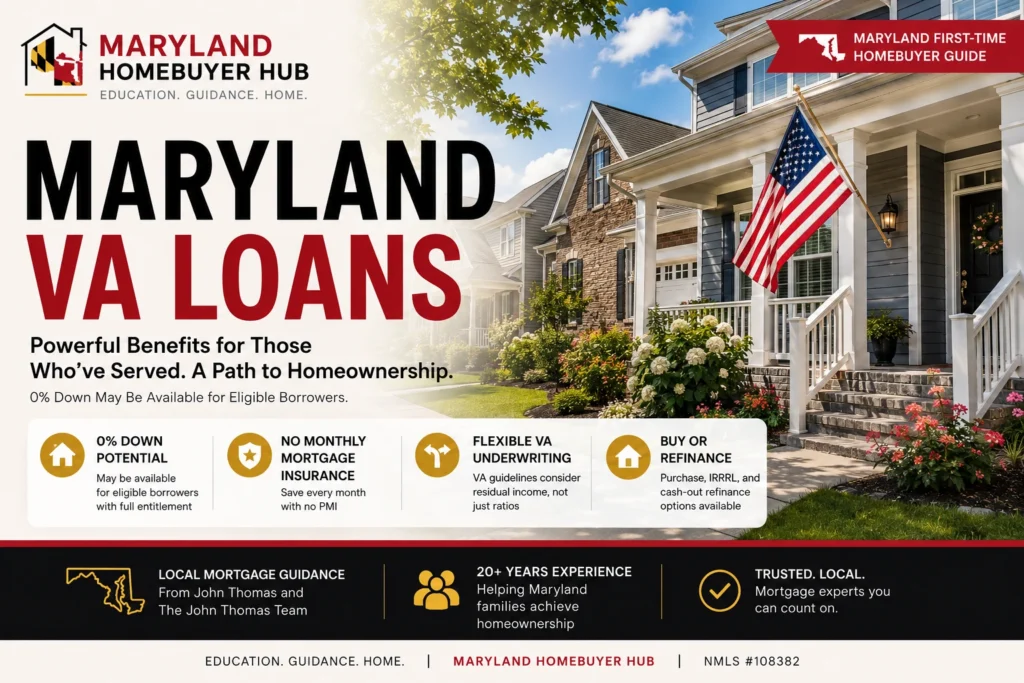
How VA loans work in Maryland
A VA loan is a mortgage made by a private lender and guaranteed by the U.S. Department of Veterans Affairs. The VA does not lend money and does not set your interest rate. A VA-approved lender does both. What the VA provides is a guaranty — a promise to cover part of the lender’s loss if the loan defaults.
That guaranty is the entire reason the benefit works. Because the lender’s downside is reduced, it can offer terms no other mainstream program matches: no down payment on most purchases, and no monthly mortgage insurance at any down payment amount. Those two facts, together, are usually worth more to a Maryland buyer than a slightly lower rate somewhere else.
Three different rulebooks apply to a Maryland VA loan
Almost every contradictory answer a veteran gets traces back to these being mixed together. They are separate, and they stack:
- VA program rules. Set by the Department of Veterans Affairs. They apply identically in Maryland and everywhere else — eligibility, entitlement, the funding fee, occupancy, appraisal standards, seller concession limits.
- Lender overlays. Any lender may require more than the VA does. The VA publishes no minimum credit score and no maximum debt-to-income ratio. A lender that requires a 620 score is quoting its own policy, not a VA rule.
- Maryland program rules. Only relevant if you layer state assistance on top. The Maryland Mortgage Program adds its own income limits, purchase price limits, education requirement and credit standards — on top of the VA’s.
If two lenders give you different answers about the same loan, an overlay is almost always the reason.
What makes VA different from every other program
- No down payment on most purchases, for buyers with full entitlement.
- No monthly mortgage insurance. Not reduced — absent. FHA charges it for the life of most loans; conventional charges it below 20% down.
- A one-time funding fee instead, which many veterans are exempt from entirely.
- Reusable. This is not a once-in-a-lifetime benefit.
- Assumable by a qualified buyer, subject to lender and VA approval.
- No prepayment penalty.
What is actually different about using a VA loan in Maryland
The benefit itself works the same in every state. What changes here is the environment around it:
- Loan limits only matter in five jurisdictions — and only if your entitlement is partial. See the Maryland figures.
- Maryland assistance can sit on top of a VA loan. A VA loan can be the first mortgage under the Maryland Mortgage Program, and Maryland waives its first-time buyer requirement for many veterans. How that works.
- Maryland transfer and recordation taxes are a real closing-cost line, with a first-time buyer break many military families qualify for. See closing costs.
- Where you buy is shaped by the installations. Fort Meade, Aberdeen, Pax River and Andrews sit in very different price environments. Compare the areas.
Who qualifies for a VA loan in Maryland?
Eligibility is based on service history, not on where you live or whether you have bought before. A veteran who separated in 1995 and a sergeant currently stationed at Fort Meade can both be eligible.
Service requirements
In general terms, you may be eligible if you meet one of the following. The VA’s own service-requirement tables are detailed and era-specific, so treat this as orientation rather than a determination:
- Active duty service members — generally after a continuous period of qualifying service.
- Veterans who met the minimum active-duty service requirement for their service era and were not dishonorably discharged.
- National Guard and Reserve members — through qualifying years of service, a qualifying period of active duty, or certain activations.
- Surviving spouses in defined circumstances, including some surviving spouses of service members who died in the line of duty or from a service-connected disability.
Guard and Reserve members pay the same funding fee
The VA eliminated the higher funding fee that once applied to National Guard and Reserve borrowers. Guard and Reserve members now pay the same rates as regular military. If you were quoted a higher fee on that basis, it is out of date.
Occupancy
A VA purchase loan is for a home you intend to occupy as your primary residence, generally within 60 days of closing. The VA recognises that this does not fit every military situation, and provides for reasonable exceptions — including circumstances where a spouse can satisfy occupancy for a deployed service member. Investment properties and vacation homes are not eligible.
Your Certificate of Eligibility (COE)
The Certificate of Eligibility is the VA’s confirmation that you are entitled to the benefit, and how much entitlement you have available. You cannot close a VA loan without one.
There are three routes to it:
- Through your lender. Usually the fastest. Most VA-approved lenders can pull a COE electronically through the VA’s system, often in minutes.
- Online yourself through the VA’s eBenefits portal.
- By mail, using VA Form 26-1880, which is the slowest route.
What you need on hand depends on your service category — typically a DD-214 for separated veterans, a statement of service for active duty, and points statements plus proof of honorable service for Guard and Reserve members.
A COE is not a pre-approval
The COE confirms your entitlement. It says nothing about your credit, income or how much you can borrow. Those are separate underwriting questions, and a COE in hand does not mean a loan is approved. You need both.
Talk through your eligibility before you start shopping
A short conversation can confirm your entitlement, sort VA rules from lender overlays, and tell you what your options actually look like in Maryland.
This is not a commitment to lend. All loans subject to credit approval.
What credit score and income do you need for a VA loan?
Short answer: the VA sets no minimum credit score and no maximum debt-to-income ratio. Individual lenders set those. What the VA does apply is a residual income test that most other programs do not use.
This is where VA rules and lender overlays get confused most often, so it is worth being precise.
Credit score
The VA does not set a minimum credit score. Every minimum score you will ever be quoted on a VA loan is a lender overlay:
- Lenders set their own floors, and those floors vary meaningfully between them.
- A file declined by one VA-approved lender may be approved by another, with no change to the loan itself.
- The VA asks lenders to assess whether your credit shows a willingness and ability to repay, considered as a whole rather than as a single number.
Key takeaway
A declined VA application is worth a second opinion. The restrictive number is usually the lender’s rather than the VA’s, so the same file can get a different answer elsewhere.
Debt-to-income ratio
The VA does not publish a hard maximum debt-to-income ratio either. VA underwriting guidance uses a DTI benchmark as a screening threshold — above it, the lender is expected to document compensating factors and give closer attention to residual income. It is a trigger for further review, not an automatic decline.
In practice, approvals above that benchmark happen regularly when residual income is strong. Approvals also get declined below it when residual income is thin. Any specific ceiling you are quoted reflects that lender’s tolerance.
Residual income: the VA’s distinguishing test
Residual income is what is left each month after the mortgage payment and your other obligations come out of your take-home pay. It is the money you actually live on.
Almost no other program uses it. It is a large part of why VA loans have historically performed well: the test asks whether the household can genuinely afford daily life, not just whether a ratio clears a threshold.
The calculation subtracts these from your monthly take-home pay:
- The new mortgage payment, including property taxes and homeowners insurance
- Your other monthly debt payments
- Estimated maintenance and utilities for the home
The amount you need varies by family size, loan amount and region of the country. Maryland sits in the VA’s South region for these tables. The figures are published in the VA Lender’s Handbook (VA Pamphlet 26-7, Chapter 4) and are periodically revised, so the number that matters is the one your lender calculates against the current table for your household, not a figure from an article.
The practical takeaway: a Maryland buyer with a modest score and strong residual income is often in a better position on a VA loan than the raw numbers suggest.
What is VA entitlement?
Entitlement is the amount the VA will guarantee on your behalf. It governs how much you can borrow with no money down, and whether you can hold two VA loans at once.
| Full entitlement | Partial entitlement | |
|---|---|---|
| What it means | Never used, or used and since restored | Some is tied up in another VA loan, or was lost to a prior loan not paid in full |
| County loan limit | Does not apply | Applies |
| Down payment | Typically none | May be needed above the county limit |
| How it is restored | Already full | Usually by selling the home and paying off the VA loan |
The distinction matters for exactly one reason, and it is the subject of the next section: full entitlement means no loan limit. Partial entitlement means a limit applies.
You can use the benefit more than once, and in some circumstances hold two VA loans simultaneously — a genuinely useful feature for service members who receive PCS orders while still owning a home bought with a VA loan.
Maryland VA loan limits
If you have full entitlement, there is no VA loan limit
This is the single most misreported fact about VA loans. Since 2020, a veteran with full entitlement has no VA loan limit. You are limited by what you can qualify for and what the appraisal supports — not by a county cap.
County loan limits still exist, but they only bind borrowers with partial entitlement. If you see a page telling you the “maximum VA loan in Maryland” is a specific number, it is describing a situation that may not be yours.
When county limits do apply
If part of your entitlement is tied up in another VA loan, the VA uses your county’s conforming loan limit to calculate the guaranty still available to you. That figure determines how much you can borrow with no down payment; you may still be able to buy above it by making a down payment on the difference.
For 2026, most of Maryland uses the national baseline conforming value. Five jurisdictions do not.
| Maryland jurisdiction | 2026 one-unit value |
|---|---|
| Montgomery, Prince George’s, Frederick, Charles | $1,249,125 |
| Calvert | $1,209,750 |
| All other Maryland counties and Baltimore City | $832,750 |
The four Washington-metro counties carry the national high-cost ceiling. Calvert County sits at its own value, slightly below the ceiling — a detail most published county tables get wrong, including some that simply group it with the rest of Southern Maryland.
These are 2026 figures published by the Federal Housing Finance Agency and they change annually. Again: if your entitlement is full, none of this constrains you.
Down payment, closing costs and seller help
The down payment
Zero, for most eligible buyers with full entitlement. VA is one of only two mainstream no-down-payment programs, and unlike USDA it carries no geographic or income restriction. On a $450,000 home in Anne Arundel County, that is $450,000 financed rather than $90,000 out of pocket for a 20% conventional loan.
You may still choose to put money down. Doing so reduces the funding fee (see below), lowers the payment, and builds equity immediately.
Closing costs still exist
Zero down is not zero cash. You will still have closing costs — appraisal, title work, recording, lender fees, and Maryland’s transfer and recordation taxes, which are a meaningful line item here and vary by county. Prepaid items such as homeowners insurance and property tax escrows are separate again.
Maryland homebuyer tip: the first-time buyer transfer tax break
Maryland charges a state transfer tax of 0.5% of the consideration. On a sale of improved residential property to a first-time Maryland home buyer who will occupy it as a principal residence, the rate drops to 0.25% and the transfer tax is paid entirely by the seller.
The statutory definition is Maryland-specific: a first-time Maryland home buyer is someone who has never owned residential real property in Maryland that was their principal residence. A service member who owned a home in another state before a move here may still qualify. This is a different test from the first-time buyer rule used by the Maryland Mortgage Program, and the two are assessed separately.
County transfer and recordation taxes are set by each county and are not affected by this provision.
The VA also restricts which fees a veteran is permitted to pay. Your lender identifies these on your Loan Estimate; if a non-allowable fee appears in a transaction, it has to be covered by someone other than the buyer.
How the seller can help
This is where VA financing is unusually flexible, and where a well-negotiated Maryland contract can get a veteran to the table with very little cash:
- Closing cost credits are not capped by the VA. A seller or builder may pay some or all of the buyer’s loan-related closing costs.
- Seller concessions are capped at 4% of the home’s reasonable value. Concessions are a narrower category — anything of value added to the deal at no extra cost to the buyer, such as paying the funding fee, paying off the buyer’s debt, or prepaying hazard insurance.
- Gift funds from an acceptable donor are permitted, with documentation.
Two different limits, often confused
Closing cost credits and seller concessions are governed separately. The 4% cap applies to concessions, not to ordinary closing cost credits. Getting this right in negotiation is worth real money.
How much is the VA funding fee?
The funding fee is a one-time charge that funds the loan program so it costs taxpayers nothing. It replaces monthly mortgage insurance — and over a typical holding period it is usually far cheaper than FHA’s or conventional’s monthly premiums.
It can be financed into the loan rather than paid in cash at closing, which is what most buyers do.
| Down payment | First use | Later use |
|---|---|---|
| Less than 5% | 2.15% | 3.3% |
| 5% up to 10% | 1.5% | 1.5% |
| 10% or more | 1.25% | 1.25% |
Rates shown are for purchase and construction loans and have been in effect since April 2023. An Interest Rate Reduction Refinance Loan carries a 0.5% fee. A VA cash-out refinance is 2.15% on first use and 3.3% on later use.
Note the shape of that table: putting down 5% cuts a repeat user’s fee from 3.3% to 1.5%. On a $500,000 loan that is a difference of $9,000 — worth modelling before you decide to put nothing down.
Who pays no funding fee at all
A significant number of Maryland veterans are exempt. You are exempt if any of the following apply:
- You receive VA compensation for a service-connected disability.
- You are eligible for VA compensation but receive retirement or active-duty pay instead.
- You are a surviving spouse receiving Dependency and Indemnity Compensation.
- You are an active-duty service member with a pre-discharge claim rating.
- You are active duty and, on or before closing, provide evidence of a Purple Heart.
Exemption is confirmed through your COE. If you have a disability claim pending, say so early — a rating that lands before closing can remove the fee entirely, and that is worth thousands.
VA vs. conventional vs. FHA in Maryland
For a buyer who is eligible, VA is usually the strongest of the three. The comparison is worth making explicitly, because plenty of eligible Maryland buyers are steered into FHA without ever being told.
| Feature | VA | FHA | Conventional |
|---|---|---|---|
| Minimum down | 0% | 3.5% | 3% to 5% |
| Monthly mortgage insurance | None | Yes, usually for the life of the loan | Yes, below 20% down |
| Upfront fee | Funding fee, often waived | Upfront premium | None |
| Credit minimum | Set by lender | Set by FHA, plus overlays | Set by agency, plus overlays |
| Who can use it | Eligible military only | Anyone who qualifies | Anyone who qualifies |
| Occupancy | Primary only | Primary only | Primary, second or investment |
When another program may still win
Being eligible does not make VA automatically correct:
- You are buying an investment property or second home. VA cannot be used.
- You have a large down payment. At 20% down, conventional has no mortgage insurance either, and you would avoid the funding fee — unless you are exempt, in which case VA likely wins again.
- The property will not meet VA’s condition standards and the seller will not repair it.
- You want to preserve entitlement for a future purchase.
If you are weighing VA against FHA specifically, our Maryland FHA loans guide covers that program in the same depth, and the Maryland loan programs overview compares all four side by side.
See what your VA benefit looks like on a real Maryland purchase
Getting pre-approved tells you your actual number, your actual payment, and whether the funding fee applies to you.
This is not a commitment to lend. All loans subject to credit approval.
Property requirements and the VA appraisal
The VA appraisal does two jobs at once, and conflating them causes most of the anxiety around VA offers. It establishes the property’s reasonable value, and it confirms the home meets the VA’s Minimum Property Requirements — that it is safe, structurally sound and sanitary.
What MPRs generally look for
- Safe mechanical systems, and adequate heat.
- A sound roof and structure, with no obvious major defects.
- Safe, potable water and working sanitary facilities.
- Safe access to the property.
- No evident hazards on the site.
- In areas where it is required, an inspection for wood-destroying insects.
Maryland’s older housing stock — Baltimore rowhomes, mid-century Anne Arundel ranches, farmhouses on the Eastern Shore — means condition issues surface more often here than in new-construction markets. That is a reason to write the offer thoughtfully, not a reason to avoid VA financing.
An appraisal is not a home inspection
The VA appraisal protects the VA and the lender. It is not a substitute for your own home inspection, and it will not tell you what you need to know as a buyer. Get an independent inspection regardless.
If the value comes in low
You are not automatically finished. There is a formal reconsideration-of-value process, and the VA also uses a procedure called Tidewater that allows the appraiser to be presented with additional supporting sales before a low value is finalised. An experienced VA lender and a well-prepared agent matter here.
Types of VA loans
The purchase loan is the one most Maryland buyers use, but it is not the only one:
- VA purchase loan. The standard benefit — typically zero down on a primary residence.
- Interest Rate Reduction Refinance Loan (IRRRL). A streamlined refinance from one VA loan into another at a lower rate, with reduced documentation and a 0.5% funding fee.
- VA cash-out refinance. Converts equity to cash, and can also be used to refinance a non-VA loan into a VA loan.
- VA renovation loan. Finances the purchase and the repairs together. Availability varies significantly by lender.
- VA construction loan. One-time-close construction financing. Offered by relatively few lenders.
- VA manufactured home loan. Permitted within VA rules, with additional property conditions and fewer participating lenders.
If you are weighing a refinance rather than a purchase, our Maryland refinance options guide covers the wider picture.
Using a VA loan with Maryland assistance
This is the question that has no good national answer, and it is where Maryland veterans are most often told something incorrect.
The Maryland Mortgage Program is the state’s homebuyer mortgage and assistance program, run through the Maryland Department of Housing and Community Development. Its down payment assistance is only available with an MMP first mortgage — it is not standalone help you can attach to any loan.
The relevant fact for veterans: a VA loan can serve as the MMP first mortgage. MMP products accommodate VA alongside FHA, USDA and conventional financing, which means an eligible veteran may be able to combine the VA benefit with Maryland assistance rather than choosing between them.
Maryland waives its first-time buyer requirement for many veterans
MMP is generally aimed at first-time homebuyers. Maryland applies a specific exception for veterans, in accordance with the Heroes Earnings Assistance and Relief Tax Act of 2008: an honorably discharged veteran who has not previously used the first-time homebuyer exemption may qualify even if they have owned a home before.
Documentation is required — a DD-214 to establish veteran status, and Maryland’s Veteran First-Time Homebuyer Exemption form. If you have owned before and assumed Maryland assistance was closed to you, it may not be.
Whether combining actually helps depends on the numbers. VA already requires no down payment, so Maryland assistance is usually most valuable for closing costs rather than for the down payment itself.
Before assuming it is the better route, weigh:
- MMP’s income limits and purchase price limits, which apply on top of the VA’s rules
- The homebuyer education requirement
- MMP’s own credit standards
- The rate on the MMP first mortgage compared with a standard VA loan
It is worth pricing both ways rather than assuming.
Our Maryland down payment assistance guide covers the state, county and city programs in detail, including how the layers interact.
One more Maryland benefit worth knowing
Maryland fully exempts from state property tax the primary residence of a veteran with a 100% service-connected permanent and total disability rating, or a rating of 100% due to individual unemployability. Surviving spouses may qualify in defined circumstances. This is a property tax benefit rather than a mortgage program, but it changes the monthly payment materially — and because escrow is part of your payment, it changes what you can afford. Applications go through your local assessment office.
Buying near Maryland’s military communities
Maryland has an unusually dense concentration of military and defense installations for its size, which shapes where VA buyers actually shop:
Central Maryland
- Fort Meade — Anne Arundel County. Home to NSA and U.S. Cyber Command, and the largest single employer in Maryland.
- Aberdeen Proving Ground — Harford County. The Army’s oldest active proving ground, roughly 72,000 acres.
- U.S. Naval Academy — Annapolis, Anne Arundel County.
- Coast Guard Yard — Curtis Bay.
Washington suburbs
- Joint Base Andrews — Prince George’s County.
- Walter Reed National Military Medical Center — Bethesda, Montgomery County.
- Fort Detrick — Frederick County.
These are the counties with the higher conforming values, which matters if your entitlement is partial.
Southern Maryland
- NAS Patuxent River — St. Mary’s County. NAVAIR headquarters and the Navy Test Pilot School.
- NSF Indian Head — Charles County.
Two practical consequences. First, commuting distance drives the trade-off between price and drive time across very different Maryland markets — a Pax River family and a Fort Meade family are shopping in almost unrelated price environments. Second, PCS timing is real: the ability to hold two VA loans in some circumstances is directly relevant if orders arrive while you still own a home financed with the benefit.
If you are still deciding where to look, our Maryland counties guide breaks the state down county by county.
Getting pre-approved and how the process runs
- Confirm eligibility and pull your COE. Usually same-day through a VA-approved lender.
- Get pre-approved. Credit, income and asset documentation are reviewed so you know your real number and whether the funding fee applies to you.
- Shop with an agent who has closed VA deals. In competitive Maryland submarkets, how the offer is written matters.
- Go under contract, negotiating closing cost help deliberately rather than as an afterthought.
- VA appraisal is ordered alongside your independent home inspection.
- Underwriting, including any conditions raised on the appraisal.
- Clear to close, then closing. Timelines depend on the file and the transaction, not on the fact that it is a VA loan.
What to have ready
- DD-214, a statement of service, or Guard and Reserve points statements
- Recent pay stubs and W-2s, or tax returns if you are self-employed
- Recent bank and asset statements
- Your Certificate of Eligibility, or the details needed to pull it
- Award documentation if you receive VA disability compensation, which may remove the funding fee
For the full Maryland buying process from planning through settlement, see Buying a Home in Maryland. If you are earlier than that and still getting oriented, Start Here covers the basics first.
Prefer to understand the whole process before speaking to anyone? The free Maryland first-time homebuyer workshop walks through financing, assistance and the buying process end to end.
Common VA loan myths
| Myth | Reality |
|---|---|
| You only get to use it once | Entitlement can be restored and reused, and two VA loans at once are possible in some circumstances. |
| VA loans take much longer to close | Not inherently. Timelines are driven by the file and the transaction. |
| Sellers will not accept VA offers | This persists on reputation rather than evidence. A clean, well-structured VA offer competes. |
| The house has to be perfect | Minimum Property Requirements target safety, soundness and sanitation, not cosmetics. |
| There is a VA minimum credit score | There is not. Lenders set their own. |
| You cannot use VA with down payment assistance | In Maryland, a VA loan can be the first mortgage under the Maryland Mortgage Program. |
| Everyone pays the funding fee | Many Maryland veterans are exempt. |
Maryland VA loan FAQ
Is there really no down payment on a Maryland VA loan?
For an eligible buyer with full entitlement, yes — no down payment is required on most purchases, up to what you qualify for and what the appraisal supports. You will still have closing costs, which is a separate question from the down payment.
Do VA loans have PMI?
No. VA loans carry no monthly mortgage insurance at any down payment amount. There is a one-time funding fee instead, and many veterans are exempt from it.
What credit score do I need for a VA loan in Maryland?
The VA sets no minimum. Any minimum you are quoted is that lender’s own overlay, and overlays differ between lenders — which is why a declined file is worth a second opinion.
What is the maximum VA loan amount in Maryland?
With full entitlement there is no VA loan limit. County conforming values only apply when your entitlement is partial. For 2026 those values are $1,249,125 in Montgomery, Prince George’s, Frederick and Charles counties, $1,209,750 in Calvert County, and $832,750 elsewhere in Maryland.
Can I use a VA loan more than once?
Yes. The benefit is reusable, entitlement can be restored after a sale and payoff, and holding two VA loans at the same time is possible in some situations — which matters when PCS orders arrive.
Can the seller pay my closing costs?
Yes. The VA does not cap ordinary closing cost credits from a seller or builder. Separately, seller concessions — a narrower category — are capped at 4% of the home’s reasonable value.
Are National Guard and Reserve members eligible?
They can be, through qualifying years of service, a qualifying period of active duty, or certain activations. They also pay the same funding fee rates as regular military.
Can a surviving spouse use the VA loan benefit?
In defined circumstances, yes, including some surviving spouses of service members who died in the line of duty or from a service-connected disability. Surviving spouses receiving Dependency and Indemnity Compensation are also exempt from the funding fee.
Can I combine a VA loan with Maryland down payment assistance?
A VA loan can serve as the first mortgage under the Maryland Mortgage Program, so the two can potentially be combined. MMP’s own income, purchase price, education and credit requirements still apply.
Do I have to be a first-time buyer to use Maryland assistance as a veteran?
Not necessarily. Maryland applies a veteran exception under the Heroes Earnings Assistance and Relief Tax Act, so an honorably discharged veteran who has not previously used the exemption may qualify despite having owned a home before. A DD-214 and Maryland’s exemption form are required.
What is an IRRRL?
An Interest Rate Reduction Refinance Loan — a streamlined refinance from one VA loan to another at a lower rate, with reduced documentation and a 0.5% funding fee.
Sources
- U.S. Department of Veterans Affairs — VA funding fee and loan closing costs (funding fee rates effective April 7, 2023; exemption categories; seller concession limit; financing the fee).
- U.S. Department of Veterans Affairs — VA home loan limits (treatment of full versus partial entitlement).
- VA Lenders Handbook, VA Pamphlet 26-7, Chapter 4 (credit underwriting and residual income by region).
- Federal Housing Finance Agency — conforming loan limit values for 2026, full county list (Maryland county values; baseline $832,750; high-cost ceiling $1,249,125).
- Maryland Department of Housing and Community Development — Maryland Mortgage Program, 1st Time Advantage product terms and the veteran first-time homebuyer exemption.
- Maryland State Department of Assessments and Taxation and the Maryland Department of Veterans and Military Families — disabled veteran property tax exemption.
- Maryland Code, Tax-Property Article § 13-203 — state transfer tax rate, the reduced first-time Maryland home buyer rate, who pays it, and the statutory definition of a first-time buyer.
- Maryland Department of Planning — military installation area profiles.
Figures verified August 22, 2026. VA program rules, funding fee rates, conforming loan limit values and Maryland program terms all change. Re-check before relying on any figure here.
This page explains how the VA home loan program generally works for Maryland buyers. It does not determine individual eligibility, is not a commitment to lend, and is not a Loan Estimate. Eligibility for the VA home loan benefit is determined by the U.S. Department of Veterans Affairs. Maryland Homebuyer Hub is not affiliated with, endorsed by, or acting on behalf of the Department of Veterans Affairs or any government agency.