
How VA manufactured home financing works
The home has to be real estate, not a vehicle
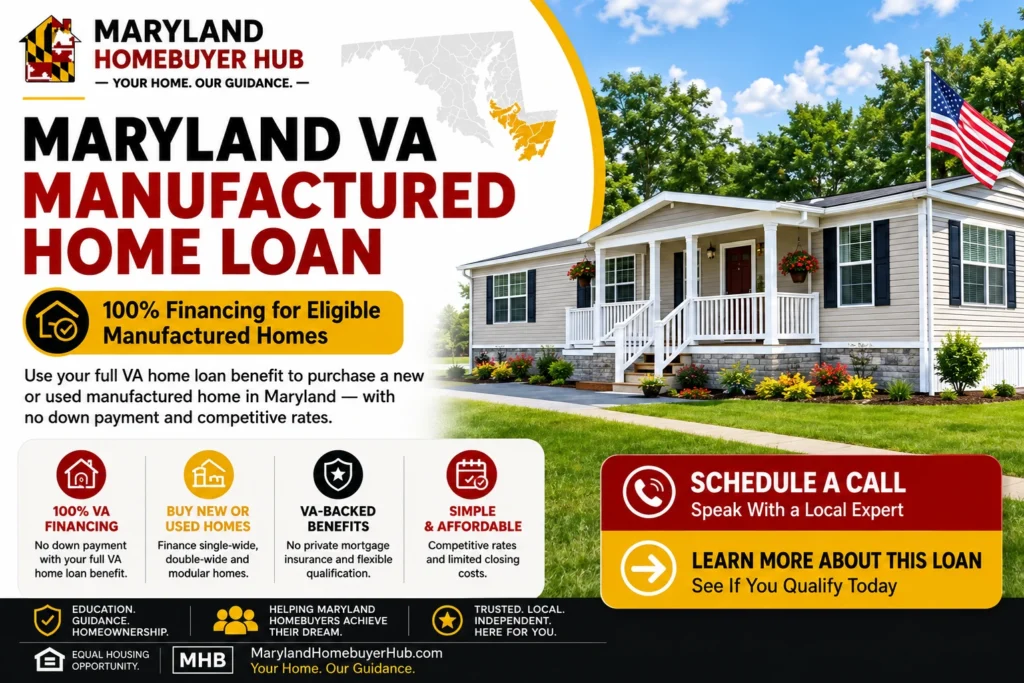
A qualifying manufactured home can be financed with a standard VA purchase loan — $0 down with full entitlement, no monthly mortgage insurance, and a 30-year fixed rate. Single-wide, double-wide and multi-wide can all qualify.
The catch is not the borrower. It is the property. To use VA financing the home generally has to sit on land you own (or are buying in the same transaction), be permanently affixed to a foundation, be legally converted to real property, comply with the HUD code, and pass the VA appraisal.
This is not the same thing as financing a mobile home on rented land. A home in a park on leased ground cannot be secured by a VA loan, no matter how well the veteran qualifies. That situation needs personal-property financing instead.
Almost everything that makes the VA benefit powerful on a site-built house carries over: no down payment, no monthly mortgage insurance, VA’s residual income underwriting, and the funding fee exemption for veterans receiving compensation for a service-connected disability.
What is added is a short list of property rules. They are not difficult rules — but they are unforgiving, and they are the reason most VA manufactured home transactions that fail, fail. Almost none of them fail because of the buyer.
Why veterans use VA financing for a manufactured home
When the property clears the requirements, VA is usually the strongest financing available to an eligible veteran buying a manufactured home:
- $0 down payment. With full entitlement, most eligible buyers finance up to 100% of the purchase price.
- No monthly mortgage insurance. Unlike FHA or low-down conventional financing, there is no monthly MI — which keeps the payment meaningfully lower.
- Competitive rates and real borrower protections built into the program.
- More home for the money. A manufactured home often costs less per square foot than a comparable site-built house, so the same benefit reaches a larger or newer home.
- Single-wide, double-wide and multi-wide all qualify when the home meets the program’s property rules.
- A 30-year fixed term is available — including on a single-wide. More on that below, because a great deal of online advice gets it wrong.
Real property vs leased land — the distinction that decides everything
This is the single most important thing on this page. Almost every confused question about VA and manufactured homes traces back to it.
A manufactured home starts life as personal property. It is built in a factory, transported on a chassis, and titled by a motor vehicle agency — much like a vehicle. In that state it is not real estate, and a mortgage cannot attach to it.
A manufactured home becomes real property when it is permanently attached to a foundation on land held by the same owner, and the personal-property title is formally surrendered. At that point it is legally part of the land, taxed as real estate, and a mortgage — including a VA loan — can attach to it.
| Factor | VA real-property financing | Leased-land / personal-property financing |
|---|---|---|
| Who owns the land | You do, or you are buying it in the same transaction | Someone else — you rent the lot or pad |
| Legal classification | Real property, taxed as real estate | Personal property, titled like a vehicle |
| Foundation | Permanent foundation required | Often a temporary or pier-and-tie setup |
| Type of loan | A mortgage secured by land and home together | A chattel or personal-property loan on the home only |
| VA eligible? | Yes, when all property requirements are met | No — a VA loan must be secured by real property |
| Typical term | Up to 30 years fixed | Shorter |
| Monthly mortgage insurance | None | Not applicable — different product entirely |
If the home is in a park, VA is not the answer
A VA loan must be secured by real property. If the lot is rented — a manufactured home community, a mobile home park, family land you do not hold title to — the home cannot be converted to real property, so a VA loan cannot attach to it.
That is not a lender preference or an overlay you can shop around. It is structural. Personal-property (chattel) financing is the path in that situation, and it is a different product with different terms.
The good news: if you are buying the land along with the home, that works. The land and the home can be purchased together on a single VA loan, provided the home will be permanently affixed and converted to real property.
How a manufactured home becomes real property in Maryland
Maryland has a specific statutory process for this, and it is worth understanding before you make an offer — because a home that cannot complete it is a home a VA loan cannot finance.
Under Maryland’s Real Property Article, Title 8B, a manufactured home is converted to real property when all three of the following have happened:
- The home is attached to a permanent foundation.
- The ownership interests in the home and the land are identical. The same person or people must own both. This is the legal reason a rented lot cannot work.
- An affidavit of affixation is recorded with the clerk of the circuit court for the county where the land sits.
What the affidavit of affixation has to contain
- A description of the home — manufacturer, make, model name, model year and dimensions, and whether it is new or used
- The street address and legal description of the parcel
- A statement that ownership of the home and the land are, or will be, identical
- A statement that the home is, or will be, attached to that parcel
- The original certificate of title issued by the Maryland Motor Vehicle Administration, surrendered — together with a release from every lienholder shown on it
- It must be signed under penalty of perjury and acknowledged
If the owner genuinely cannot locate the certificate of title, Maryland law provides an alternative: a report from a Maryland-licensed attorney or title insurance producer who has searched both the county land records and the MVA’s records and identified every lien on the home.
Two Maryland details worth knowing
Recording the affidavit does not trigger transfer tax. Maryland law provides that recordation of an affidavit of affixation does not represent a sale or transfer of real property for the purpose of collecting any State, county or municipal tax or fee.
The MVA has to be told. Immediately after the affidavit is filed with the clerk of the circuit court, a certified copy must be sent to the Motor Vehicle Administration, which records it. The clerk is required to accept the affidavit for recordation and may charge a reasonable fee.
In practice your title company and closing attorney handle this, and on a purchase it is generally coordinated to happen around closing. What matters for you is knowing it has to happen — and finding out early whether anything stands in the way.
The most common Maryland blocker: an unreleased lien on the MVA title
If the home still carries an old chattel loan, a repair lien, or any other encumbrance on its MVA certificate of title, that lien has to be released before the home can be converted. A seller who has forgotten about a decades-old lien, or whose lender no longer exists, can stall a transaction for weeks.
Ask early whether the title has already been surrendered and the home already converted. On many Maryland properties it was done years ago and the question is settled in one search.
Who qualifies
You need to meet both VA service requirements and ordinary financial qualifications — income, credit, residual income and underwriting. The property rules on this page are in addition to those, not instead of them.
On the service side, you may be eligible if you are:
- A veteran, active-duty service member, or someone with prior service who meets the minimum service standards — the exact requirement varies by era and type of service
- A National Guard or Reserve member who meets the qualifying service criteria
- A qualified surviving spouse as defined by VA guidelines
Occupancy. The home must be your primary residence, and you certify your intent to occupy it — generally within 60 days of closing under VA guidelines. Manufactured homes bought as rentals or vacation properties are not eligible for VA financing.
Credit. VA does not publish a single minimum credit score. Lenders set their own, and around 620 is a common working figure. Because that number is a lender decision rather than a VA rule, it varies between lenders and is worth asking about directly. What VA does require is an overall satisfactory credit profile alongside income, residual income and the property itself.
Residual income. VA uses a two-part test that most loan programs do not: your debt-to-income ratio and your residual income — the money left each month after the housing payment, taxes, utilities, maintenance and major debts. Maryland sits in VA’s South region. Residual income is frequently what actually decides a VA file, and it is knowable before you shop.
Your Certificate of Eligibility
The Certificate of Eligibility (COE) is how a lender confirms VA has verified your entitlement. In most cases a lender can retrieve it electronically in minutes. What you need depends on your status:
- Veterans and former service: your DD-214 — use the Member-4 or service copy showing the character of your service
- Active duty: a Statement of Service signed by your commanding officer or personnel office
- National Guard or Reserve: your NGB-22 or NGB-23, or a Reserve points statement
- Surviving spouses: the supporting documents required under VA guidelines
What the property has to meet
VA will finance a single-wide, double-wide or multi-wide manufactured home when the property meets all of the following:
- Classified as real property. Permanently affixed to a foundation, the personal-property title retired, and the home legally classified and taxed as real estate rather than personal property.
- Land ownership. You own the land, or you are buying it together with the home in the same transaction. A home on rented or leased land does not qualify.
- HUD code compliance. The home must comply with the federal Manufactured Home Construction and Safety Standards, which took effect June 15, 1976. It must carry the HUD certification labels and a Data Plate — or the lender must be able to verify they were issued.
- Permanent foundation certification. Most VA files require a licensed engineer’s certification that the foundation meets HUD’s Permanent Foundations Guide for Manufactured Housing. This inspection typically runs a few hundred dollars and is usually ordered around the appraisal.
- Minimum size. As general guidance, a single-wide is expected to have at least 400 square feet of living area and a double-wide at least 700 square feet.
- VA Minimum Property Requirements. The property must be safe, structurally sound and sanitary — working mechanical systems, safe utilities, proper access, and no obvious health or safety hazards.
A practical sequencing tip
Before you pay for an appraisal or an engineer’s report, confirm with the county that the home is — or can be — titled as real property. A titling problem discovered early costs you a phone call. The same problem discovered after the appraisal costs you the appraisal.
HUD code, certification labels and the Data Plate
These two documents come up in every manufactured home file, they are routinely confused with each other, and they are not the same thing.
The HUD certification label
Often called the red tag. It is a permanent metal label attached to each transportable section of the home — so a double-wide has two, a triple-wide has three. Federal standards specify a label roughly 2 inches by 4 inches, etched on aluminum and attached with rivets or drive screws so it cannot be removed without defacing it. It is fixed to the exterior, usually at the rear of each section.
The Data Plate
A paper or laminated label affixed inside the home, near the main electrical panel or another readily accessible and visible location. Federal standards require it to show:
- The name and address of the manufacturing plant
- The serial number, model designation and the date the home was manufactured
- A statement that the home was built to the federal standards in force at the time of manufacture
- A list of the certification label numbers affixed to each section — which is how the two documents tie together
- Major factory-installed equipment
- The roof load and wind load zones the home was designed for
Why the date on the Data Plate matters more than anything else on it
The HUD code took effect June 15, 1976. A home manufactured before that date is a pre-HUD-code “mobile home,” and it is generally not eligible for VA real-property financing at all.
This is the fastest disqualifier there is, and it is usually visible in the listing. Check the model year before you do anything else.
What if the HUD label or Data Plate is missing?
It happens constantly — particularly on older homes, homes that have been re-sided, or homes where a previous owner painted over the tag. A missing label does not automatically end the transaction, but it does need to be resolved, and resolving it takes time.
The Institute for Building Technology and Safety (IBTS) is HUD’s label verification contractor and the only organisation that can issue these documents:
| What is missing | What you can obtain | Notes |
|---|---|---|
| HUD certification label (red tag) | A Label Verification Letter from IBTS | The original metal label is never replaced; the letter documents that it was issued |
| Data Plate | A Performance Certificate from IBTS | Used as a substitute for the missing Data Plate |
| Home built before June 15, 1976 | Nothing — verification is not available | Pre-HUD-code homes cannot be verified and are generally not VA eligible |
Most lenders accept an IBTS Label Verification Letter in place of a missing label. The lender still has to confirm the home meets VA, HUD, title, foundation, appraisal and underwriting requirements — the letter solves one problem, not all of them.
Order it early. Catching a missing label before the appraisal turns a potential delay into a routine errand.
Permanent foundation certification
Most VA files on a manufactured home require a licensed engineer’s certification that the foundation complies with HUD’s Permanent Foundations Guide for Manufactured Housing.
This is a structural question, not a cosmetic one. The engineer is confirming that the home is genuinely anchored and supported as a permanent structure — not simply set on blocks with skirting around it.
A setup designed for relocation will not certify
Temporary piers, tie-down-only anchoring, and installations built so the home can be moved again are exactly what the certification is designed to catch. If the foundation cannot pass, the VA loan cannot proceed — and remediation on an existing home can be expensive.
Expect the certification to cost a few hundred dollars, and expect it to be ordered around the same time as the appraisal.
Before you make an offer on a manufactured home
This is the most valuable section on the page. An appraisal, an engineer’s certification and inspections together can run well over a thousand dollars — and every one of them is spent after you are under contract. Catching a property problem before you make an offer is the cheapest money you will ever save.
Seven things to confirm before you write an offer
- Do you own the land, or are you buying it with the home? If the lot is rented, stop here — VA is not available.
- Is the home titled as real property, or can it be? Check whether the affidavit of affixation was already recorded and the MVA title surrendered.
- Was it built after June 15, 1976? The model year on the listing usually answers this in seconds.
- Are the HUD certification labels and the interior Data Plate present, or verifiable through IBTS?
- Can the foundation pass a licensed engineer’s certification? Look for a permanent foundation, not blocks and skirting.
- Has the home ever been relocated after its original installation? Ask the seller directly, and ask early.
- Are there obvious VA property-condition problems? Roof, utilities, well and septic, access, safety hazards.
If the answer to all seven is favourable, a VA loan is very likely worth pursuing. If any one of them is a no, it is far better to know now — while you can still walk away, renegotiate, or ask the seller to resolve it before you are financially committed.
Send the listing to a lender who has actually closed VA manufactured home files before you write the offer. Reading a listing for land, titling, HUD labels and the foundation path takes minutes and costs nothing.
Have the property checked before you spend a dollar on it
Land, titling, HUD labels and the foundation path can usually be read straight off the listing. It is a short conversation, and it is the one that decides whether a VA loan is even possible.
This is not a commitment to lend. All loans subject to credit approval.
Where VA manufactured home loans run into problems
Most VA manufactured home files that fall apart do not fail because of the buyer. They fail because of the property paperwork. These are the recurring ones:
- Title never converted to real property. If the MVA certificate of title was never surrendered, the home is still legally personal property and a VA loan cannot attach to it. Confirm the county land records before the appraisal.
- Leased land. A rented lot cannot satisfy the identical-ownership requirement, so conversion is impossible.
- Missing HUD label or Data Plate. Usually solvable through IBTS, but only if you start early.
- Foundation will not pass certification. A temporary or relocation-ready setup will not meet HUD’s Permanent Foundations Guide.
- The home has been relocated. One of the most common disqualifiers — see the section below.
- An unreleased lien on the MVA title. A forgotten chattel loan can hold up conversion for weeks.
- Appraisal or Minimum Property Requirement problems. Safety, structural or utility issues can stall a file until they are repaired and re-inspected.
- Pre-HUD-code homes. Built before June 15, 1976 and generally not eligible.
None of this is meant to be discouraging. Every one of these is knowable in advance, and most are answerable from the listing and a title search. The point is simply that the checking happens before the spending.
What if the home has been moved?
A manufactured home that has been relocated after its original installation is one of the most common reasons a file is declined.
This is mostly a lender rule, not an absolute VA rule
Most lenders will not finance a manufactured home that has been moved from its original installation site. This is a widespread lender and investor overlay rather than a blanket VA prohibition — which means it can vary between lenders, and it is worth asking rather than assuming.
The cleanest files are homes moved exactly once: from the factory to their current permanent site. A home that has been relocated a second time is much harder to place.
Because it varies by lender, move history is worth establishing before you make an offer rather than after. Sellers do not always volunteer it, and it is not always obvious from the property. Ask directly.
Single-wide, double-wide and multi-wide
All three configurations can be VA-eligible. The number of sections does not by itself decide anything — a persistent misconception, and one that costs single-wide buyers real opportunities.
| Configuration | VA eligible? | General size guidance |
|---|---|---|
| Single-wide | Yes | Generally at least 400 square feet of living area |
| Double-wide | Yes | Generally at least 700 square feet of living area |
| Multi-wide (triple-wide and larger) | Yes | Same standards apply |
What actually decides eligibility is the same short list every time: the home is titled as real property on land you own, built after June 15, 1976, set on a certified permanent foundation, and able to pass the VA appraisal.
Can you really get a 30-year fixed VA loan on a single-wide?
Yes — and this is where a great deal of online advice is simply wrong.
You will find articles stating flatly that VA loans on manufactured homes are capped at 20 years. That figure is real, but it describes something different: VA’s separate manufactured home loan program, in which the home is financed as personal property without the land. That program has its own statutory term limits:
| What is being financed | Maximum term |
|---|---|
| Single-wide home, or single-wide home and lot | 20 years and 32 days |
| Lot only, for a home the veteran already owns | 15 years and 32 days |
| Double-wide home | 23 years and 32 days |
| Double-wide home and lot | 25 years and 32 days |
| Used home | The above, or the home’s remaining physical life expectancy — whichever is less |
That program also carries a low loan cap, and very few lenders offer it at all. It is where the “20 years” number comes from, and it is almost never the loan a Maryland buyer is actually asking about.
The path most Maryland buyers actually use
When the home is permanently affixed, on land you own, and titled as real property, it is financed as a standard VA purchase loan — the same loan a veteran uses on a site-built house.
That means a 30-year fixed term is available, single-wide included, with no VA loan limit when you have full entitlement, provided the home and your file meet VA property standards and underwriting.
Individual lenders may add their own conditions — minimum scores, reserves, home-age limits, or extra foundation documentation. But the 30-year fixed is genuinely on the table for eligible real-property manufactured homes, and a buyer who has been told otherwise has usually been given advice about the wrong program.
What that looks like in practice
An eligible veteran with full entitlement buys a $250,000 double-wide on a lot they own. On the real-property VA purchase path, a buyer in that situation may be able to finance up to 100% of the purchase price with no down payment and no monthly mortgage insurance.
That outcome is subject to credit, income, residual income, the VA appraisal, property eligibility and full underwriting. It is an illustration of the structure, not a quote.
Manufactured vs modular — not the same thing
These two get confused constantly, and the difference genuinely changes how a loan is handled.
| Manufactured home | Modular home | |
|---|---|---|
| Built to which code | The federal HUD code | The same state and local building codes as a site-built house |
| HUD certification labels | Yes — red tags on each section | No |
| Initially titled as | Personal property, through the MVA | Real property, like site-built construction |
| Extra VA requirements | Real-property conversion, foundation certification, HUD labels | Generally treated as standard construction once set |
Because a modular home is treated much like standard construction once it is assembled on a permanent foundation, it usually faces fewer manufactured-home-specific hurdles. If you are not certain which category a home falls into, the Data Plate and the presence or absence of HUD labels will tell you — and it is worth confirming before you make an offer.
The VA appraisal and Minimum Property Requirements
A VA appraiser does two jobs at once: establishing the reasonable value of the property, and confirming it meets VA’s Minimum Property Requirements — that it is safe, structurally sound and sanitary.
On a manufactured home, the things that most often draw a condition are practical rather than exotic:
- Roof and exterior condition, including seals and flashing on older homes
- Working mechanical systems — heating, plumbing and electrical in safe operating order
- Safe utilities, and on rural Maryland parcels that usually means a well and a septic system
- Proper access to the property
- Skirting and under-home enclosure appropriate to a permanent installation
- No obvious health or safety hazards
Valuation can be its own hurdle. An appraiser needs comparable sales of similar manufactured homes on similar land nearby. In parts of rural Maryland those comparables exist readily; in areas where manufactured housing is uncommon, supporting the value can be harder. It is worth raising with your lender early if the property is unusual for its area.
Buying the land and the home together
You do not need to already own land. Many buyers purchase the lot and the manufactured home together on a single VA loan, as long as the home will be permanently affixed and converted to real property.
What matters is that the paperwork lands in the right order: the ownership interests in the home and the land must end up identical, the affidavit of affixation has to be recorded, and the MVA title has to be surrendered with any liens released. On a purchase this is coordinated through closing, and your title company does the mechanical work.
If you are placing a brand-new home on land you already own
That is a different transaction from buying an existing manufactured home, and it may be handled as construction financing rather than a straight purchase. It is worth establishing which path applies before you order anything, because the two have different appraisal and draw mechanics.
The VA funding fee
Because a real-property manufactured home is financed as a standard VA purchase loan, the funding fee follows the standard VA schedule based on your entitlement use and your down payment. It is a one-time fee and it can be rolled into the loan rather than paid in cash.
Many veterans pay nothing. Those receiving VA compensation for a service-connected disability are typically exempt, as are certain surviving spouses and several other categories. For an exempt buyer the benefits stack: no down payment, no monthly mortgage insurance, and no funding fee.
Your exact fee depends on whether this is a first or subsequent use of your entitlement and on how much equity you bring, so confirm the figure before you commit rather than budgeting from a general chart.
VA vs FHA vs USDA vs personal-property financing
VA is usually the strongest path for an eligible veteran buying a real-property manufactured home — but it helps to see it next to the alternatives, and many Maryland buyers qualify for more than one.
| Program | Down payment | Land and titling | Term and mortgage insurance |
|---|---|---|---|
| VA | $0 with full entitlement | Must own the land; titled as real property | Up to 30 years fixed, with no monthly mortgage insurance |
| FHA | From 3.5% | Real property on owned land | Up to 30 years fixed, with mortgage insurance |
| USDA | $0 in eligible rural areas | Real property in an eligible rural area | Up to 30 years fixed, with an annual guarantee fee |
| Personal property (chattel) | Varies | Home only — leased land or a park | Shorter terms; mortgage insurance does not apply |
Which path points toward you:
- VA — eligible veterans and service members, where the home can be titled as real property
- FHA — buyers without VA eligibility, or with lower credit
- USDA — buyers within the household income limits, in an eligible rural area
- Personal property financing — homes on leased land that cannot be titled as real property
The practical rule: if you own or are buying the land and the home can be titled as real property, VA is almost always the strongest option for a veteran. If the home sits on leased land or in a park, VA is simply unavailable and personal-property financing is the path — a different product, a different conversation, and one worth having with clear eyes about the terms.
Compare this option with other Maryland manufactured home loan programs.
If you do not have VA eligibility, our Maryland FHA loans guide covers how FHA financing works more generally.
Find out which path your property actually qualifies for
Land, titling and the foundation decide the answer before credit and income ever come into it. Establishing all three early is what keeps a manufactured home purchase on schedule.
This is not a commitment to lend. All loans subject to credit approval.
How the process works
- Confirm eligibility and pull your COE. Service eligibility verified and the Certificate of Eligibility requested — usually retrievable electronically in minutes.
- Get pre-approved. Income, credit and residual income reviewed to set a realistic price range before you shop.
- Vet the property early. Land ownership, real-property titling, HUD labels and Data Plate, move history and the foundation path — checked before you spend money on inspections.
- Make the offer with the property questions already answered.
- Appraisal and foundation certification. The VA appraisal is ordered, along with the licensed engineer’s foundation certification.
- Underwriting. Your file and the property are reviewed together. Both have to clear.
- Title conversion coordinated. The affidavit of affixation and MVA title surrender are arranged through your title company around closing.
- Clear to close. Sign once, and the home is yours — as real estate.
Documents you will need
- Your Certificate of Eligibility — your lender can usually obtain it for you
- Government-issued ID and proof of military service, such as a DD-214 or Statement of Service
- The most recent 30 days of pay stubs or LES
- W-2s or 1099s for the past two years, and where required the last two years of federal tax returns
- The most recent 60 days of bank and asset statements
- The ratified purchase contract
- Property documentation — HUD label and Data Plate information, foundation documentation, and proof of title conversion to real property where applicable
When VA manufactured home financing is not the right fit
Being straight about this saves everyone time:
- The home is on leased land or in a park. VA requires real-property titling on land you own. Personal-property financing is the alternative.
- The home was built before June 15, 1976. Pre-HUD-code homes are generally not eligible, and IBTS cannot verify them.
- The home cannot be titled as real property, or cannot be placed on a certifiable permanent foundation. If the titling or foundation path is blocked, so is the loan.
- The home has been relocated after its original installation and no lender you can reach will place it.
- You do not have VA eligibility. FHA, or USDA in eligible rural areas, may fit instead.
- The property will not be your primary residence. Rentals and vacation homes are outside the program.
Common mistakes
- Assuming a mobile home in a park can be VA financed. The most common misunderstanding on this topic, and the one that wastes the most time.
- Paying for an appraisal before checking the title status. Titling is a records search. The appraisal is money.
- Not asking about move history. Sellers rarely volunteer it, and it is one of the most common disqualifiers.
- Ignoring the model year. Anything before June 15, 1976 is a dead end, and it is usually right there in the listing.
- Assuming a single-wide cannot get a 30-year fixed. It can, on the real-property path.
- Confusing the certification label with the Data Plate. They are different documents, replaced by different IBTS products.
- Overlooking an old lien on the MVA title. It has to be released before conversion, and tracking down a defunct lender takes weeks.
- Assuming blocks and skirting count as a permanent foundation. They generally do not.
- Using a lender who has never closed one. These files have a distinct rhythm, and experience shows.
Frequently asked questions
Can I buy a manufactured home with a VA loan in Maryland?
Yes, when the home qualifies. It must be on land you own or are buying in the same transaction, permanently affixed to a foundation, converted to real property, built to HUD code after June 15, 1976, and able to pass the VA appraisal. Single-wide, double-wide and multi-wide are all eligible.
Can I buy a single-wide with a VA loan?
Yes. The number of sections does not decide eligibility. A single-wide on owned land, titled as real property, on a certified permanent foundation and built after June 15, 1976, can be financed on the same terms as any other qualifying home — including a 30-year fixed rate.
Can I get a VA loan for a manufactured home on leased land?
No. A VA loan must be secured by real property, which requires land ownership and real-property titling. Maryland law also requires that ownership of the home and the land be identical before the home can be converted. If the home is in a park or on a rented lot, personal-property (chattel) financing is the path instead.
Can I really get a 30-year fixed VA loan on a manufactured home?
Yes, when the home is titled as real property on owned land and meets VA and HUD standards. Articles claiming VA caps manufactured homes at 20 years are describing VA’s separate manufactured-home-only program, where the home is financed as personal property. A permanently affixed real-property manufactured home is financed as a standard VA purchase loan.
How does a manufactured home become real property in Maryland?
Three things must happen: the home is attached to a permanent foundation, ownership of the home and the land is identical, and an affidavit of affixation is recorded with the clerk of the circuit court for the county where the land is. The MVA certificate of title is surrendered with any liens released, and a certified copy of the affidavit goes to the Motor Vehicle Administration.
Does recording the affidavit of affixation trigger transfer tax in Maryland?
No. Maryland law provides that recording an affidavit of affixation does not represent a sale or transfer of real property for the purpose of collecting any State, county or municipal tax or fee. The clerk may charge a reasonable recordation fee.
What if the seller cannot find the MVA title?
Maryland law provides an alternative: a report from a Maryland-licensed attorney or title insurance producer who has searched both the county land records and the MVA’s records and identified every lien on the home. It adds a step, but it is not a dead end.
What if the HUD label or Data Plate is missing?
It usually does not end the loan, but it can delay it. IBTS — HUD’s label verification contractor — can issue a Label Verification Letter for a missing certification label, and a Performance Certificate in place of a missing Data Plate. Original metal labels are never replaced. Order the documentation before the appraisal.
Are older mobile homes built before June 1976 eligible?
Generally no. Homes must comply with the HUD Manufactured Home Construction and Safety Standards, which took effect June 15, 1976. IBTS does not provide verification for homes built before that date either, so the documentation path is closed as well.
Can a manufactured home that was moved qualify?
It depends on the lender. Most prefer homes moved only once, from the factory to the permanent site, and a home relocated after its first installation is one of the most common disqualifiers. This is largely a lender and investor overlay rather than an absolute VA rule, so it can vary — but review the move history before you make an offer.
Is there a minimum credit score?
VA does not set a universal minimum. Lenders apply their own standards, often around 620. Approval depends on your whole profile — credit history, income, residual income and the property itself — so the number varies between lenders and is worth asking about directly.
Can I buy the land and the manufactured home together with one VA loan?
Yes. Many buyers purchase the lot and the home together on a single VA loan, provided the home will be permanently affixed and titled as real property. The titling and foundation requirements are coordinated to be satisfied around closing.
Do I have to pay the VA funding fee?
Most VA buyers do, and it can be rolled into the loan. Veterans receiving VA compensation for a service-connected disability, and certain surviving spouses, are typically exempt. Because a real-property manufactured home is a standard VA purchase loan, the fee follows the standard VA schedule.
Is there a minimum size?
As general guidance, a single-wide is expected to have at least 400 square feet of living area and a double-wide at least 700 square feet. Confirm the specific requirement with your lender, since practice varies.
What is the difference between a manufactured home and a modular home?
A manufactured home is built to the federal HUD code and carries HUD certification labels. A modular home is built in sections to the same state and local building codes as a site-built house and is generally treated as standard construction once set on a permanent foundation, so it faces fewer manufactured-home-specific requirements.
Does the home have to be my primary residence?
Yes. VA financing is for a home you will occupy, and you certify your intent to occupy — generally within 60 days of closing. Investment and vacation properties are not eligible.
How much does the foundation certification cost?
A licensed engineer’s certification typically runs a few hundred dollars and is usually ordered around the same time as the appraisal. It confirms the foundation meets HUD’s Permanent Foundations Guide for Manufactured Housing.
Sources
- Md. Code, Real Property Article, Title 8B (Manufactured Homes), Subtitle 2: the three conditions for conversion to real property, the required contents of the affidavit of affixation, surrender of the MVA certificate of title with lien releases, the attorney or title insurance producer report where the title cannot be located, recordation with the clerk of the circuit court, the provision that recordation is not a sale or transfer for tax purposes, and the certified copy sent to the Motor Vehicle Administration.
- 38 CFR § 36.4204(f): maximum loan terms under VA’s separate manufactured home loan program — 20 years and 32 days, 15 years and 32 days, 23 years and 32 days, and 25 years and 32 days, and the remaining-physical-life limit on used homes.
- 38 CFR § 36.4202: VA’s definitions of a manufactured home and a double-wide manufactured home.
- 24 CFR § 3280.5 (Data plate) and § 3280.11 (Certification label): the required contents and placement of the Data Plate, and the size, material and per-section attachment of the certification label.
- Institute for Building Technology and Safety (IBTS), HUD’s label verification contractor: the Label Verification Letter for a missing certification label, the Performance Certificate in place of a missing Data Plate, the fact that original metal labels are not replaced, and that verification is not available for homes built before June 15, 1976. See also HUD’s Manufactured Housing Programs.
Verified August 24, 2026. Credit score minimums, reserve requirements, home-age limits, the treatment of previously relocated homes, and the extent of foundation documentation required are lender and investor standards rather than VA rules, and they vary between lenders. The 400 and 700 square foot figures are presented as general program guidance; they do not appear in VA’s regulatory definition of a manufactured home. Confirm all current requirements with a lender that actively originates VA manufactured home loans.
This page explains how VA financing for manufactured homes generally works for Maryland veterans and service members. It does not determine individual eligibility, is not a commitment to lend, and is not a Loan Estimate. Any figures shown are arithmetic illustrations, not quotes, and no interest rate is offered or implied. It is general information rather than legal or tax advice; Maryland titling, recording and tax questions should be confirmed with your title company, closing attorney, or the appropriate Maryland agency. Program terms are set by the U.S. Department of Veterans Affairs, and participating lenders may apply additional requirements that differ from lender to lender. Maryland Homebuyer Hub is not affiliated with, endorsed by, or acting on behalf of the U.S. Department of Veterans Affairs, the U.S. Department of Housing and Urban Development, the Maryland Motor Vehicle Administration, or any government agency.