
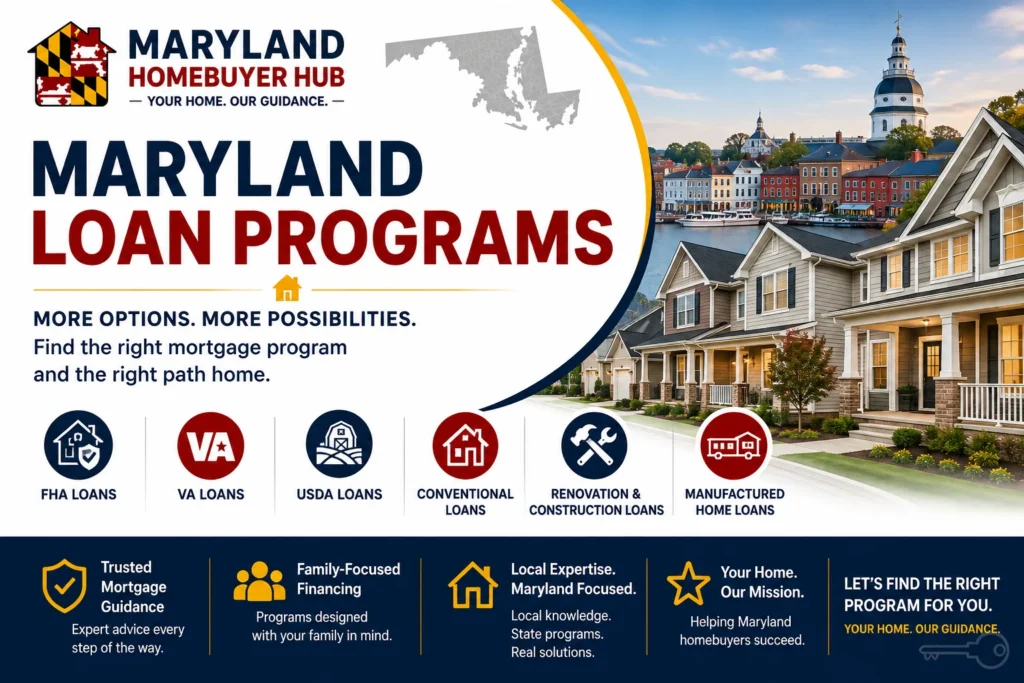
The four main loan programs Maryland buyers use
Most Maryland home purchases are financed through one of four programs. They are not ranked, and none is automatically better than the others — each fits a different situation. What follows is the short version of each, with links to the full guides as we publish them.
FHA Loans
Insured by the Federal Housing Administration. A down payment as low as 3.5% for borrowers meeting FHA’s credit requirements, and more flexible credit and debt guidelines than most conventional financing. Primary residences only.
Trade-off: FHA charges both an upfront and an annual mortgage insurance premium, and for most borrowers the annual premium is not cancellable.
Conventional Loans
The broadest financing category, following Fannie Mae and Freddie Mac guidelines rather than a government insurance program. Low-down-payment options exist for some buyers, and conventional financing supports a wider range of property and occupancy types, including second homes and investment property on certain programs.
Key difference: private mortgage insurance applies when the down payment is under 20%, but unlike FHA it can generally be cancelled once you have enough equity.
VA Loans
Guaranteed by the Department of Veterans Affairs for eligible veterans, active-duty service members and certain surviving spouses. Financing with no down payment is possible for eligible borrowers, and there is no monthly private mortgage insurance.
Requirement: eligibility depends on service history and entitlement, confirmed through a Certificate of Eligibility. A VA funding fee applies in most cases.
USDA Loans
Backed by the U.S. Department of Agriculture’s Rural Development program. Financing up to 100% of the purchase price is possible for eligible buyers, and parts of Maryland qualify — including areas on the Eastern Shore and in Western Maryland that many buyers assume would not.
Two gates: the property must be in a USDA-eligible location and your household income must be within the limit for that area. Primary residences only.
Comparing the four programs
The most useful way to read this table is to look for the row that matters most in your situation, rather than looking for an overall winner.
| FHA | Conventional | VA | USDA | |
|---|---|---|---|---|
| Possible minimum down payment | 3.5% for qualifying borrowers | As low as 3% on some programs | 0% for eligible borrowers | 0% for eligible borrowers |
| Who it is for | Broad eligibility; no service or location requirement | Broad eligibility; underwriting is more credit-sensitive | Eligible veterans, active duty, certain surviving spouses | Income-eligible buyers in USDA-eligible areas |
| Mortgage insurance or fee | Upfront and annual premium | PMI when under 20% down; cancellable at sufficient equity | No monthly PMI; funding fee usually applies | Upfront and annual guarantee fee |
| Property and location | Primary residence; FHA property standards apply | Widest range, including second homes and investment on some programs | Primary residence; VA property requirements apply | Primary residence in an eligible area only |
| Often worth exploring when | Credit or savings are the limiting factor | Credit is stronger and you want cancellable mortgage insurance | You have VA eligibility | You are buying outside the denser suburbs and income-qualify |
| Main limitation | Annual premium usually not cancellable under 10% down | Less accommodating of credit issues | Eligibility is not open to everyone | Both location and income must qualify |
A note on how to read any comparison like this, including ours: these describe program rules. They do not tell you what a specific lender will actually do with your file. That distinction is explained below.
Maryland homebuyer programs and assistance
This is where Maryland buyers have options that a national article will not tell them about — and where the most confusion happens.
Assistance layers on top of a mortgage; it does not replace one
FHA, Conventional, VA and USDA describe the first mortgage — the loan that actually finances the home. Maryland homebuyer programs generally provide assistance that sits on top of that first mortgage, most often as a separate deferred second lien used toward the down payment and closing costs.
That means the two decisions are related but separate: which mortgage program fits, and whether you qualify for assistance alongside it.
The Maryland Mortgage Program
The Maryland Mortgage Program (MMP) is administered by the Maryland Department of Housing and Community Development and offered through state-approved lenders. It runs two main product lines — one for first-time buyers and one open to first-time or repeat buyers — plus specialty products, including options aimed at buyers with eligible student debt and buyers with disabilities.
Most MMP products pair a 30-year fixed first mortgage with down payment assistance structured as a zero-interest deferred second loan: no monthly payment, repayable when you sell, refinance or pay off the first mortgage.
What Maryland programs require that the mortgage program does not
Meeting FHA’s or Fannie Mae’s requirements does not mean you meet Maryland’s. Assistance programs commonly add their own gates, which typically include:
- Household income limits, varying by jurisdiction and household size
- Purchase price limits by jurisdiction
- A first-time buyer definition for some product lines, generally meaning no principal residence owned in the past three years, with exceptions for targeted areas and certain qualifying veterans
- Completion of homebuyer education through an approved provider
- Their own minimum credit score, which can be higher than the mortgage program’s
Repeat buyers and local programs
Assistance in Maryland is not exclusively for first-time buyers — some product lines are open to repeat buyers as well. Separately, many Maryland counties and municipalities run their own down payment or settlement assistance programs, sometimes usable alongside state assistance. Availability, funding and rules vary locally and change.
Nothing here determines whether you qualify. Program terms, income limits and funding change, so verify current details with the Maryland Mortgage Program and an approved lender.
Non-traditional and Non-QM home loans
Some buyers have genuinely strong finances but do not fit the documentation patterns standard agency underwriting expects. A business owner who writes off expenses, a commissioned salesperson, someone whose wealth sits in assets rather than a steady paycheck — these are not weak borrowers, they are borrowers whose income is hard to read on a W-2.
Non-QM — “non-qualified mortgage” — refers to financing that falls outside the Qualified Mortgage standard. That is a regulatory classification, not a judgment about the borrower.
Two things Non-QM is not
It is not subprime lending. Non-QM describes documentation and underwriting structure, not borrower quality. Many Non-QM borrowers have excellent credit and substantial assets.
It is not no-documentation lending. Alternative documentation still means documentation — often more of it, not less. A bank statement program substitutes one form of verification for another; it does not remove verification.
Situations where alternative financing may be worth exploring
- Self-employed borrowers and business owners whose tax returns understate cash flow
- Borrowers documenting income through bank statements or 1099s rather than W-2s
- Borrowers qualifying primarily through assets rather than monthly income
- Real estate investors financing property based on rental income
- Borrowers with a past credit event who are otherwise well positioned
These programs are offered by individual lenders and investors rather than by a federal agency, which means terms, rates, down payment requirements and documentation standards vary considerably from one lender to the next. There is no single set of Non-QM rules, and any specific guideline you read about is that lender’s, not the category’s.
Specialty financing situations
Some purchases need financing built for the situation rather than the borrower. Brief orientation on the most common:
- Renovation loans, including FHA 203(k) — finance the purchase and the renovation in one mortgage, useful for homes that will not meet property standards as-is.
- Construction financing — for building rather than buying, sometimes structured to close once and convert to a permanent mortgage.
- Manufactured home financing — available on several programs with additional construction and foundation requirements.
- Condominium financing — eligibility can depend on the project as well as the borrower, and rules differ by program.
- Two- to four-unit properties — owner-occupied multi-unit purchases, where rental income may help you qualify.
- Jumbo loans — for loan amounts above the limits that apply in your county, with their own credit and reserve expectations.
- Investment property financing — for properties you will not occupy, typically requiring more down payment.
Which Maryland loan program might fit your situation?
These are starting points for a conversation, not eligibility determinations. Most buyers fit more than one.
I have limited money for a down payment
FHA at 3.5%, certain conventional programs at 3%, and VA or USDA at 0% if you qualify. Maryland assistance may also help with cash to close. Worth comparing all of them rather than assuming FHA.
I’m a veteran or active-duty service member
Start with VA eligibility. When available, no down payment requirement and no monthly mortgage insurance usually make it the strongest option — but confirm eligibility before ruling other programs out.
I’m buying in a rural or outer-suburban area
Check USDA eligibility for the specific address. More of Maryland qualifies than most buyers expect. Your household income has to qualify too.
My credit profile is fairly strong
Compare conventional against FHA rather than assuming either. The deciding factor is often mortgage insurance: conventional PMI can be cancelled, FHA’s annual premium usually cannot.
I’m self-employed or my income is complicated
Agency programs may still work — many self-employed buyers qualify conventionally. If tax returns understate your actual cash flow, alternative documentation programs are worth exploring.
I need help with cash to close
Look at Maryland homebuyer assistance alongside your mortgage choice, and at what a seller may contribute toward closing costs. Assistance has its own income and price limits.
I’m planning to buy in the next few months
Get pre-approved before serious shopping. It tells you the real number, surfaces problems while there is still time to fix them, and Maryland sellers generally expect it with an offer.
Program rules, Maryland rules, and lender overlays
If you take one thing from this page, take this. Four different layers of rules apply to your mortgage, and confusing them is the single most common reason buyers get conflicting answers:
- Agency or program rules. What FHA, Fannie Mae, Freddie Mac, VA or USDA require. These are the same for everyone.
- Maryland program rules. What a state or local assistance program requires on top — income limits, purchase price limits, homebuyer education, its own credit minimum.
- Automated underwriting outcomes. What the underwriting system returns on your specific file. Two borrowers with the same credit score can receive different findings.
- Individual lender overlays. What a particular lender requires beyond all of the above. Overlays are why one lender declines a file another approves.
So when someone tells you “you need a 640 score for FHA,” the useful question is: whose rule is that? Usually it is the fourth layer, not the first.
Maryland loan program FAQ
What home loan programs are available in Maryland?
Maryland buyers can generally use FHA, Conventional, VA and USDA financing, the same programs available nationally. Eligible buyers may also combine one of those first mortgages with Maryland homebuyer assistance. Buyers who do not fit standard agency documentation may have Non-QM or alternative-documentation options through individual lenders.
Which mortgage is best for a first-time buyer in Maryland?
There is no single best program. FHA is common when credit or savings are the limiting factor; conventional often costs less over time for stronger credit profiles because its mortgage insurance can be cancelled; VA is usually the strongest option for those eligible. The right answer depends on your credit, your available cash and how long you plan to keep the loan.
Do I need 20% down to buy a home in Maryland?
No. That figure is the point at which conventional financing typically avoids private mortgage insurance — not a requirement to buy. Several programs allow far less, and eligible buyers may put nothing down on VA or USDA financing.
Can repeat buyers use Maryland homebuyer programs?
Some Maryland product lines are open to repeat buyers as well as first-time buyers, while others are limited to first-time buyers. Definitions and eligibility vary by product, so confirm current terms with the Maryland Mortgage Program and an approved lender.
What is the difference between FHA and conventional financing?
FHA is insured by a federal agency and is generally more accommodating on credit and down payment. Conventional follows Fannie Mae and Freddie Mac guidelines and is more credit-sensitive. The most consequential difference is mortgage insurance: conventional PMI can generally be cancelled at sufficient equity, while FHA’s annual premium usually continues for the full mortgage term when the starting loan-to-value is above 90%.
Who qualifies for VA financing?
Eligible veterans, active-duty service members, certain members of the National Guard and Reserves, and certain surviving spouses. Eligibility depends on service history and available entitlement, confirmed through a Certificate of Eligibility rather than estimated from length of service alone.
How does USDA eligibility work in Maryland?
Two conditions must both be met: the property has to sit in a USDA-eligible area, and your household income has to fall within the limit for that area. Eligible areas include parts of Maryland closer to population centers than most buyers assume, so it is worth checking a specific address rather than ruling it out.
Can Maryland down payment assistance work with different mortgage types?
Assistance is generally layered on top of a first mortgage, and programs specify which first mortgages they can pair with. Whether a particular combination works depends on the assistance program’s rules, not on the mortgage program’s. Verify with an approved lender before planning around it.
What if I’m self-employed?
Many self-employed buyers qualify through standard agency programs using tax returns. If your returns understate your actual cash flow, alternative documentation programs — such as those using bank statements or 1099s — may be worth exploring. These are lender-specific programs, so terms vary.
Should I get pre-approved before choosing a loan program?
Usually yes, because the two happen together. A pre-approval review looks at your credit, income and assets and is where program options get compared against your actual numbers rather than in the abstract. It also surfaces issues while there is still time to address them.
Sources
- FHA program requirements — U.S. Department of Housing and Urban Development, Single Family Housing Policy Handbook 4000.1 and current Mortgagee Letters.
- Maryland homebuyer assistance — Maryland Department of Housing and Community Development, Maryland Mortgage Program.
- VA home loan eligibility — U.S. Department of Veterans Affairs.
- USDA Rural Development financing — U.S. Department of Agriculture, Rural Development.
- Qualified Mortgage standard — Consumer Financial Protection Bureau.
This page is educational and general in nature. It does not determine your eligibility for any mortgage or assistance program, is not a commitment to lend, and is not a Loan Estimate. Program rules, loan limits, assistance funding and lender requirements change. Verify current requirements with a licensed mortgage professional and, for assistance programs, with the administering agency.