
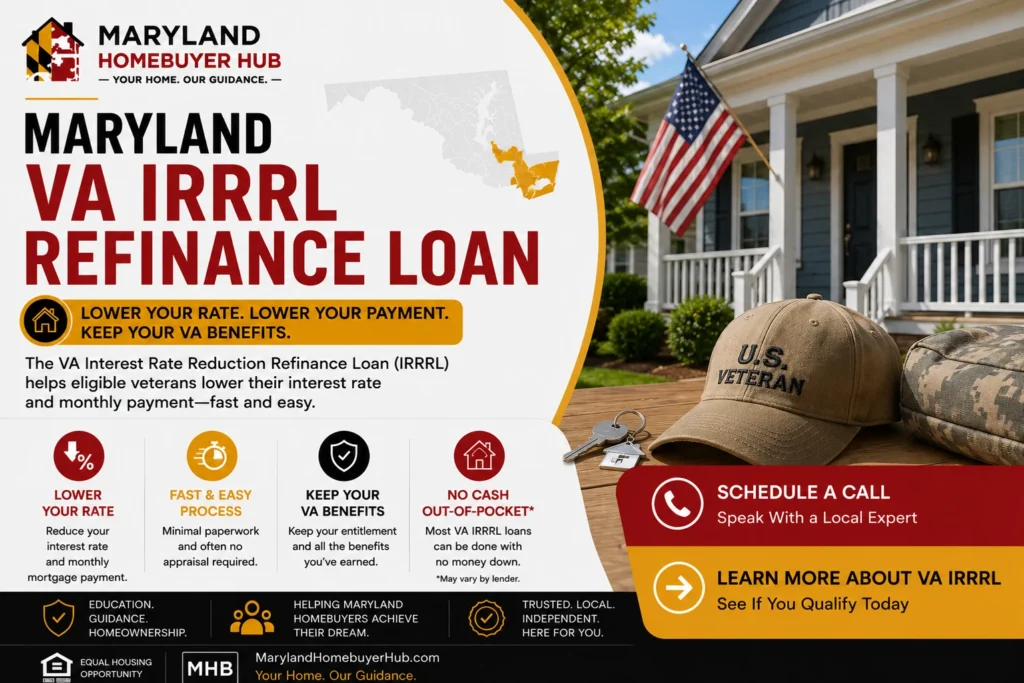
How a VA Streamline Refinance works
A streamlined way to refinance a VA loan you already have
IRRRL stands for Interest Rate Reduction Refinance Loan. It is the VA’s streamlined refinance for homeowners who already hold a VA-backed mortgage — and yes, “VA IRRRL” and “VA Streamline Refinance” are two names for the same thing.
It exists to improve the terms of a loan you already have. VA does not require an appraisal or a full credit and income underwrite, which is what makes it fast and inexpensive compared with a normal refinance.
Three rules shape everything: the refinance must deliver a net tangible benefit, the costs must be recouped within 36 months, and you cannot take cash out.
You do not have to live in the home now. VA asks you to certify that you currently live in or used to live in the property — so a home you have moved out of can still qualify.
If you bought during a higher-rate stretch and have been watching rates since, this is the product built for your situation. The question worth answering is not what an IRRRL is. It is whether doing one actually leaves you better off.
Would a VA IRRRL actually save you money?
This is the only question that matters, and it deserves more than “rates are lower, so refinance.” Work through these before you apply.
Seven things to establish before you refinance
- Your current rate, and the rate actually available to you. Not the advertised rate — the one you would be offered.
- The change in principal and interest. The real monthly difference, not an estimate.
- Total closing costs, including the VA funding fee if it applies to you.
- Whether those costs are financed. Rolling them in avoids cash at closing but adds to your balance and your interest.
- Your break-even point. Costs divided by monthly savings. VA requires recoupment within 36 months — but your own tolerance may be shorter.
- How long you expect to keep the loan. If you may sell or move before break-even, the refinance costs you money.
- What happens to your loan term. Restarting a 30-year clock changes lifetime interest even when the monthly payment falls.
If several of those point the same direction, you have your answer. If they conflict — a meaningfully lower payment but a possible move in two years, say — the arithmetic deserves to be run properly rather than assumed.
Find out whether refinancing your VA loan actually leaves you ahead
Your current rate, the available rate, the costs and your break-even point decide this. They take a few minutes to run against your real loan.
This is not a commitment to lend. All loans subject to credit approval.
Lower rate, lower payment and lower total cost are three different things
This distinction is where refinance decisions are usually won or lost, and most published guidance skips it entirely.
| What improves | What it means | What it does not tell you |
|---|---|---|
| Lower interest rate | You are charged less per dollar borrowed | Whether the cost of getting that rate is worth paying |
| Lower monthly payment | Less leaves your account each month | Whether you pay more in total, over a longer period |
| Lower total cost | You pay less over the life of the loan | Whether the monthly payment is comfortable now |
Why a lower payment is not automatically a win
Suppose you are eight years into a 30-year VA loan and refinance into a new 30-year term at a lower rate. The monthly payment falls — genuinely.
But you have also reset the clock. You now have 30 years of payments ahead instead of 22, and the total interest paid across the life of the loan can rise even though the rate went down.
That may still be the right call — monthly cash flow matters, and freeing it up has real value. The point is that it is a trade, not a free win, and you should know which one you are making.
This is educational information, not financial advice. Your circumstances decide which measure matters most.
What does VA mean by “net tangible benefit”?
In plain terms: VA does not want veterans refinanced repeatedly by whoever can sell them another mortgage. The transaction has to leave the borrower measurably better off, and the rules are specific rather than aspirational.
Two of those requirements are numeric, and they depend on what kind of rate you are moving between.
| Refinancing from | Refinancing into | Required rate reduction |
|---|---|---|
| Fixed rate | Fixed rate | At least 50 basis points — half a percentage point |
| Fixed rate | Adjustable rate | At least 200 basis points — two percentage points |
The larger reduction required to move from a fixed rate into an adjustable one is deliberate. You would be taking on future rate risk, so VA requires the up-front improvement to be substantial before that trade is permitted.
Moving the other way — from an adjustable rate into a fixed one — is a recognised reason to use an IRRRL even without a large rate drop, because the benefit is payment stability rather than a lower number.
The 36-month recoupment rule
This is the rule that stops a refinance from costing more than it saves, and it is worth understanding precisely because it is frequently described loosely.
How recoupment actually works
All fees and incurred costs must be recouped on or before 36 months after the date of the loan note.
Recoupment is calculated through the reduction in your regular monthly payments. Certain items are excluded from that calculation — taxes, amounts held in escrow, and fees paid under the VA loan chapter, which includes the funding fee.
In practice: divide the costs being recouped by your monthly payment reduction. If the result is 36 months or less, the test is satisfied.
Note what this means. A refinance with modest monthly savings and high costs will fail the test — by design. And a refinance that passes at 34 months is permitted but not necessarily wise if you expect to move in two years.
Net tangible benefit and recoupment are two separate requirements. A transaction has to satisfy both. Guidance that treats them as one thing is the most common error in published IRRRL content.
How soon can you refinance your VA loan?
Not immediately. VA applies a seasoning requirement measured two ways, and you must satisfy the later of them.
- 210 days from the date of the first monthly payment you made on the loan being refinanced
- The date on which the sixth monthly payment is made on that loan
Whichever of those two dates falls later is your earliest eligibility date. For borrowers paying on a normal schedule the two land close together, but they are not the same test and a lender will check both.
The practical takeaway: if your VA loan is less than roughly seven months old, an IRRRL is not yet available to you.
Who can use an IRRRL?
- You already have a VA-backed loan, and you are using the IRRRL to refinance it. You cannot streamline a conventional, FHA or USDA loan into VA financing this way — that is a different VA refinance with full underwriting.
- You certify occupancy — that you currently live in, or used to live in, the home.
- Your loan satisfies the seasoning requirement described above.
- The refinance produces a net tangible benefit and the costs recoup within 36 months.
The occupancy rule is more generous than people expect
On a VA purchase loan you must intend to occupy the home. On an IRRRL, VA asks you to certify that you currently live in or used to live in the property.
That difference matters in Maryland more than in most states. Service members stationed at Fort Meade, the Naval Academy, Aberdeen Proving Ground, Patuxent River, Joint Base Andrews or Fort Detrick frequently buy a home, then receive orders and move — while keeping the property.
If that describes you, a home you no longer live in may still be eligible. Confirm your specific situation with a lender, but do not assume having moved rules you out.
Do you need an appraisal, income documents or a credit score?
Here is where VA’s rules and an individual lender’s requirements diverge most sharply — and where much of the confusion around this loan originates.
| Item | VA program requirement | What individual lenders may add |
|---|---|---|
| Appraisal | Not required for an IRRRL | Some lenders order one anyway as internal policy |
| Credit score | No VA minimum score for an IRRRL | Most lenders apply a minimum of their own |
| Income verification | Not required as on a full refinance | Lenders may still verify employment or income |
| Asset documentation | Not generally required | May be requested by the lender |
| Debt-to-income | Not underwritten as on a full refinance | Lenders may apply internal ceilings |
| Payment history | Seasoning and payment requirements apply | Lenders may impose stricter recent-history standards |
Why this distinction is worth money to you
If a lender declines your IRRRL, or insists on an appraisal, that may be their policy rather than a VA rule. A different lender may see it differently.
This matters most for two groups: veterans whose credit has slipped since they bought, and veterans whose home value may have fallen. VA does not require a score minimum or an appraisal on an IRRRL, so a decline on either basis is worth a second opinion.
It is entirely fair to ask a lender directly: “Is that a VA requirement, or your overlay?”
You also generally do not need a new Certificate of Eligibility, since the entitlement already in use on the existing loan carries through.
What does an IRRRL cost, and what can be rolled in?
The headline cost is the VA funding fee, which is 0.5% of the loan amount for an IRRRL — substantially lower than the fee on a VA purchase or cash-out refinance. On a $300,000 loan that is $1,500.
VA states that closing costs may be included in the new loan so you do not pay them up front, or alternatively that the loan may be made at a rate high enough that the lender pays the costs. Both routes are legitimate; they simply move the cost somewhere else, which is exactly why the break-even calculation matters.
Who does not pay the funding fee
- You are receiving VA compensation for a service-connected disability
- You are eligible to receive that compensation but are receiving retirement or active-duty pay instead
- You are receiving Dependency and Indemnity Compensation as the surviving spouse of a veteran
- You are a service member who received a proposed or memorandum rating before the closing date confirming eligibility for compensation from a pre-discharge claim
- You are an active-duty service member who provides evidence, on or before closing, of having received a Purple Heart
If you are exempt, the arithmetic changes meaningfully — removing 0.5% of the loan amount from your costs shortens the break-even considerably. Confirm your exemption status early rather than discovering it at closing.
A Maryland point on recordation tax
Under Maryland Tax-Property § 12-108(g), a mortgage or deed of trust is not subject to recordation tax to the extent it secures refinancing of an amount no greater than the unpaid principal balance of the existing mortgage — where the property is used as a principal residence by the original mortgagor and is refinanced by that mortgagor, or that mortgagor and their spouse.
There is a wrinkle specific to this loan. VA permits an IRRRL on a home you used to occupy, but the Maryland exemption is written around a property used as a principal residence. A veteran refinancing a home they have moved out of should not assume the exemption applies.
Raise it with your settlement company early — it must be claimed and documented at recording, and on a former residence the answer may differ.
Can you take cash out or pay off other debt?
No, and this is stricter than most people assume.
You may not receive cash from the loan proceeds. Further, no loan other than the existing VA loan may be paid from the proceeds of an IRRRL.
What that rules out
An IRRRL cannot be used to pay off a home equity line of credit, a second mortgage, credit cards, a car loan or any other debt. It refinances the VA loan and nothing else.
If you have subordinate financing on the property, it does not get paid off — it stays in place, and the holder will generally need to agree to subordinate to the new first mortgage. Raise that at the start, because it takes time.
If accessing equity is your actual goal, an IRRRL is the wrong product. That is a VA Cash-Out Refinance.
Can you change your loan term?
Yes, within limits. The new loan term may not exceed the term on the original note by more than 10 years.
You can shorten the term — moving from a 30-year to a 15-year loan, for instance — which usually raises the monthly payment while reducing lifetime interest. You can also keep a similar term, or extend within the limit above.
Shortening is the option most often overlooked. A veteran several years into a 30-year loan who refinances into a shorter term at a lower rate may keep their payment close to where it is while removing years of interest. Whether that suits you depends on your cash flow, but it deserves to be priced alongside the standard option.
IRRRL or VA Cash-Out: which refinance are you looking for?
| Feature | VA IRRRL | VA Cash-Out Refinance |
|---|---|---|
| Purpose | Improve the terms of an existing VA loan | Access equity, or refinance from another loan type |
| Existing VA loan required | Yes | No |
| Cash to borrower | Not permitted | Permitted, subject to VA rules |
| Pay off other debt from proceeds | Not permitted | Possible, subject to VA rules |
| Appraisal | Not required by VA | Required |
| Credit and income underwriting | Streamlined | Full underwriting |
| Funding fee | 0.5% | Higher, and varies by prior use |
The test is simple. If you want better terms on the VA loan you already have, that is an IRRRL. If you want money out of the house, or you are refinancing a non-VA loan into VA financing, that is a cash-out refinance with entirely different requirements. We cover that product separately — and our Maryland loan programs overview sets out how the main financing routes compare.
Compare this option with other Maryland mortgage refinance options.
Get your VA refinance options priced side by side
An IRRRL and a cash-out refinance answer different questions and carry different costs. Seeing both on your numbers makes the choice obvious.
This is not a commitment to lend. All loans subject to credit approval.
Will you skip a mortgage payment?
You will probably encounter this framed as a benefit. It is worth being straight about what actually happens.
Because mortgage interest is paid in arrears, the timing of a refinance closing often means there is a month in which no payment is due on either the old loan or the new one. That is a genuine cash-flow gap and it can be useful.
It is not a free month
No payment leaves your account, but interest does not stop accruing, and the payoff on your existing loan accounts for interest through the closing date. You are shifting when you pay, not avoiding the cost.
Any escrow balance on your old loan is handled separately and a new escrow account is typically established, which also affects what you bring to closing.
Treat a skipped payment as a timing convenience. Any lender presenting it as a reason to refinance is selling, not advising.
When you should keep your current VA loan
Refinancing is not automatically the right answer, and the honest cases against it are worth stating.
- You may sell or move before break-even. If costs recoup in 30 months and you expect to move in 18, refinancing loses you money.
- The savings are thin. A refinance that barely satisfies the tests is usually not worth the disruption.
- You need cash from the property. An IRRRL cannot do it.
- You need to pay off a second lien or other debt. Also outside what this loan permits.
- Your loan is too new to meet the seasoning requirement.
- You are well into your existing term and resetting the clock would add years of interest you were close to finishing.
- Your current rate is already competitive. Being courted for a refinance is not evidence that you need one.
Mistakes worth avoiding: shopping on advertised rate alone rather than total cost; not asking whether a requirement is VA’s or the lender’s; forgetting the funding fee when it applies, or forgetting your exemption when it does; and leaving subordination on a second lien until late in the process.
What the process looks like
- Review your existing loan. Current rate, balance, remaining term, payment history and seasoning eligibility.
- Run the benefit and recoupment math. The rate reduction test, the 36-month recoupment calculation and your own break-even point.
- Confirm your funding fee position — whether you are exempt.
- Decide how costs are handled — paid at closing, financed into the loan, or covered by the lender through the rate.
- Apply and lock. Documentation is light compared with a full refinance.
- Processing. Payoff ordered, title work completed, subordination requested if there is a second lien.
- Closing. The new loan replaces the old one on the agreed terms.
An IRRRL generally moves faster than a full refinance, because there is no appraisal to schedule and no income file to assemble. Where a lender adds an appraisal or fuller documentation as an overlay, expect the timeline to extend accordingly.
Frequently asked questions
Is a VA IRRRL the same as a VA Streamline Refinance?
Yes. IRRRL stands for Interest Rate Reduction Refinance Loan, and “VA Streamline Refinance” is the informal name for the same product.
Do I have to already have a VA loan?
Yes. An IRRRL refinances an existing VA-backed loan. Moving a conventional, FHA or USDA loan into VA financing requires a different VA refinance with full underwriting and an appraisal.
Does an IRRRL require an appraisal?
VA does not require one. Some lenders order an appraisal as their own policy, so if you are told one is needed, it is worth asking whether that is a VA requirement or a lender overlay.
Do I still have to live in the home?
Not necessarily. VA asks you to certify that you currently live in or used to live in the property, so a former primary residence may still qualify. This is a meaningful difference from VA purchase occupancy rules.
Is there a minimum credit score?
VA does not set a minimum credit score for an IRRRL. Individual lenders commonly apply their own minimums, and those vary, so a decline from one lender does not necessarily mean you are ineligible.
How soon can I refinance?
You must reach the later of two dates: 210 days from the first monthly payment you made on the loan being refinanced, and the date the sixth monthly payment is made. As a rule of thumb, a loan under roughly seven months old is not yet eligible.
How much does my rate have to drop?
Refinancing from a fixed rate into another fixed rate requires a reduction of at least 50 basis points — half a percentage point. Moving from a fixed rate into an adjustable rate requires at least 200 basis points.
What is the recoupment rule?
All fees and incurred costs must be recouped within 36 months of the loan note date, measured through the reduction in your regular monthly payments. Taxes, escrow amounts and VA chapter fees are excluded from the calculation.
What is the funding fee, and can I avoid it?
The IRRRL funding fee is 0.5% of the loan amount. Several categories of borrower are exempt, including those receiving VA compensation for a service-connected disability. If you are exempt, confirm it early — it materially changes your break-even.
Can I get cash back or pay off other debts?
No. You may not receive cash from the proceeds, and no loan other than the existing VA loan may be paid from an IRRRL. A home equity line, second mortgage or consumer debt cannot be rolled in.
What happens to my second mortgage or HELOC?
It stays in place. The holder will generally need to agree to subordinate to the new first mortgage, and that approval takes time, so flag it at the very start of the process.
Can I refinance if my home has lost value?
VA does not require an appraisal on an IRRRL, so current market value is generally not the limiting factor. A lender that orders an appraisal as an overlay may treat it differently.
Can I refinance if I am behind on payments?
Payment history matters, and the seasoning requirement includes having made the required payments. If your loan is delinquent, discuss it with a lender directly rather than assuming either way.
Do I need a new Certificate of Eligibility?
Generally no. The entitlement in use on the existing VA loan carries through to the IRRRL.
Can I shorten my loan term?
Yes. You can refinance into a shorter term, and the new term may not exceed the original note term by more than 10 years. Shortening usually raises the payment while reducing total interest.
Sources
- U.S. Department of Veterans Affairs — Interest Rate Reduction Refinance Loan: the requirement to hold an existing VA-backed loan and use the IRRRL to refinance it; the occupancy certification that the veteran currently lives in or used to live in the home; and that closing costs may be included in the new loan or covered by the lender through a higher interest rate.
- U.S. Department of Veterans Affairs — VA funding fee: the IRRRL funding fee of 0.5%, and the exemption categories covering service-connected disability compensation, entitlement to that compensation while receiving retirement or active-duty pay, Dependency and Indemnity Compensation as a surviving spouse, a pre-discharge proposed or memorandum rating, and active-duty receipt of a Purple Heart.
- 38 U.S.C. § 3709: seasoning at the later of 210 days from the first monthly payment made and the date the sixth monthly payment is made; recoupment of all fees and incurred costs within 36 months of the loan note date through reduced regular monthly payments, excluding taxes, escrow and VA chapter fees; and the net tangible benefit rate tests of 50 basis points for fixed-to-fixed and 200 basis points for fixed-to-adjustable refinancing.
- VA Lenders Handbook, VA Pamphlet 26-7 — IRRRL loan terms and proceeds: the new term may not exceed the original note term by more than 10 years; no cash may be received from the proceeds; and no loan other than the existing VA loan may be paid from IRRRL proceeds.
- Maryland Code, Tax-Property § 12-108(g): the recordation tax exemption for refinancing up to the unpaid principal balance where the property is used as a principal residence by the original mortgagor.
Verified August 23, 2026. This page distinguishes VA program requirements from lender overlays. Minimum credit scores, debt-to-income ceilings, appraisal requirements, documentation beyond VA minimums and payment-history standards are lender-specific and vary between lenders. No interest rates are quoted, and VA program rules change. Confirm current requirements with a VA-approved lender.
This page explains how the VA Interest Rate Reduction Refinance Loan generally works for Maryland homeowners with an existing VA-backed mortgage. It does not determine individual eligibility, is not a commitment to lend, and is not a Loan Estimate. Any figures shown are arithmetic illustrations, not quotes, and no interest rate is offered or implied. Program terms are set by the U.S. Department of Veterans Affairs, and participating lenders may apply additional requirements that differ from lender to lender. Maryland Homebuyer Hub is not affiliated with, endorsed by, or acting on behalf of the U.S. Department of Veterans Affairs or any government agency.