
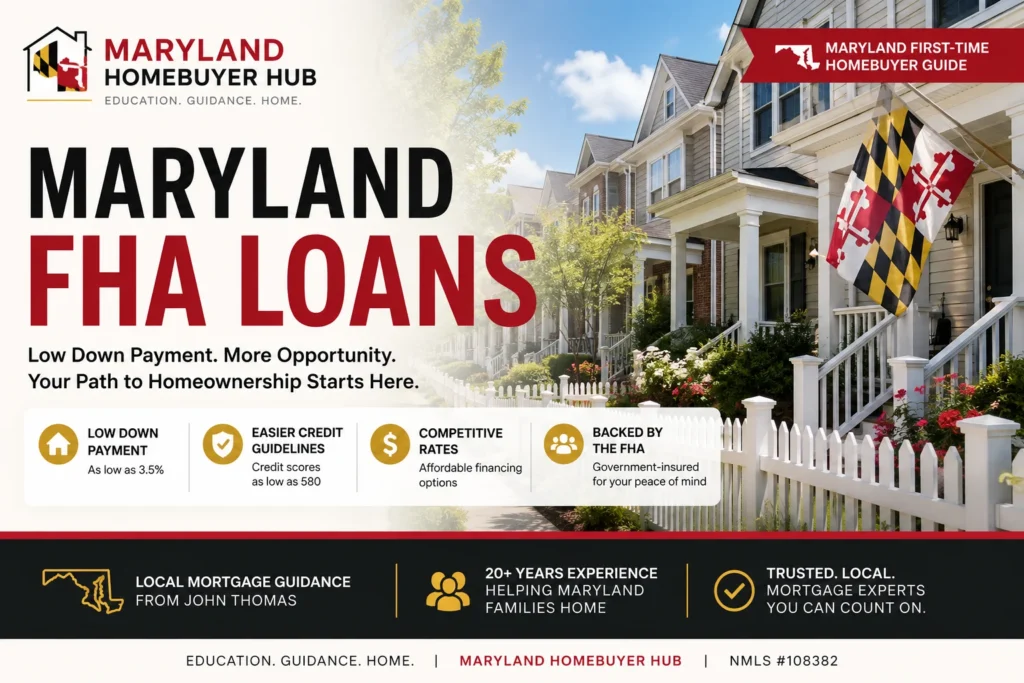
How FHA loans work in Maryland
An FHA loan is a mortgage insured by the Federal Housing Administration, which is part of the U.S. Department of Housing and Urban Development. The distinction that trips up most buyers is this: FHA does not lend you money. An FHA-approved lender makes the loan. FHA insures it.
That insurance is why the program exists. Because the lender’s risk is reduced, FHA-approved lenders can work with credit profiles, down payment sizes and debt levels that would not fit most conventional loans. The borrower pays for that insurance directly through mortgage insurance premiums, which is the trade-off at the center of every FHA decision.
Three different rulebooks apply to a Maryland FHA loan
Nearly every confusing answer a buyer gets traces back to these being mixed together. They are separate, and they stack:
- Federal FHA rules. Set by HUD. They apply identically in every state — credit score tiers, minimum down payment, occupancy, mortgage insurance, appraisal standards.
- Maryland program rules. If you use down payment assistance through the Maryland Mortgage Program, that program adds its own requirements on top — income limits, purchase price limits, homebuyer education, and its own minimum credit score.
- Individual lender overlays. Any lender may require more than FHA does. A lender that requires a 640 score is not quoting an FHA rule; it is quoting its own.
When two lenders give you different answers about the same loan, an overlay is usually the reason — not a change in FHA policy.
Why Maryland first-time buyers consider FHA
FHA is heavily used by first-time buyers because the entry requirements line up with what people early in their careers actually have: a moderate credit score, limited savings, and possibly student loan or car debt. It is not automatically the cheapest option over time, and for buyers with strong credit and a larger down payment it often is not. It is frequently the most accessible option, which is a different thing.
Who qualifies for an FHA loan in Maryland?
These are the federal FHA requirements. A specific lender may require more.
Credit score requirements
| Credit score | Minimum down payment | Maximum loan-to-value |
|---|---|---|
| 580 or higher | 3.5% | 96.5% |
| 500–579 | 10% | 90% |
| Below 500 | Not eligible for FHA financing | |
Those are FHA’s published minimums. In practice, many lenders will not originate at the low end of that range. A lender declining a 560-score file is applying an overlay, not enforcing an FHA rule — and a different FHA-approved lender may look at the same file differently.
Income, employment and debt
FHA underwriting looks at whether you can reasonably support the payment, generally considering:
- A documented, stable income history, usually reviewed over roughly two years
- Verified income through pay stubs, W-2s, or tax returns if you are self-employed
- Your debt-to-income ratio — total monthly debt payments compared with gross monthly income
- Funds to close, and in some cases reserves
There is no single debt-to-income ratio that determines approval for every FHA borrower. The outcome depends on the findings returned by FHA’s TOTAL Mortgage Scorecard and the lender’s automated underwriting system, on the separate requirements that apply when a file is manually underwritten, and on any overlays the individual lender applies. Compensating factors such as reserves, residual income or a documented history of paying comparable housing costs can affect the result as well.
The practical consequence: two lenders can reach different conclusions on the same file. Any specific percentage you are quoted reflects that lender’s process and tolerance — treat it as that lender’s answer, not as a universal FHA cap.
Occupancy and property requirements
- Primary residence only. FHA does not insure investment properties or second homes.
- You are expected to occupy the home, generally within 60 days of closing and for at least the first year.
- The property must meet FHA’s minimum property standards, confirmed through the FHA appraisal.
Eligibility also depends on residency status, and FHA has revised these requirements in recent years. Confirm current eligibility rules with an FHA-approved lender before relying on older guidance.
How much down payment do you need for an FHA loan in Maryland?
3.5% of the purchase price with a credit score of 580 or higher. 10% with a score of 500–579.
On a $400,000 Maryland home, 3.5% is $14,000. That is the down payment only. Closing costs are separate, which is the single most common budgeting mistake first-time buyers make.
Where your down payment can come from
FHA is notably flexible about the source of the funds, provided the paper trail is documented:
- Your own savings, seasoned in your account
- Gift funds from an approved donor
- Down payment assistance from an eligible program, including Maryland programs
- Proceeds from the sale of an asset, with documentation
- Certain retirement account withdrawals or loans
- Employer-assisted housing programs
Using gift funds
FHA permits the entire down payment to come from an eligible gift. What matters is documentation: a signed gift letter stating the funds are a gift with no expectation of repayment, evidence of the donor’s ability to give, and a clear transfer trail into your account.
The mistake that causes delays is an undocumented cash transfer. Money that appears in your account without a traceable source generally cannot be used, regardless of who actually provided it. Talk to your lender before the money moves.
How much is FHA mortgage insurance?
Every FHA loan carries two mortgage insurance charges, and understanding both is essential to comparing FHA against a conventional loan honestly.
- Upfront mortgage insurance premium (UFMIP) — a one-time charge calculated as a percentage of the base loan amount, paid at closing or financed into the loan. Financing it is common, and it increases your loan balance above the purchase price.
- Annual mortgage insurance premium (MIP) — charged yearly and collected monthly as part of your payment.
How long you pay annual MIP
This is the detail that most affects long-term cost, and it is where FHA differs fundamentally from conventional financing:
- If your starting loan-to-value is above 90% — which is what a down payment under 10% produces — annual MIP generally remains for the full mortgage term.
- If your starting loan-to-value is 90% or less — a down payment of 10% or more — annual MIP generally ends after 11 years.
HUD sets this by the loan-to-value ratio at the start of the loan, not by the size of the down payment on its own, and the treatment also varies with the mortgage term. Paying the loan down later does not change the duration rule your loan started under.
Conventional loan private mortgage insurance works differently — it can generally be cancelled once you reach sufficient equity. On FHA, for most borrowers, the practical way to remove mortgage insurance is to refinance into a conventional loan after building enough equity, which depends on future rates and your credit at that time.
Because premium rates are set by HUD and revised periodically, confirm the current rates with an FHA-approved lender rather than relying on a figure published elsewhere.
What if you already have an FHA loan?
If you already have an FHA-insured mortgage, an FHA Streamline Refinance may provide a simplified way to refinance into a new FHA loan. It is different from refinancing into a conventional loan and has its own eligibility requirements.
Maryland FHA loan limits by county
FHA will not insure a loan above a set maximum, and that maximum depends on where the property is. HUD sets limits by county or metropolitan area based on local home prices, with a national “floor” and “ceiling” derived from the conforming loan limit.
Maryland is unusual: it spans nearly the entire national range. Jurisdictions in the Washington metropolitan area sit at the national ceiling, while much of Western Maryland, Southern Maryland and the Eastern Shore sit at the national floor.
2026 Maryland FHA loan limits, one-unit properties
| Tier | Maryland jurisdictions | 1-unit limit |
|---|---|---|
| National ceiling | Charles, Frederick, Montgomery, Prince George’s | $1,249,125 |
| Baltimore metro | Anne Arundel, Baltimore City, Baltimore County, Carroll, Harford, Howard, Queen Anne’s | $747,500 |
| Philadelphia metro | Cecil | $630,200 |
| National floor | Allegany, Calvert, Caroline, Dorchester, Garrett, Kent, St. Mary’s, Somerset, Talbot, Washington, Wicomico, Worcester | $541,287 |
Source: HUD Mortgagee Letter 2025-23 and its supporting county files, effective for FHA case numbers assigned on or after January 1, 2026. Retrieved from hud.gov on August 17, 2026. Limits are reviewed annually and can change.
Calvert County changed significantly for 2026
Calvert County moved out of the Washington metropolitan area for FHA limit purposes and now sits at the national floor. Its one-unit FHA limit went from $1,209,750 in 2025 to $541,287 in 2026 — a decrease of more than $668,000. HUD lists Calvert among the jurisdictions with decreased limits for 2026.
If you are buying in Calvert County and working from 2025 figures, or from a website that has not updated, your FHA borrowing capacity may be far lower than you expect. Several widely used mortgage websites still show the old number.
How to verify your county’s limit
Limits change annually and multi-unit properties have higher limits than the one-unit figures above. Before making an offer near the top of your range, confirm the current figure for your specific county using HUD’s official FHA Mortgage Limits lookup, and confirm with your lender which limit applies to your property type.
If the home you want exceeds the FHA limit for that county, your options are to increase your down payment enough to bring the loan under the limit, or to use conventional or jumbo financing instead.
What a Maryland FHA purchase actually costs
Percentages are hard to budget against. Here is how the pieces fit together on a round number.
Educational illustration — not a quote or estimate of your costs
The figures below use a round $400,000 purchase price to show how the math is structured. They are not a Loan Estimate, not a quote, and not a prediction of what you would pay.
| Purchase price (hypothetical) | $400,000 |
| Down payment at 3.5% | $14,000 |
| Base loan amount | $386,000 |
| Upfront mortgage insurance premium | Added to the base loan amount |
| Total financed loan | Base loan plus financed UFMIP |
| Closing cost categories | Lender fees, title and settlement, recording and transfer charges, appraisal, prepaid taxes and insurance, escrow setup |
Closing costs are shown as categories rather than a dollar figure on purpose. They vary meaningfully by lender, title company, and Maryland jurisdiction — transfer and recordation charges in particular differ from county to county. Your Loan Estimate is the document that gives you real numbers.
Two things that change the cash you bring
- Seller contributions. FHA generally permits interested parties, including the seller, to contribute up to 6% of the sales price toward allowable closing costs and related items, subject to FHA’s requirements and to the actual costs incurred — a contribution cannot exceed what the eligible costs actually are. This is negotiated in the contract and depends on the seller agreeing. Seller contributions reduce closing costs; they do not replace the borrower’s required minimum investment.
- Down payment assistance. If you qualify for a Maryland assistance program, it may cover part or all of the down payment and some closing costs. Eligibility is determined by the assistance program, not by FHA.
Can you combine an FHA loan with Maryland down payment assistance?
In many cases an FHA first mortgage can be paired with a qualifying Maryland assistance program — and for first-time buyers this is often the combination that makes a purchase possible sooner. It is also the area where the three-rulebook distinction matters most.
How the Maryland Mortgage Program works with FHA
The Maryland Mortgage Program (MMP) is administered by the Maryland Department of Housing and Community Development. MMP is not a substitute for FHA — in a typical structure MMP provides the first mortgage, which may itself be an FHA loan, and layers down payment assistance on top as a separate deferred second lien.
MMP is offered through state-approved lenders only. A lender that is not MMP-approved cannot originate these loans, which is a practical reason buyers sometimes receive inconsistent answers.
The MMP product structure
MMP runs two main product lines plus specialty products:
- 1st Time Advantage — for first-time homebuyers, generally offering the program’s most competitive rates. Includes a version with no assistance and versions that pair with down payment assistance.
- Flex — available to first-time or repeat buyers, with assistance options attached to several products.
- Specialty products — including options for buyers with eligible student debt, buyers with disabilities, and certain county-specific programs.
Assistance is generally structured as a zero-interest deferred second mortgage — no monthly payment, but repayable when you sell, refinance or pay off the first mortgage. Some products offer a set dollar amount; others offer a percentage of the first mortgage. Maryland also offers a partner match that can add to assistance from an approved employer or community organization on specific products.
Assistance is not a grant, and not automatic
Down payment assistance in Maryland is generally a loan you repay later, not free money. Eligibility is determined by the assistance program — not by FHA, and not by meeting FHA’s requirements. Program amounts, income limits, purchase price limits and eligibility rules change, and funding availability can change as well.
Nothing on this page determines whether you qualify for any program. Verify current details with the Maryland Mortgage Program and an MMP-approved lender.
What Maryland programs require that FHA does not
This is the part that surprises buyers. Meeting FHA’s requirements does not mean you meet MMP’s. MMP layers on requirements FHA does not impose, which commonly include:
- Household income limits, which vary by jurisdiction and household size
- Purchase price limits by jurisdiction
- A first-time homebuyer definition for some product lines — generally meaning no ownership of a principal residence in the past three years, with exceptions for targeted areas and certain qualifying veterans
- Homebuyer education, completed through an approved provider
- Its own minimum credit score, which may be higher than FHA’s
So a buyer can meet every FHA requirement and still not qualify for MMP assistance — usually on income or purchase price. That is not an FHA problem, and it does not affect FHA eligibility on its own.
County and city programs
Beyond the state program, many Maryland counties and municipalities operate their own down payment or settlement assistance programs, sometimes layerable with state assistance. Availability, funding and rules vary locally and change frequently.
FHA vs conventional loans in Maryland
FHA is not automatically better. For a buyer with strong credit and 5% or more to put down, a conventional loan is often less expensive over time, largely because its mortgage insurance can be cancelled.
| Feature | FHA | Conventional |
|---|---|---|
| Minimum down payment | 3.5% at 580+; 10% at 500–579 | As low as 3% on some programs |
| Minimum credit score | 500 per FHA rules | Varies by underwriting method and program; automated underwriting may not impose a universal minimum score |
| Credit flexibility | More accommodating of past credit issues | Less accommodating; pricing is credit-sensitive |
| Mortgage insurance | Upfront premium plus annual MIP | PMI only, when down payment is under 20% |
| Can mortgage insurance be cancelled? | Generally not, under 10% down | Yes, at sufficient equity |
| Occupancy | Primary residence only | Primary, second home or investment |
| Gift funds | Permitted, fully documented | Permitted, with conditions |
| Assumable by a future buyer | Generally yes, with qualification | Generally no |
Questions that actually determine which fits
Rules of thumb like “FHA below 680” are too blunt to be useful. These questions do more work:
- How long do you expect to keep this mortgage? The longer you hold it, the more non-cancellable mortgage insurance matters.
- Is your credit score near a pricing threshold? A modest improvement can move conventional pricing considerably.
- Can you reach 10% down? On FHA that changes the mortgage insurance duration substantially.
- Does the property have condition issues? FHA’s appraisal includes property condition standards a seller may have to satisfy.
- Are you using assistance that requires a specific first mortgage? The assistance program may make the decision for you.
- Is the condominium unit eligible for FHA financing? The project may be FHA-approved, or an individual unit may qualify through FHA’s Single-Unit Approval process. Eligibility has to be confirmed either way.
The honest answer is that both should be priced side by side on your actual numbers before you choose.
FHA vs VA vs USDA in Maryland
FHA is one of three government-backed options. The boundaries are fairly clean:
- VA loans — for eligible veterans, active-duty service members and certain surviving spouses. No down payment requirement for eligible borrowers and no monthly mortgage insurance. If you are VA-eligible, VA is usually worth evaluating before FHA.
- USDA loans — for buyers within USDA income limits purchasing in a USDA-eligible area. Parts of Maryland qualify, particularly on the Eastern Shore and in Western Maryland. Both the property location and your income must qualify.
- FHA loans — the broadest eligibility. No military service requirement, no geographic restriction, and no program income limit on FHA itself.
What property types can you buy with an FHA loan in Maryland?
FHA finances more property types than many buyers expect, as long as you occupy the property as your primary residence:
- Single-family detached homes — the most common
- Townhouses — widely available across Maryland
- Two- to four-unit properties — permitted when you live in one unit. Rental income from the other units may help you qualify, subject to FHA’s rules and documentation.
- Condominiums — eligible either in an FHA-approved condominium project, or, where HUD’s requirements are met, through FHA’s Single-Unit Approval process for an individual unit in a project that is not FHA-approved. Single-Unit Approval is not automatic: HUD applies conditions to the project and the unit, and there are limits on how many units in a given project can be approved this way. Confirm eligibility before you write an offer.
- Manufactured homes — permitted with additional requirements around construction and foundation. Lender participation varies.
Properties needing significant repair may not satisfy FHA’s property standards in as-is condition. FHA’s 203(k) renovation programs finance the purchase and the renovation together, and Maryland’s own program offerings include a limited 203(k) option.
FHA financing is not limited to purchasing an existing home. Borrowers planning to build may also want to explore an FHA One-Time Close construction loan, which can combine construction financing and the permanent FHA mortgage into a single transaction.
The Maryland FHA loan process, step by step
- Get pre-approved. A lender reviews your credit, income, and assets and issues a pre-approval indicating what you may qualify for. Do this before you shop — most Maryland sellers expect it with an offer.
- Confirm your program path. If you may use assistance, establish that early. Assistance programs can affect which lender you use and which first mortgage fits.
- Shop for a home. Keep the county FHA limit in mind, and confirm condominium eligibility — project approval or Single-Unit Approval — before writing an offer on a condominium.
- Offer and contract. Seller contributions toward closing costs are negotiated here, within FHA’s limits.
- FHA appraisal. The appraiser determines value and confirms the property meets FHA’s minimum property standards. Required repairs generally must be completed before closing.
- Home inspection. Separate from the appraisal, ordered by you, for your protection. The appraisal is not an inspection.
- Underwriting. The lender verifies everything and issues conditions. Respond quickly; this is where timelines slip.
- Closing disclosure and settlement. You receive a Closing Disclosure before closing showing final costs. Compare it against your Loan Estimate.
Common FHA mistakes Maryland buyers make
- Assuming a lender’s overlay is an FHA rule. Being told “you need a 640” does not mean FHA requires 640. Another FHA-approved lender may view the file differently.
- Writing an offer on a condominium without confirming FHA eligibility. If the project is not FHA-approved, financing may still be possible through Single-Unit Approval, but that is a separate determination with its own requirements — not something to assume. Have your lender confirm the path before you write the offer.
- Moving gift money before talking to the lender. Undocumented deposits are the most common avoidable delay in FHA underwriting.
- Budgeting only the down payment. Closing costs are separate and substantial, and Maryland transfer and recordation charges vary by jurisdiction.
- Assuming down payment assistance is guaranteed. Assistance has its own income and purchase price limits, its own credit minimum, and finite funding.
- Taking on new debt before closing. Financing furniture or a vehicle during the transaction can change your qualification. Lenders re-verify before closing.
- Not comparing FHA against conventional. Because FHA mortgage insurance usually cannot be cancelled, the cheaper option at closing is not always the cheaper option over time.
- Using outdated loan limit figures. Limits change annually, and Calvert County’s 2026 change is a clear example of why last year’s number can be badly wrong.
Maryland FHA loan FAQ
What credit score do you need for an FHA loan in Maryland?
FHA’s published minimum is 580 for the 3.5% down payment, and 500 with 10% down. Individual lenders frequently require higher scores as their own overlay, so a decline at one lender does not mean you are ineligible for FHA financing generally.
How much down payment do you need for an FHA loan in Maryland?
3.5% of the purchase price with a credit score of 580 or higher, or 10% with a score between 500 and 579. On a $400,000 home, 3.5% is $14,000. Closing costs are separate from the down payment.
Can the down payment be a gift?
Yes. FHA allows the entire down payment to come from an eligible gift, provided it is properly documented with a gift letter, evidence of the donor’s ability to give, and a clear transfer trail. Speak with your lender before the funds move.
Do you have to be a first-time homebuyer to use an FHA loan?
No. FHA has no first-time buyer requirement. Some Maryland assistance programs do have a first-time buyer requirement for certain product lines, which is a program rule rather than an FHA rule.
Can you use an FHA loan with Maryland down payment assistance?
In many cases an FHA first mortgage can be paired with qualifying Maryland assistance, including through the Maryland Mortgage Program. Eligibility is determined by the assistance program’s own requirements — income limits, purchase price limits, homebuyer education and its own credit minimum — not by FHA. Verify current terms with an MMP-approved lender.
How much is FHA mortgage insurance, and does it ever go away?
FHA charges an upfront premium at closing, commonly financed into the loan, plus an annual premium collected monthly. How long you pay the annual premium depends on your loan-to-value at the start of the loan: above 90% loan-to-value it generally continues for the full mortgage term, and at 90% or less it generally ends after 11 years. Many borrowers remove it by refinancing into a conventional loan once they have sufficient equity.
What are the FHA loan limits in Maryland?
For 2026 they range from $541,287 in floor counties to $1,249,125 in Charles, Frederick, Montgomery and Prince George’s counties. Baltimore-area jurisdictions are $747,500 and Cecil County is $630,200. Multi-unit limits are higher. Verify your county with HUD’s official lookup before making an offer.
Can you buy a condo or a multi-unit property with an FHA loan?
Condominiums are eligible when the project is FHA-approved, and in some cases when an individual unit qualifies under FHA’s Single-Unit Approval process even though the project is not approved. Single-Unit Approval has its own HUD requirements and is not automatic, so confirm the path with your lender before writing an offer. Two- to four-unit properties are eligible when you occupy one unit as your primary residence, and rental income from the other units may help you qualify subject to FHA’s documentation rules.
Is an FHA loan better than a conventional loan?
Neither is universally better. FHA is generally more accessible on credit and down payment. Conventional is often less expensive over time because its mortgage insurance can be cancelled. The right comparison depends on your credit, your down payment, and how long you expect to keep the loan — have both priced on your actual numbers.
How long does an FHA loan take to close in Maryland?
Timelines vary by lender, property and transaction. The appraisal, underwriting turn times, and how quickly you return requested documents have the largest effect. Your lender can give you a realistic timeline for your specific file — and your contract will set the dates that actually matter.
Sources
- 2026 FHA loan limits— U.S. Department of Housing and Urban Development, Mortgagee Letter 2025-23 (published December 11, 2025), with the supporting “Areas at Ceiling,” “Areas Above Floor and Below Ceiling,” and “CY2026 Counties with Loan Limit Decreases” files. Effective for FHA case numbers assigned on or after January 1, 2026. Retrieved from hud.gov on August 17, 2026.
- FHA program requirements — HUD Single Family Housing Policy Handbook 4000.1 and current FHA Mortgagee Letters.
- County-level limit verification — HUD FHA mortgage limits, which can be checked for a specific Maryland county.
- Maryland Mortgage Program — Maryland Department of Housing and Community Development.
This page is educational and general in nature. It does not determine your eligibility for any mortgage or assistance program, is not a commitment to lend, and is not a Loan Estimate. Program rules, loan limits, mortgage insurance premiums and assistance funding change. Verify current requirements with an FHA-approved lender and, for assistance programs, with the administering agency.