
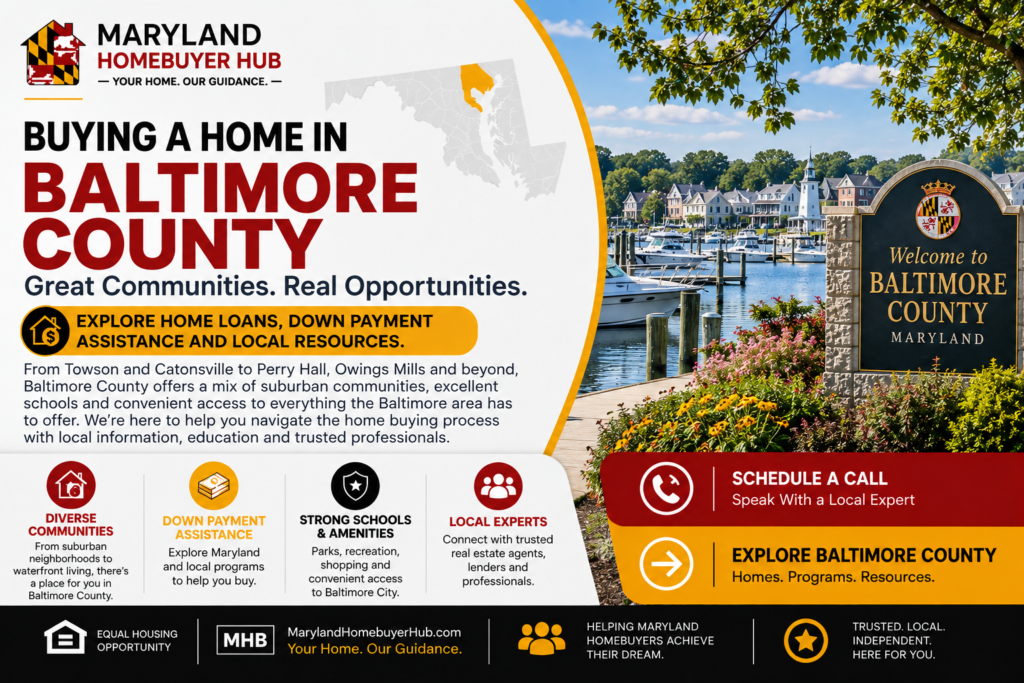
Baltimore County housing market
Baltimore County wraps around Baltimore City on three sides and covers about 682 square miles, from the waterfront communities of the southeast to farmland along the Pennsylvania line. It is Maryland’s third most populous jurisdiction, with roughly 852,000 residents and about 351,000 housing units.
- $389,900Median list price↓ 0.0% year over year
- 38Median days on market↑ 8.6% year over year
- 1,636Homes actively listed↑ 15.9% year over year
- $87,884Median household income
Market data period: August 2026. Median list price, median days on market and active listing count: Realtor.com residential listings data for Baltimore County, Maryland, retrieved from FRED, Federal Reserve Bank of St. Louis. Year-over-year comparisons use August 2025.
- $359,000Median value, owner-occupied
- 65.9%Homeownership rate
- $1,668Median gross rent
- 852,425County population
Population, median household income, median owner-occupied home value, homeownership rate and median gross rent: U.S. Census Bureau, American Community Survey 2024 1-year estimates for Baltimore County, Maryland. These are survey estimates and carry margins of error.
Long-run price trend
Measured by the Federal Housing Finance Agency All-Transactions House Price Index for Baltimore County, home prices rose an average of about 4.7% a year over the ten years to 2025, and about 6.8% a year over the five years to 2025. Most of that five-year figure was earned between 2020 and 2023; the index has risen far more slowly since. Long-run averages describe past periods. They are not a forecast.
The most useful thing in these numbers is what has not happened. The median asking price in August 2026 was essentially unchanged from a year earlier, while the number of homes actively listed rose about 16% and the median time on the market lengthened slightly. After several years of rapid appreciation, that combination describes a market that has stopped climbing and started giving buyers more to choose from — and more room to negotiate inspection repairs, closing help and timelines than was realistic a few years ago.
Two different “median prices”
The median list price is what sellers are currently asking across homes actively on the market. The median value of owner-occupied homes is a survey estimate of what existing owners report their homes are worth, across all owned homes rather than only those for sale. The two measure different populations, which is why they differ.
Featured Baltimore County real estate agents
Maryland Homebuyer Hub maintains a free directory of local professionals serving Maryland homebuyers. Featured agents work in Baltimore County and have completed a full profile with us.
Featured agents for Baltimore County are being added. Featured agents are local real estate professionals who have completed a full profile with Maryland Homebuyer Hub, and some also record a Local Agent Spotlight interview about the communities they serve.
Explore Baltimore County homebuying professionals
Buying a home involves more people than an agent and a lender. These are the categories Maryland Homebuyer Hub is building out for Baltimore County.
- Real Estate Agents
- Home Inspectors
- Title & Settlement
- Homeowners Insurance
- Moving Companies
- Home Services
Buying a home in Baltimore County
Baltimore County’s housing stock is notably varied. Just under half of the county’s housing units are detached single-family homes. Nearly a quarter are attached — townhouses and rowhouses. More than a quarter are in multi-unit buildings. In Baltimore County, property type is an important part of the homebuying decision: it can affect your financing options, your monthly costs, your insurance and the obligations that come with ownership.
Housing type varies widely
Of about 351,000 housing units, roughly 167,000 are detached houses, 85,000 are attached townhouses or rowhouses, and 96,000 sit in multi-unit buildings. A detached house, a townhouse in an HOA and a condo in a 60-unit building are three genuinely different purchases, even at the same price.
Condos need project approval
Financing a condo means the lender underwrites the building as well as you. Owner-occupancy ratios, reserve funding, litigation and the share of units held by one owner can all make a project ineligible for a given loan program — sometimes after you are already under contract. Ask about project approval before you write the offer, not after.
HOA and condo fees are part of qualifying
With roughly half the county’s housing attached or multi-unit, monthly association fees are common. Lenders count those fees in your debt-to-income ratio, so a $300 monthly fee reduces what you can borrow. Get the actual fee — and what it covers — early.
A postwar county, not a prewar one
Only about 7% of the county’s housing predates 1940, but roughly 60% was built before 1980, and the 1950s alone account for about one unit in six. Expect mid-century systems and the federal pre-1978 lead-based paint disclosure on a large share of transactions — but not the prewar building methods common further west.
Ground rent exists, but is uncommon here
Maryland ground rent — where you own the house but lease the land beneath it — is overwhelmingly a Baltimore City feature. A small number of Baltimore County properties carry one. It is worth asking your title company to confirm either way, because a ground rent is redeemable and is usually best dealt with at purchase.
Water, sewer and the rural north
Most of the county inside and near the Beltway is served by public water and sewer. In the rural northern and western areas, private wells and on-site septic are common, and neither is covered by a standard home inspection. Both need their own evaluation, and some loan programs set requirements for private systems.
Down payment assistance for Baltimore County buyers
Maryland statewide programs
Baltimore County buyers can generally use the statewide assistance Maryland offers everywhere, primarily through the Maryland Mortgage Program. MMP pairs a first mortgage with down payment and closing cost assistance, most often structured as a deferred second lien rather than a grant. Product families include 1st Time Advantage, Flex, HomeStart and SmartBuy, each with its own eligibility rules, income limits and purchase price limits, and several offer assistance calculated as a percentage of the loan amount rather than a flat sum.
Maryland also designates certain Targeted Areas where the first-time homebuyer requirement is waived and income limits may be higher. Parts of Baltimore County may fall within one; whether a specific address does should be confirmed against the Maryland Mortgage Program’s own Targeted Area tool, because designations change.
Explore Maryland down payment assistance programs · How the Maryland Mortgage Program works
Baltimore County’s own program
Unlike many Maryland counties, Baltimore County runs its own settlement assistance program through its housing department. The Settlement Expense Loan Program (SELP) provides assistance toward settlement costs for income-eligible first-time buyers purchasing in Baltimore County.
As the county has described the program, its main features are:
- Assistance of up to $10,000 toward settlement expenses.
- Structured as a deferred loan that is forgiven if you keep the home as your principal residence through the affordability period, which the county has set at 15 years under federal HOME program rules.
- Income eligibility at 80% of area median income, adjusted for household size.
- First-time buyer required, defined as not having owned a home in the previous three years.
- You must qualify for a fixed-rate mortgage with a participating lender.
- A borrower cash contribution equal to 5% of gross household income.
- Homebuyer education and individual counseling are required before settlement.
Program terms, funding availability and the participating lender list change, so confirm current details directly with Baltimore County’s housing department before relying on them. Note also that this is a Baltimore County program. Baltimore City operates separate programs of its own, and the two jurisdictions are not interchangeable.
Important
Down payment and homebuyer assistance programs are subject to eligibility requirements, funding availability, program guidelines and change. Programs shown are examples and are not a complete list of assistance that may be available. Income limits, purchase-price limits, property requirements, first-time homebuyer requirements and other conditions may apply. A licensed mortgage professional can help review programs that may be available based on your individual circumstances.
Maryland Homebuyer Hub does not determine eligibility for any program and does not make mortgage loans.
Home financing resources
Which loan program fits depends on your credit, your cash to close, whether you have VA entitlement, and — in Baltimore County especially — whether you are buying a detached house, a townhouse or a condo. These are the programs most relevant here, with the full Maryland guide behind each one.
Conventional loans
The broadest category, with low-down-payment options for some borrowers. Private mortgage insurance generally applies below 20% down and can be removed as equity builds.
FHA loans
Lower down payment and more flexible credit guidelines. If you are buying a condo, the building itself must meet FHA project requirements, so confirm approval status before you write an offer.
VA loans
Zero-down financing with no monthly mortgage insurance for eligible service members, veterans and surviving spouses. Condo projects need VA approval, which is a separate list from FHA.
Renovation financing
Finances the purchase and the repairs in one loan. Relevant across much of the county, where roughly 60% of housing was built before 1980 and updating is common.
USDA loans
Zero-down financing, but geographically limited here. Eligibility in Baltimore County is generally confined to the rural northern and western areas, and is set by the exact property address rather than by county.
Learn how Maryland homebuying works
Most of what determines whether a purchase goes smoothly happens before you tour a single home: understanding what you can borrow, what assistance you might use, what your credit needs to look like, and what the Maryland contract and settlement process actually involves. Baltimore County’s own assistance program also requires homebuyer education and counseling, so for many local buyers this is a necessary step rather than an optional one.
Maryland Homebuyer Hub runs a free first-time homebuyer seminar covering the process end to end, and publishes a full Maryland buying guide. Both are free, and neither requires you to work with anyone.
Attend the free Maryland homebuyer seminar · Read the Maryland home buying guide
Baltimore County Local Professional Spotlights
Spotlights are conversations with real estate agents and other professionals who work in Baltimore County every day — the communities they serve, the buyers they most often work with, and what they wish first-time buyers knew earlier.
Baltimore County Spotlights are in production. Spotlights are recorded conversations with local professionals about the communities they serve, the buyers they work with, and what they wish first-time buyers knew earlier. They are published here as they are recorded.
Explore local professionals in Baltimore County
The Baltimore County professional directory is being built. Maryland Homebuyer Hub is adding local real estate agents, home inspectors, title and settlement companies, homeowners insurance professionals, movers and home service businesses county by county. Listings are free and no professional pays for placement.
Communities in Baltimore County
Baltimore County is unusual among Maryland jurisdictions: it has no incorporated cities or towns at all. County government provides all local services directly, so there is no separate municipal tax or municipal utility layer to compare between communities. Towson is the county seat and Dundalk is the largest community, but neither is a municipality in the legal sense — both are census-designated places.
These are some of the county’s larger and more established communities. It is not a complete list, and the areas below vary widely in housing type, age and price.
- TowsonThe county seat, north of Baltimore City and inside the Beltway.
- DundalkThe county's largest community, in the southeast near the waterfront.
- CatonsvilleSouthwest, along the Baltimore City line.
- Owings MillsNorthwest, at the terminus of the Metro SubwayLink.
- WoodlawnWest, home to the Social Security Administration headquarters.
- Perry HallNortheast, largely postwar and later suburban development.
- PikesvilleNorthwest, inside the Beltway.
- EssexEast, near the Middle River waterfront.
- Lutherville-TimoniumNorth, along the York Road corridor.
Beyond these, the rural northern part of the county — around Hereford, Parkton, Monkton, Sparks and Upperco — is far less densely settled, more likely to be served by well and septic, and the part of the county most likely to fall within USDA’s rural lending boundaries.
Baltimore County homebuyer questions
Is Baltimore County the same as Baltimore City?
No, and the distinction matters for homebuyer programs. Baltimore City separated from Baltimore County in 1851 and is an independent city, not part of the county. They have separate governments, separate tax structures and separate homebuyer assistance programs. A Baltimore City program cannot generally be used on a Baltimore County property, and vice versa. Confirm which jurisdiction a property is in before applying for local assistance.
Does Baltimore County offer its own homebuyer assistance?
Yes. The county’s Settlement Expense Loan Program provides assistance toward settlement expenses for income-eligible first-time buyers, structured as a deferred loan that is forgiven if you keep the home as your principal residence through the affordability period. It has income limits, a borrower cash contribution requirement and a homebuyer education requirement. Confirm current terms and funding with Baltimore County’s housing department.
What is the Baltimore County housing market like?
As of August 2026 the median asking price was $389,900 — essentially flat against a year earlier — with 1,636 homes actively listed, about 16% more than the year before, and a median 38 days on the market. That describes a market that has levelled off after a period of strong appreciation, with more inventory than buyers have had recently.
Are USDA loans available in Baltimore County?
Only in parts of it. USDA rural eligibility in Baltimore County is generally limited to the less densely settled northern and western areas; most of the county inside and near the Beltway is not eligible. Eligibility is determined by the exact property address rather than by county, so check the specific address on USDA’s official eligibility lookup before assuming a property qualifies.
What should I know about buying a townhouse or condo here?
Roughly half of Baltimore County’s housing is attached or in a multi-unit building, so this affects a large share of buyers. Two things matter most: association fees count toward your debt-to-income ratio and therefore reduce what you can borrow, and condo financing requires the lender to approve the project as well as the borrower. Ask about both before writing an offer.
Do Baltimore County homes have ground rent?
Some do, but it is far less common than in Baltimore City, where ground rent is widespread. Ground rent means you own the house and hold a long-term lease on the land beneath it. It is redeemable, and if a property has one it is usually best addressed at the time of purchase. Your title company can confirm whether a specific property is subject to one.
How do I find a real estate agent serving Baltimore County?
Maryland Homebuyer Hub is building a free directory of local professionals, including real estate agents serving Baltimore County. Agents do not pay to be listed, and a listing is not an endorsement. You are free to work with any agent you choose.
Sources and data notes
Market activity figures — median list price, median days on market and active listing count — are from Realtor.com residential listings data, retrieved from FRED, Federal Reserve Bank of St. Louis (series MEDLISPRI24005, MEDDAYONMAR24005, ACTLISCOU24005), for the period stated in the snapshot. All series are for Baltimore County, Maryland (FIPS 24005), which is a separate jurisdiction from Baltimore City (FIPS 24510).
Population, median household income, median home value, homeownership rate, median gross rent, total housing units, units in structure and year-structure-built figures are from the U.S. Census Bureau, American Community Survey 2024 1-year estimates for Baltimore County, Maryland. ACS figures are survey estimates and carry margins of error.
Long-run price change is calculated from the Federal Housing Finance Agency All-Transactions House Price Index for Baltimore County, MD (annual, index 2000=100), retrieved from FRED. Percentages shown are compound annual growth rates between the stated years.
Settlement Expense Loan Program details are drawn from Baltimore County government materials describing the program. Statewide program information is drawn from the Maryland Mortgage Program and the Maryland Department of Housing and Community Development. USDA eligibility is determined by USDA Rural Development. Program terms change; confirm current details with the administering agency before relying on them.