
How conventional manufactured home financing works
A conventional mortgage on a manufactured home — when the property qualifies
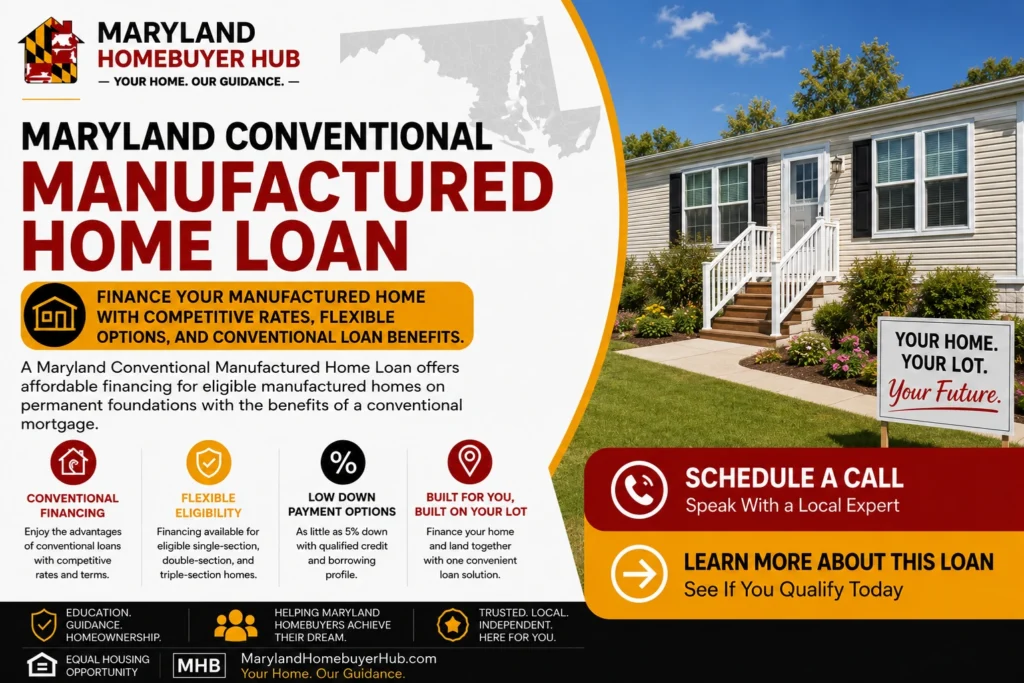
Yes, you can buy a manufactured home with a conventional loan. Both Fannie Mae and Freddie Mac finance eligible manufactured homes, and two enhanced programs — MH Advantage and CHOICEHome — offer better terms for homes built to higher design and energy standards.
The requirements sit on the property, not the borrower. The loan must be secured by both the home and your interest in the land, and both must be legally classified as real property under Maryland law.
That single rule is why a manufactured home on rented land in a community or park generally cannot be financed this way. It is a different kind of lending entirely.
Occupancy is limited too: principal residences and second homes only. Investment properties are not eligible for conventional manufactured-home financing.
Conventional financing on a manufactured home works the way conventional financing works on any house — conforming loan limits, private mortgage insurance below 20% equity that can eventually be removed, and underwriting through automated systems — with a layer of manufactured-housing rules on top covering construction standard, foundation, labels and titling.
Those rules are not difficult. They are unforgiving, and almost every conventional manufactured-home transaction that fails, fails on the property rather than on the buyer.
Manufactured, modular or mobile? The words matter
These three terms get used interchangeably in conversation. In lending they mean different things, and the difference decides which rules apply to your loan.
| Type | Built to which code | How lenders treat it |
|---|---|---|
| Manufactured home | Federal HUD code, established June 15, 1976 | Manufactured housing rules apply — foundation, labels, titling |
| Modular home | The International Residential Code, administered by the state | Not manufactured housing; treated the same as site-built |
| Mobile home | Built before the HUD code took effect | Generally not eligible for conventional mortgage financing |
A manufactured home is defined as any dwelling unit built on a permanent chassis, attached to a permanent foundation system, and evidenced by a HUD Data Plate and HUD Certification Labels. It is built to the Federal Manufactured Home Construction and Safety Standards established June 15, 1976, as amended.
Modular homes are not manufactured housing at all
A modular home is built to the International Residential Code rather than the HUD code, and it is not considered manufactured housing. It is eligible under the ordinary one-unit property guidelines and receives the same treatment as site-built housing — with no minimum requirements for width, size, roof pitch or any other construction detail.
If your home is modular, none of the manufactured-housing hurdles on this page apply to you. Confirming which category a home falls into is worth doing before anything else.
Prefabricated, panelized and sectional housing sit in a third group: they must conform to local building codes but are not required to meet the HUD code or the International Residential Code.
We use “mobile home” on this page where that is genuinely how people search, but the technical term for a home built after June 1976 is manufactured, and it is the term your loan file will use.
Fannie Mae and Freddie Mac — two channels, not one
Conventional lending runs through two government-sponsored enterprises, and their manufactured-housing rules are similar but not identical. Which one your loan is delivered to can genuinely change what is possible.
- Fannie Mae offers standard manufactured housing plus MH Advantage, its enhanced program for homes built to site-built-style design and energy standards.
- Freddie Mac offers standard manufactured housing plus CHOICEHome, its equivalent enhanced offering.
Both enhanced programs exist for the same reason: manufactured homes have improved dramatically, and a home built with a pitched roof, a covered porch, real siding and genuine energy performance behaves far more like a site-built house than the stereotype suggests. The programs reward that with better financing and, in Freddie Mac’s case, a different appraisal approach.
Ask which channel your lender is using
A lender may deliver to one enterprise, the other, or both. Because the rules differ — particularly around single-width homes and the enhanced programs — a home that will not work in one channel may work in the other.
If you are told a manufactured home is not financeable, the useful follow-up question is “in which channel, and have you looked at the other one?”
Down payment and maximum financing
This is where the enhanced programs earn their keep, and where a blanket “3% down” claim would mislead you.
Standard conventional manufactured housing carries its own maximum loan-to-value ratios, set by the applicable eligibility requirements for the transaction type, occupancy and program. They are generally more conservative than for a site-built house, and your lender will confirm the figure for your specific scenario.
Freddie Mac CHOICEHome is the clearest published example of what an enhanced program allows: maximum loan-to-value of 95%, or 97% with an affordable second mortgage, with a down payment as low as 3% through qualifying programs.
Land you already own counts toward your down payment
This is the single most useful rule for a Maryland lot owner. Where the borrower holds title to the land on which the manufactured home will be permanently attached, the value of the land may be credited toward the borrower’s minimum down payment.
For someone who already owns a parcel, that can cover a meaningful share of the required investment — sometimes all of it. It depends on the appraised land value, the total transaction and full underwriting, so have it calculated rather than assumed.
The honest summary: 3% down is achievable on an enhanced-program home, and standard manufactured housing generally requires more. Which applies to you depends on whether the specific home carries an MH Advantage Sticker or a CHOICEHome label — which is a fact about the house, not something you can negotiate.
Credit, income and underwriting
Conventional qualification runs on the whole file rather than a single number, and there is a nuance here most buyers never hear.
The two enterprises treat credit scores differently
Freddie Mac generally works to a 620 minimum credit score for an approved conventional loan.
Fannie Mae no longer publishes a single minimum credit score, using risk-based eligibility instead — the automated underwriting decision weighs your whole profile rather than testing one threshold.
In practice most conventional borrowers sit at 620 or above, and individual lenders can and do apply higher minimums of their own. Because that varies, it is worth asking each lender directly rather than assuming you have been ruled out.
Income and debt are evaluated through the automated underwriting systems — Desktop Underwriter on the Fannie Mae side and Loan Product Advisor on the Freddie Mac side. Neither tests a single published debt-to-income ceiling in isolation. What the underwriting weighs together is:
- Your credit history and depth
- Your housing payment relative to your income
- Your total monthly debt
- Your assets and reserves
- The occupancy — principal residence or second home
- The property itself and the loan characteristics
Two borrowers with the same score and the same ratio routinely get different answers, which is why a pre-qualification beats guessing from a published number.
Eligible loan types are fully amortizing fixed-rate loans, and adjustable-rate mortgages with initial fixed periods of seven or ten years.
Do you have to own the land?
Yes, in almost every case — and this is the question to settle before anything else.
A conventional manufactured-home loan must be secured by both the manufactured home and your interest in the land on which it is situated, and both the home and the land must be legally classified as real property under applicable state law.
That single requirement rules out the most common manufactured-home situation in Maryland: a home sited on a rented lot in a manufactured-home community. There is no land interest for the mortgage to attach to, so a conventional mortgage cannot be made.
If the lot is leased, conventional financing is generally unavailable
Leasehold manufactured homes are ineligible — with one narrow exception. A leasehold manufactured home may be eligible where it is located in a Fannie Mae-approved condominium or PUD project.
That exception is genuinely narrow and does not describe a typical manufactured-home park. If your home sits on rented ground, assume conventional mortgage financing is off the table until a lender confirms otherwise, and read the chattel section further down.
Three situations, three answers:
- You already own the land. This works, and your land value can be credited toward the minimum down payment.
- You are buying the home and land together. This also works, and is the most common arrangement.
- The home is on leased land in a park or community. Generally not eligible, outside the approved condo or PUD exception.
Find out whether the property can actually be financed
Land ownership, the title status and how the home is classified decide whether a conventional mortgage is possible at all. Most of it can be established from the listing and a title search in one conversation.
This is not a commitment to lend. All loans subject to credit approval.
Why real-property classification matters
A manufactured home begins life as personal property. It is built in a factory, transported on a chassis, and titled by a motor vehicle agency much like a vehicle. In that state no mortgage can attach to it.
It becomes real property when it is permanently attached to land held by the same owner and the personal-property title is formally surrendered. At that point it is legally part of the land, taxed as real estate, and financeable with a mortgage.
Everything else follows from that: the permanent foundation, the titling paperwork, the lien covering both home and land. Each requirement exists so that if the loan were ever foreclosed, the lender takes the house and the ground it stands on — not a vehicle somebody could tow away.
Converting to real property in Maryland
Maryland has a specific statutory process, and understanding it before you make an offer matters — because a home that cannot complete it is a home a conventional lender cannot finance.
Under Maryland’s Real Property Article, a manufactured home is converted to real property when all three of the following have happened:
- The home is attached to a permanent foundation.
- Ownership of the home and the land is identical. The same person or people must own both — which is the legal reason a rented lot can never work.
- An affidavit of affixation is recorded with the clerk of the circuit court for the county where the land is located.
What the affidavit must contain
- A description of the home — manufacturer, make, model name, model year and dimensions, and whether it is new or used
- The street address and legal description of the parcel
- A statement that ownership of the home and the land is, or will be, identical
- A statement that the home is, or will be, attached to that parcel
- The original Maryland MVA certificate of title, surrendered, with a release from every lienholder shown on it
- Signature under penalty of perjury, and acknowledgement
If the owner genuinely cannot locate the certificate of title, Maryland law provides an alternative: a report from a Maryland-licensed attorney or title insurance producer who has searched both the county land records and the MVA’s records and identified every lien on the home.
Two Maryland details worth knowing
Recording the affidavit does not trigger transfer tax. Maryland law provides that recordation of an affidavit of affixation does not represent a sale or transfer of real property for the purpose of collecting any State, county or municipal tax or fee.
The MVA must be notified. Immediately after filing with the clerk of the circuit court, a certified copy goes to the Motor Vehicle Administration, which records it. The clerk is required to accept the affidavit and may charge a reasonable recordation fee.
The most common Maryland blocker: an unreleased lien on the MVA title
If the home still carries an old chattel loan or another encumbrance on its certificate of title, that lien must be released before conversion can happen. A seller who has forgotten a decades-old lien, or whose lender no longer exists, can stall a transaction for weeks.
Ask early whether the title has already been surrendered and the home already converted. On many Maryland properties it was done years ago and one search settles it.
Permanent foundation requirements
A permanent foundation is built into the very definition of a manufactured home for conventional purposes: a dwelling unit built on a permanent chassis that is attached to a permanent foundation system.
In practice that means a foundation designed to hold the home permanently in place — not a temporary set-up that would allow it to be moved again. The appraiser will comment on it, and depending on the property and the lender you may be asked for a foundation certification, typically prepared by a licensed engineer, confirming the installation meets the applicable standards.
Blocks and skirting are not a permanent foundation
This is the most common misunderstanding on the topic. A unit set on piers with skirting around the perimeter looks permanent from the street and frequently is not.
Whether a fresh engineer’s certification is required on your specific transaction depends on the property, its history and the lender’s requirements. What is never optional is the underlying condition: the home has to be genuinely, permanently affixed.
HUD Certification Labels and the Data Plate
These two documents are how a lender proves the home is what it claims to be, and they are constantly confused with each other.
- The HUD Certification Label — the metal “red tag” attached to the outside of each transportable section. A double-wide has two; a triple-wide has three. It certifies the home was built to the federal standards in effect on its date of manufacture.
- The HUD Data Plate — a paper or laminated label inside the home showing the manufacturer, the model, the serial number, the date of manufacture, the certification label numbers, and the design load zones.
The conventional definition of a manufactured home requires the home to be evidenced by a HUD Data Plate and HUD Certification Labels, so this is not paperwork you can skip. The Data Plate is also where you confirm the date of manufacture, which settles the June 15, 1976 question in seconds.
A missing label is usually a delay, not a dead end
Labels go missing all the time, particularly on older homes, re-sided homes, or homes where a previous owner painted over the tag. Verification documentation is available through HUD’s label verification contractor to evidence that a label was issued, and lenders commonly accept it.
What it costs you is time. Establish whether both are present before the appraisal is ordered, not after.
How old can the manufactured home be?
This question is asked constantly, and the answer is more useful than most people expect.
The date that matters is June 15, 1976 — not a maximum age
Fannie Mae’s manufactured-housing sections do not impose a blanket maximum age. What they impose is a construction standard: the home must have been built to the Federal Manufactured Home Construction and Safety Standards, established June 15, 1976.
A home built before that date is a pre-HUD-code “mobile home” and is generally not eligible for conventional mortgage financing at all. No documentation can create a HUD label retrospectively.
So an older manufactured home is not automatically disqualified by its model year. What an older home does have to do is satisfy everything else — a certifiable permanent foundation, present or verifiable labels, real-property titling, and an appraisal supporting the value in acceptable condition. On a manufactured home, age tends to show first in the roof, the siding, the utility connections and the underside.
Individual lenders and investors sometimes apply their own age overlays on top. Because that is a lender decision rather than an agency rule, it varies — and it is worth asking more than one.
Single-wide or multi-section?
Width matters in conventional lending, but not in the blanket way it does under some other programs. The rules are specific, and they depend on what you are doing.
| Situation | Single-width | Multi-width |
|---|---|---|
| Principal residence | Eligible | Eligible |
| Second home | Not eligible | Eligible |
| Investment property | Not eligible | Not eligible |
| Cash-out refinance | Not permitted | Eligible |
Two things are worth pulling out of that table. A single-width manufactured home can be financed as your principal residence, which surprises people who have been told otherwise. And investment properties are not eligible at all, regardless of width — conventional manufactured-home financing is for homes you will live in.
On the Freddie Mac side, CHOICEHome covers both single-section and multi-section factory-built homes, which is another reason the channel your lender uses can matter.
What is Fannie Mae MH Advantage?
MH Advantage is Fannie Mae’s enhanced manufactured-housing offering. It exists for homes built to construction, architectural design and energy efficiency standards that are more consistent with site-built homes — and it offers better financing than standard manufactured housing in return.
A qualifying home is built with features such as:
- Distinctive roof treatments — eaves and a higher pitch roofline
- A masonry or poured concrete perimeter foundation
- An attached garage or carport
- A covered porch
- Durability features, such as the siding and cabinetry materials
- Energy efficiency standards, with minimum energy ratings applying
The sticker is the test — not how nice the home looks
A home qualifies for MH Advantage because it was built to the standard and labelled at the factory, not because a buyer or agent thinks it looks like a site-built house.
Lenders verify eligibility by reviewing appraisal photos showing the MH Advantage Sticker or the CHOICEHome label, placed in proximity to the HUD Data Plate. If the sticker is not there, the home is standard manufactured housing however attractive it is.
If you are shopping and the enhanced financing matters to you, ask the seller or the dealer directly whether the home carries the sticker — and have your agent photograph it. It is a small question that changes the terms available on the loan.
What is Freddie Mac CHOICEHome?
CHOICEHome is Freddie Mac’s equivalent program — financing for real property factory-built homes, built to HUD Code requirements, with many of the same features as site-built homes.
A qualifying CHOICEHome needs:
- Aesthetic and architectural attributes comparable to site-built homes — a pitched roof, a covered porch, eaves
- Minimum insulation values of R-33 ceiling, R-11 wall and R-22 floor
- Energy efficiency features exceeding current HUD requirements
As with MH Advantage, identification is physical: a home is identified as a CHOICEHome by a certification label affixed to it in the factory where it is built.
What CHOICEHome changes
- Financing. Maximum loan-to-value of 95%, or 97% with an affordable second mortgage, with a down payment as low as 3% through qualifying programs.
- Appraisal. CHOICEHome appraisals use site-built comparables rather than manufactured-home comparables — which can materially change the value conclusion in a market with few manufactured-home sales.
- Width. Both single-section and multi-section homes are covered.
That appraisal difference is the quietly important one. In parts of Maryland where manufactured homes rarely sell, finding comparable manufactured sales is the hardest part of the file.
New homes, existing homes, and installation
Conventional financing can be used for both new and existing manufactured homes, and the practical differences are mostly about documentation.
Buying an existing manufactured home
The work is establishing history and status: the title position and whether the home has already been converted to real property, the presence of the HUD labels and Data Plate, the condition and adequacy of the foundation, whether any additions were properly done, and whether the appraiser can support the value.
Buying a new manufactured home
Here the documentation runs through the dealer and manufacturer — the purchase paperwork, delivery, the foundation and installation, and the certificates and inspections that go with a new set-up. The home also has to end up titled as real property alongside the land, exactly as an existing home does.
A standard purchase mortgage finances a completed home
This is the distinction that trips people up. A conventional purchase mortgage closes on a property that exists and is installed and complete. If you are buying land and a new manufactured home that still has to be delivered, set on a foundation and connected, that installation period is a construction question rather than a straight purchase.
Where that applies, a conventional construction-to-permanent structure is the right tool — a different product with its own appraisal and disbursement mechanics, which we cover separately. Establish which path you are on before you order anything, because the two are not interchangeable.
Additions, modifications and homes that have been moved
Additions and structural changes
Porches, decks, room additions, garages, carports and roof-over structures are common on manufactured homes, and they can quietly complicate a loan. The recurring problems are:
- Work done without permits or without the required inspections
- Structural modifications that affect the home’s original design or its load paths
- Additions attached to the home in a way that compromises the manufactured structure rather than being independently supported
- Alterations the appraiser cannot evaluate, which may prompt a request for certification from a licensed professional
None of these is automatically fatal. A well-built, properly permitted addition on its own foundation is routine. An unpermitted room tied into the roof structure is a genuine problem, and it is far better identified before you are under contract than after the appraisal.
Homes that have been moved
This deserves care, because the rules here are not the same across programs and the differences are widely misreported.
Conventional treatment differs from USDA and FHA
USDA financing carries an explicit federal bar on purchasing an existing manufactured home that has been moved from another site. Fannie Mae’s manufactured-housing sections do not impose an equivalent blanket prohibition, and this page deliberately does not import that rule from the government programs.
In practice a previously relocated home still has to clear everything else — a certifiable permanent foundation at its current site, intact labels and documentation, clean real-property titling, and an appraisal supporting the value. Individual lenders and investors may also apply their own restrictions.
If the home has been moved, raise it early and ask the specific lender how they treat it. Do not assume it is disqualifying, and do not assume it is fine.
How the manufactured-home appraisal works
Appraising a manufactured home is not simply appraising a small house, and the appraisal is where a surprising number of these transactions come unstuck.
The appraiser is looking at more than condition. They confirm the home’s identity through the HUD Data Plate and Certification Labels, assess the foundation and installation, evaluate any additions or alterations, separate the contribution of the land from the contribution of the home, and select comparable sales.
Comparable sales are the hard part
Standard manufactured-housing appraisals generally rely on comparable manufactured homes. Where manufactured homes rarely sell, finding recent, genuinely similar sales on similar owned land can be difficult — and a thin comparable set produces a conservative value.
This is the practical advantage of the enhanced programs: CHOICEHome appraisals use site-built comparables, which changes the analysis entirely in a market with little manufactured-home turnover.
In Maryland this plays out geographically rather than by rule. The program is identical statewide, but the evidence available to an appraiser is not. On the Eastern Shore, in Southern Maryland, in the western counties and across rural central Maryland, manufactured homes on owned land change hands regularly and comparables are usually obtainable. In the denser Baltimore and Washington suburbs, where manufactured housing is uncommon, supporting the value can be genuinely harder.
Private mortgage insurance
Conventional private mortgage insurance generally applies when you finance more than 80% of value, and it works the same way on a manufactured home as on any other conventional loan. Its great advantage over FHA is that it can be removed.
| Route | When it happens |
|---|---|
| Borrower-requested cancellation | When the balance is scheduled to reach 80% of original value — you must request it in writing |
| Automatic termination | When the balance is scheduled to reach 78% of original value, provided you are current on payments |
| Final termination | The month after you reach the midpoint of the amortization schedule, regardless of balance |
Two things people get wrong
Cancellation at 80% is not automatic. You have to request it in writing, be current with a good payment history, certify there are no junior liens, and where required provide evidence the value has not declined. The automatic termination comes later, at 78%.
“Original value” is a defined term — generally the lower of the contract sales price or the appraised value at purchase. It is not this year’s market value, so appreciation alone does not trigger these rules.
One practical note specific to manufactured housing: mortgage insurance has to be available for the transaction, and coverage requirements and pricing on manufactured homes can differ from a site-built house. That availability is part of what shapes the maximum financing on a given file, so confirm it early rather than assuming the site-built maths carries across.
2026 Maryland conforming loan limits
Conventional manufactured-home financing is conforming financing, so the loan must fit within the conforming limit for the county where the property sits.
Maryland is not a single-limit state. Nineteen of its twenty-four jurisdictions sit at the national baseline; five Washington-metro counties are designated high-cost.
| Jurisdiction | 2026 one-unit limit |
|---|---|
| Charles, Frederick, Montgomery and Prince George’s | $1,249,125 |
| Calvert | $1,209,750 |
| All other Maryland counties and Baltimore City | $832,750 |
For most manufactured-home purchases the conforming limit is comfortably above the transaction and never becomes the binding constraint — the appraised value and your repayment ability usually decide the loan size first. It is included here because the rule applies, and because a home-plus-land purchase on an expensive parcel can occasionally approach it. Limits are revised annually.
Conventional compared with FHA, VA and USDA
Four routes exist for financing a manufactured home as real estate. Which fits is usually decided by eligibility rather than preference.
| Program | Down payment | Who it suits | The main constraint |
|---|---|---|---|
| Conventional | From 3% on an MH Advantage or CHOICEHome | Buyers wanting removable mortgage insurance and no income or location limits | Primary and second homes only; no rentals |
| VA | None with full entitlement | Eligible veterans and service members | Requires VA eligibility |
| USDA | None | Buyers within the income limit, in an eligible area | Location and income both have to work |
| FHA | From 3.5% | Buyers with lower credit profiles | Mortgage insurance often for the life of the loan |
The practical hierarchy: if you are a veteran, VA usually wins — no down payment and no monthly mortgage insurance. If not, and the property is in a USDA-eligible area and your household income fits, USDA is the other no-money-down route. FHA is the fallback when credit is the obstacle. Conventional earns its place when your income exceeds USDA limits, when you are buying a second home, when you want mortgage insurance that eventually comes off — or when the home carries an MH Advantage or CHOICEHome label, which the government programs do not reward.
Compare this option with other Maryland manufactured home loan programs.
Our Maryland FHA loans guide covers FHA financing more generally if that looks like the likely path.
Find out which financing path your property qualifies for
Land ownership, the title status, the home's labels and your credit profile decide the answer between them. All of it is quick to establish on a specific property.
This is not a commitment to lend. All loans subject to credit approval.
Conventional mortgage vs chattel financing
If the home cannot be real property, a conventional mortgage is not available — but financing may still be. That financing is a chattel or personal-property loan, and it is a genuinely different instrument rather than a worse version of the same thing.
| Factor | Conventional mortgage | Chattel financing |
|---|---|---|
| Land | You own it, or buy it in the same transaction | Typically rented or leased |
| Legal status of the home | Real property, taxed as real estate | Personal property, titled like a vehicle |
| What secures the loan | The home and the land together | The home only |
| Instrument | A mortgage or deed of trust recorded in the land records | A personal-property security agreement |
| Typical term | Up to 30 years | Generally shorter |
| Backed by | Fannie Mae or Freddie Mac | The individual lender or a specialty investor |
Chattel lending exists because a large share of manufactured homes sit on land the occupant does not own, and those households need financing too. It is the appropriate structure in that situation, and for many buyers it is the only realistic route to owning a home in a community they want to live in.
What matters is knowing which conversation you are actually in. A manufactured home can look identical to a house down the street and still be a completely different financing proposition because of who owns the ground. That is worth establishing on day one rather than after you have made an offer.
When conventional manufactured-home financing makes sense
It is a strong fit when:
- You own the land, or are buying it with the home
- The home was built after June 15, 1976 to the HUD code, with its labels intact or verifiable
- The home is or can be titled as real property in Maryland
- The foundation is permanent, or can be brought to a certifiable standard
- You qualify under conventional underwriting
- The home carries an MH Advantage Sticker or CHOICEHome label, unlocking better financing
- You want mortgage insurance that eventually comes off rather than lasting the life of the loan
- Your income is above USDA limits, or the property is outside an eligible area
- You are buying a second home, which the government programs do not finance
- Your land equity can count toward the down payment
Another path is probably better when:
- You are a veteran — VA financing offers no down payment and no monthly mortgage insurance
- The property is USDA-eligible and your income fits — also no down payment
- Your credit is on the lower end — FHA is generally more accommodating
- The home is on leased land outside an approved condo or PUD project
- The home was built before June 15, 1976
- You are buying an investment property — not eligible for conventional manufactured-home financing
- The home still has to be delivered and installed — that is a construction transaction
- The title cannot be converted or the foundation cannot be certified
Common problems that derail these transactions
- The home is on leased land. The most common one by far, and not solvable by shopping lenders.
- Built before June 15, 1976. Check the Data Plate first; it takes seconds.
- Title never converted. If the MVA certificate was never surrendered, the home is still personal property and no mortgage can attach.
- An unreleased lien on the MVA title. A forgotten chattel loan can hold up conversion for weeks.
- Missing HUD label or Data Plate. Usually solvable through verification documentation, but only if you start early.
- The foundation will not certify. Blocks and skirting are not a permanent foundation.
- Unpermitted additions or structural modifications that compromise the home’s original design.
- Appraisal comparables. Where manufactured homes rarely sell locally, supporting the value can be difficult on a standard manufactured appraisal.
- Buying it as a rental. Investment properties are not eligible, whatever the width.
- Single-width on a second home or cash-out refinance. Eligible as a principal residence; not for those two.
- Assuming a nice-looking home has the sticker. MH Advantage and CHOICEHome are factory-applied labels, not judgements about appearance.
- Assuming your lender offers it. Not every conventional lender does manufactured homes, and overlays vary between those that do.
Frequently asked questions
Can you buy a manufactured home with a conventional loan?
Yes, when the property qualifies. Both Fannie Mae and Freddie Mac finance eligible manufactured homes. The loan must be secured by both the home and your interest in the land, and both must be legally classified as real property. Occupancy is limited to principal residences and second homes.
Do I have to own the land?
In almost every case, yes. The loan must be secured by both the manufactured home and your interest in the land beneath it. Leasehold manufactured homes are ineligible unless located in a Fannie Mae-approved condominium or PUD project, which is a narrow exception that does not describe a typical manufactured-home park.
Can I get a conventional loan on a home in a manufactured-home community?
Generally no, if the lot is rented. Without a land interest there is nothing for the mortgage to attach to. Personal-property or chattel financing is the usual route in that situation.
How much down payment do I need?
It depends on the home. Freddie Mac CHOICEHome allows a maximum loan-to-value of 95%, or 97% with an affordable second mortgage, with a down payment as low as 3% through qualifying programs. Standard manufactured housing generally requires more, with maximum financing set by the applicable eligibility requirements for your transaction. Land you already own can be credited toward the minimum down payment.
What credit score do I need?
Freddie Mac generally works to a 620 minimum. Fannie Mae no longer publishes a single minimum and uses risk-based eligibility instead, with the automated underwriting decision weighing your whole profile. Individual lenders can apply higher minimums, so it is worth asking each one directly.
Is there a maximum debt-to-income ratio?
There is no single published ceiling. Qualification runs through Desktop Underwriter or Loan Product Advisor, which weigh credit, housing cost against income, total debt, assets and reserves, the occupancy and the property together.
How old can the manufactured home be?
Fannie Mae’s manufactured-housing sections do not impose a blanket maximum age. What matters is the construction standard: the home must have been built to the Federal Manufactured Home Construction and Safety Standards established June 15, 1976. A home built before that date is generally not eligible. Individual lenders sometimes apply their own age overlays.
Can I finance a single-wide?
Yes, as a principal residence. Single-width homes are eligible for principal residences but not for second homes, and a cash-out refinance requires a multi-width home. Investment properties are not eligible at any width. Freddie Mac CHOICEHome covers both single-section and multi-section homes.
Can I buy a manufactured home as a rental property?
No. Conventional manufactured-home financing is limited to principal residences and second homes. Investment properties are explicitly prohibited.
What is MH Advantage?
Fannie Mae’s enhanced manufactured-housing program for homes built to construction, architectural design and energy standards more consistent with site-built homes — distinctive roof treatments with eaves and a higher pitch, a masonry or poured concrete perimeter foundation, an attached garage or carport, a covered porch, durability features and minimum energy ratings. Lenders verify eligibility from appraisal photos showing the MH Advantage Sticker near the HUD Data Plate.
What is CHOICEHome?
Freddie Mac’s offering for real property factory-built homes built to HUD Code with many of the same features as site-built homes. Qualifying homes need site-built-comparable architecture such as a pitched roof, covered porch and eaves, minimum insulation values of R-33 ceiling, R-11 wall and R-22 floor, and energy features exceeding current HUD requirements. A qualifying home is identified by a certification label affixed at the factory.
How do I know whether a home qualifies for MH Advantage or CHOICEHome?
By the label. Both are applied at the factory to homes built to the standard, and the lender verifies them from appraisal photos. A home that simply looks like a site-built house does not qualify without the sticker.
What is the difference between a manufactured home and a modular home?
A manufactured home is built on a permanent chassis to the federal HUD code and carries HUD labels. A modular home is built to the International Residential Code administered by the state, is not considered manufactured housing, and receives the same treatment as site-built housing — with no minimum requirements for width, size or roof pitch.
How does a manufactured home become real property in Maryland?
Three things must happen: the home is attached to a permanent foundation, ownership of the home and the land is identical, and an affidavit of affixation is recorded with the clerk of the circuit court for the county where the land sits. The MVA certificate of title is surrendered with any liens released, and a certified copy of the affidavit goes to the Motor Vehicle Administration.
Does converting to real property trigger Maryland transfer tax?
No. Maryland law provides that recording an affidavit of affixation does not represent a sale or transfer of real property for the purpose of collecting any State, county or municipal tax or fee. The clerk may charge a reasonable recordation fee.
What if the HUD label or Data Plate is missing?
It is usually a delay rather than a dead end. Verification documentation is available through HUD’s label verification contractor to evidence that a label was issued, and lenders commonly accept it. Establish whether both are present before the appraisal is ordered.
Can a manufactured home that has been moved qualify?
Possibly. Unlike USDA financing, which bars the purchase of an existing manufactured home moved from another site, Fannie Mae’s manufactured-housing sections do not impose an equivalent blanket prohibition. The home still has to satisfy everything else, and individual lenders may apply their own restrictions, so raise the move history early and ask the specific lender.
Do additions cause problems?
They can. Work done without permits, structural modifications affecting the home’s original design, or additions attached in a way that compromises the manufactured structure are the recurring issues. A properly permitted, independently supported addition is routine.
Can I buy the land and a new manufactured home together?
Yes, but the structure depends on timing. A conventional purchase mortgage closes on a home that is already installed and complete. If the home still has to be delivered, set and connected, that installation period is a construction transaction and needs a construction-to-permanent structure instead.
Will I have to pay mortgage insurance?
Generally yes if you finance more than 80% of value. Conventional PMI can be removed: you may request cancellation when the balance is scheduled to reach 80% of original value, it terminates automatically at 78% if you are current, and it ends the month after the amortization midpoint regardless of balance. Coverage requirements and availability on manufactured homes can differ from a site-built house.
Why is the appraisal harder on a manufactured home?
Standard manufactured-housing appraisals generally rely on comparable manufactured-home sales, and in areas where manufactured homes rarely sell those are hard to find. A thin comparable set produces a conservative value. CHOICEHome appraisals use site-built comparables instead, which can change the analysis substantially.
Sources
- Fannie Mae Selling Guide B2-3-02 — Factory-Built Housing: Factory-Built Housing): the definition of a manufactured home as a dwelling unit built on a permanent chassis attached to a permanent foundation system and evidenced by a HUD Data Plate and HUD Certification Labels; construction to the Federal Manufactured Home Construction and Safety Standards established June 15, 1976, as amended, and HUD regulations at 24 CFR Part 3280; the treatment of modular homes under the International Residential Code as not manufactured housing, eligible under the one-unit property guidelines and receiving the same treatment as site-built housing with no minimum requirements for width, size or roof pitch; the treatment of prefabricated, panelized and sectional housing; the MH Advantage design, durability and energy standards; and verification of MH Advantage eligibility from appraisal photos showing the MH Advantage Sticker or CHOICEHome label near the HUD Data Plate.
- Fannie Mae Selling Guide B5-2-01 — Manufactured Housing: the manufactured home definition, and the requirement that the manufactured home and the land on which it is situated be legally classified as real property.
- Fannie Mae Selling Guide B5-2-02 — Manufactured Housing Loan Eligibility: the requirement that the loan be secured by both the manufactured home and the borrower’s interest in the land, with both legally classified as real property under applicable state law; eligible occupancy of principal residences in single- and multi-width and second homes in multi-width only, with investment properties prohibited; the ineligibility of leasehold manufactured homes except in a Fannie Mae-approved condo or PUD project; eligible fixed-rate and 7-year and 10-year ARM loan types; and the reference of maximum LTV ratios to the Eligibility Matrix.
- Fannie Mae Selling Guide B5-2-03 — Manufactured Housing Underwriting Requirements: the requirement that a cash-out refinance be secured by a multi-width manufactured home, with single-width not permitted; and the provision that where the borrower holds title to the land on which the manufactured home will be permanently attached, the value of the land may be credited toward the borrower’s minimum down payment.
- Freddie Mac — CHOICEHome: the description of CHOICEHome as financing for real property factory-built homes built to HUD Code with many of the same features as site-built homes; the required architectural attributes, minimum insulation values of R-33 ceiling, R-11 wall and R-22 floor, and energy efficiency features exceeding current HUD requirements; identification by a certification label affixed at the factory; maximum loan-to-value of 95% or 97% with an affordable second mortgage and a down payment as low as 3% through qualifying programs; coverage of single-section and multi-section homes; and the use of site-built comparables for appraisal. Freddie Mac’s broader manufactured home requirements are published separately from Fannie Mae’s and are not assumed to match them.
- Consumer Financial Protection Bureau — Homeowners Protection Act: borrower-requested cancellation of private mortgage insurance at 80% of original value, automatic termination at 78% where payments are current, and final termination the month after the midpoint of the amortization schedule.
- Md. Code, Real Property Article, Title 8B (Manufactured Homes), §§ 8B-201 through 8B-203: the three conditions for conversion; the required contents of the affidavit of affixation; surrender of the MVA certificate of title with lien releases; the attorney or title insurance producer report where the title cannot be located; recordation with the clerk of the circuit court; the provision that recordation is not a sale or transfer for tax purposes; and the certified copy sent to the Motor Vehicle Administration.
- Federal Housing Finance Agency — conforming loan limit values for calendar year 2026: the Maryland one-unit limits used above.
Verified August 25, 2026. Maximum loan-to-value ratios for standard conventional manufactured housing are set by the applicable eligibility requirements and the automated underwriting decision and are not published here. No maximum age limit appears in the manufactured-housing sections reviewed; individual lenders and investors may apply their own age, credit and property overlays that are more restrictive than agency guidelines. Fannie Mae’s manufactured-housing sections do not impose a blanket prohibition on previously relocated homes, and the relocation rules applying to FHA and USDA financing have deliberately not been carried across. Whether single-width homes qualify for MH Advantage specifically should be confirmed with your lender; the operative test for either enhanced program is the factory-applied sticker or label. Conforming loan limits are revised annually. No interest rates are shown. Confirm all current figures and requirements with a lender that actively originates conventional manufactured home loans.
This page explains how conventional financing for manufactured homes generally works for Maryland homebuyers. It does not determine individual eligibility, is not a commitment to lend, and is not a Loan Estimate. Any figures shown are arithmetic illustrations, not quotes, and no interest rate is offered or implied. It is general information rather than legal or tax advice; Maryland titling, recording and tax questions should be confirmed with your title company, closing attorney, or the appropriate Maryland agency. Program terms are set by Fannie Mae and Freddie Mac and are subject to change, and participating lenders may apply additional requirements that differ from lender to lender. Maryland Homebuyer Hub is not affiliated with, endorsed by, or acting on behalf of Fannie Mae, Freddie Mac, the Federal Housing Finance Agency, the U.S. Department of Housing and Urban Development, the Maryland Motor Vehicle Administration, or any government agency.