
How a VA construction-to-permanent loan works
One loan that buys the land, builds the house, and then becomes your mortgage
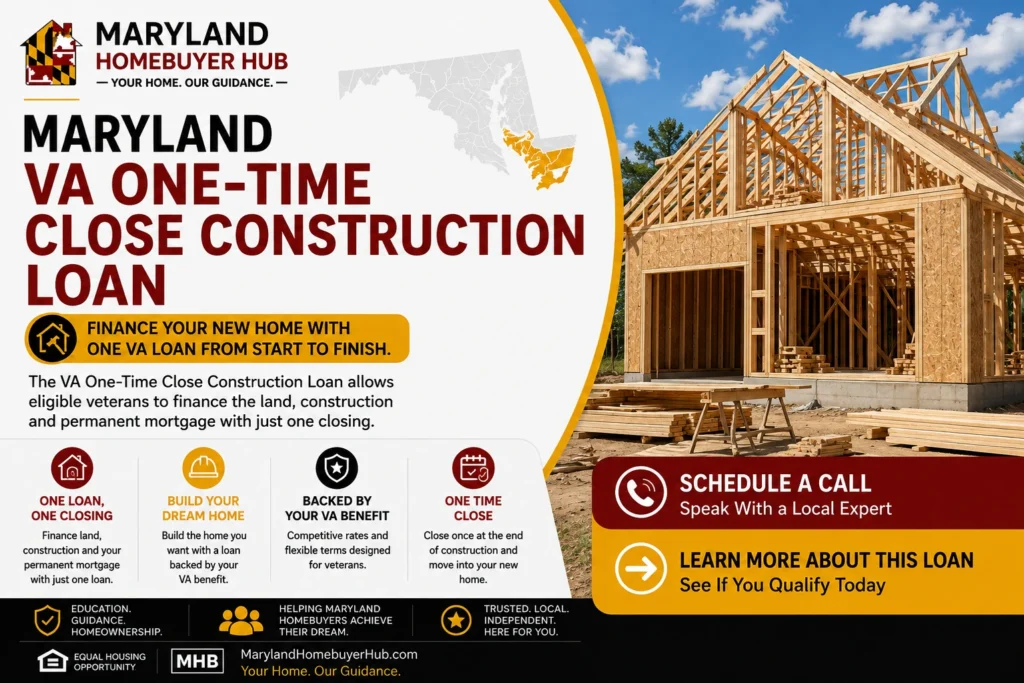
A VA One-Time Close Construction Loan combines the land, the construction, and your permanent 30-year VA mortgage into a single loan with one closing — and that closing happens before the first shovel goes in the ground.
You qualify once. You sign once. You pay one set of closing costs. Your interest rate is set at that closing, not a year later. When the home is finished and the county or municipality issues the Certificate of Occupancy, the loan converts into your permanent VA mortgage automatically — with no requalification.
With full VA entitlement it is $0 down, with no monthly mortgage insurance and no VA loan limit.
You will also see it called a VA construction-to-permanent loan, a VA single-close construction loan, or simply VA OTC. Same product.
The name describes the mechanics accurately: the loan begins life as construction financing and ends life as a permanent mortgage, without you having to do anything to make the switch happen.
Nearly everything that makes a standard VA purchase loan attractive carries over — no down payment, no monthly mortgage insurance, VA’s residual income underwriting, and the funding fee exemption for veterans receiving compensation for a service-connected disability. What changes is that you are financing a house that does not exist yet, and that adds a layer of requirements around the builder, the plans, the budget and the appraisal.
Can you buy land and build with a VA loan?
Yes. This is the question most veterans arrive with, and the answer is more generous than most expect.
A VA One-Time Close Construction Loan finances both the land purchase and the cost of construction in a single loan. You do not need a separate lot loan, you do not need to bring cash for the land, and you do not need to own the ground before you start.
If you already own the land, that works too. Its value is treated as equity toward the overall project rather than as something you need to buy again.
The three pieces, in one transaction
- Land — purchased at closing, or paid off, or credited as equity if you already own it
- Construction — released to your licensed builder in draws as verified work is completed
- Permanent mortgage — the 30-year fixed VA loan the whole thing becomes at completion
Financed separately, those are two or three transactions and two or three sets of closing costs. Here they are one.
What this does not cover is buying a lot now with no intention of building for several years. That is a land loan, a different product with different terms. A VA One-Time Close is for a project that is ready to go: plans, builder, budget and a construction start.
Why “one-time close” is the whole point
It sounds like a paperwork convenience. It is really a risk feature, and that is the part worth understanding before you compare offers.
In the traditional arrangement you take a short-term construction loan, build the house, and then get a separate permanent mortgage to pay off the construction loan. Two loans, two applications, two underwriting reviews, two closings, two sets of costs — and, critically, two qualification events.
The risk almost nobody thinks about until it happens
With two separate loans, you have to qualify all over again after the house is built — typically nine to twelve months later.
If your income changed, if you separated from service, if you switched employers, if your credit moved, if rates rose, or if guidelines tightened in the meantime, you may not qualify for the permanent loan. The house is finished. The construction loan is coming due. And you are re-applying from a weaker position than the one you started in.
A VA One-Time Close removes that scenario. You are already approved. Nothing about the build depends on you qualifying a second time.
The second structural advantage is rate certainty. Your permanent rate is established at that single closing, before construction begins, rather than being whatever the market happens to offer you a year later. Some construction programs also allow a one-time float-down if rates fall meaningfully before completion — that is a lender feature rather than a VA rule, so ask specifically whether it is available and what it costs.
How much can you finance?
With full VA entitlement, up to 100% of the reasonable value of the completed project — land, construction costs, and closing costs — provided the appraised as-completed value supports the total.
What “100%” actually means here
It means 100% of appraised value, not 100% of whatever the project costs. Those are usually the same number. When they are not, the appraisal wins.
If the land and construction total $640,000 and the as-completed appraisal comes in at $640,000 or above, no down payment is required. If the appraisal comes in at $610,000, the $30,000 gap is yours to cover in cash or to design out of the project.
That is the single most important number in a construction file, and it is the reason the appraisal section below matters more on this page than it would on an ordinary purchase.
If you already own the land
Land you already own is an asset in the transaction, not an expense. Its appraised value counts toward your equity position in the completed project.
That has a useful side effect: because the VA funding fee steps down at 5% and 10% equity, a lot you have owned for years can push you into a lower funding fee bracket — or, if you are exempt from the fee entirely, simply reduce the amount you need to finance. See the funding fee section for how the tiers work.
Maryland loan limits — and when they actually apply
Here is the part that trips people up: if you have full VA entitlement, there is no VA loan limit. None. You can build a $1.4 million home with $0 down if you qualify for the payment and the appraisal supports the value.
County loan limits only come into play if your entitlement is reduced — typically because you have an existing VA loan you have not paid off, because you sold a home with a VA loan without restoring entitlement, or because of a prior VA loan default. In those cases the county conforming loan limit sets the ceiling on the guaranty calculation, and a down payment may be required above it.
| Maryland jurisdiction | 2026 one-unit limit |
|---|---|
| Charles, Frederick, Montgomery and Prince George’s counties | $1,249,125 |
| Calvert County | $1,209,750 |
| All other Maryland counties and Baltimore City | $832,750 |
Nineteen of Maryland’s twenty-four jurisdictions sit at the national baseline. The five that do not are the Washington-metro counties, where the higher limit reflects local home values. Building in Frederick County and building in Washington County are, from a loan-limit standpoint, materially different propositions — but only for a veteran with partial entitlement.
Check your entitlement before you assume the limit applies to you
Most veterans building a home have full entitlement, in which case the table above is irrelevant to them. It takes one Certificate of Eligibility to know which situation you are in, and that is worth establishing early — it changes the maximum project size by hundreds of thousands of dollars.
How the appraisal works before the house exists
A VA appraiser values the proposed completed home using your plans, your specifications and your cost breakdown, compared against recently completed similar homes in the area. This is an “as-completed” or proposed-construction appraisal, and it is a different exercise from valuing a house someone can walk through.
Three practical consequences follow from that:
- Detailed plans matter. The appraiser can only value what is documented. Vague specifications produce conservative values.
- Comparable sales govern. If nothing remotely like your house has sold nearby, the appraiser has a harder job and the value is harder to support. This is the real constraint on unusual builds.
- Proposed-construction appraisals take longer. Build the extra time into your schedule rather than discovering it.
The completed home must also meet VA’s Minimum Property Requirements when it is finished — safe, structurally sound, sanitary, with proper utilities and a permanent foundation. On new construction that is rarely a problem, because the same code inspections that produce your Certificate of Occupancy generally cover the same ground.
Credit, debt-to-income and qualifying
VA itself does not publish a minimum credit score. Lenders do, and for construction lending they are stricter than for a standard purchase, because a construction loan carries risk for a year before it becomes an ordinary mortgage.
| Item | VA One-Time Close |
|---|---|
| Loan type | 30-year fixed rate |
| Down payment | 0% with full entitlement |
| Maximum financing | Up to 100% of reasonable value |
| Minimum credit score | Typically 620; lower is possible with compensating factors |
| Debt-to-income | No fixed VA cap — residual income governs |
| Loan limits | None with full entitlement |
| Mortgage insurance | None |
| Construction period | Commonly up to 12 months; extensions may be possible |
| Prepayment penalty | None |
| Occupancy | Primary residence; 1–4 units if you occupy one |
| Land | Purchase at closing or build on land you already own |
620 is the practical working minimum for VA construction financing, and scores below it can still work where the rest of the file is strong — long stable employment, meaningful reserves, a clean recent payment history, low debt. Some national lenders set the bar at 640 or 660 for construction. That is a lender decision rather than a VA rule, and it varies enough between lenders to be worth shopping.
Debt-to-income is where VA differs most from every other loan program. There is no hard VA ceiling. 41% is the benchmark in VA’s underwriting standards, and a ratio above it does not disqualify you — it triggers a requirement that the lender document its justification in writing. Ratios of 50% and above are approved routinely when residual income is strong, which brings us to the number that actually decides these files.
Residual income: the real approval gate
VA uses a two-part test: debt-to-income ratio and residual income. Most loan programs use only the first. Residual income is the money left over each month after the full housing payment, estimated maintenance and utilities, taxes, and all major debts have been paid.
It is the most misunderstood number in VA lending, and on a construction loan it is the one most likely to determine how much house you can actually build.
On a construction loan, residual income is modelled on the finished house
Your underwriter does not calculate residual income against construction draws. They calculate it against the estimated permanent mortgage payment — what you will owe every month once the home is complete and you have moved in.
This is why the build budget and the qualification are the same conversation. A bigger house is a bigger permanent payment, and the permanent payment is what has to clear the residual income threshold.
Maryland is in VA’s South region. The thresholds below apply to loan amounts of $80,000 and above, which covers essentially every Maryland construction project.
| Family size | Monthly residual income required |
|---|---|
| 1 | $441 |
| 2 | $738 |
| 3 | $889 |
| 4 | $1,003 |
| 5 | $1,039 |
| More than 5 | Add $80 per additional member, up to a family of seven |
Two refinements matter and are routinely missed.
- The 20% rule works in your favour. If your debt-to-income ratio is above 41% and your residual income exceeds the guideline by at least 20%, VA’s standards do not require the second-level review and written justification that a high ratio would otherwise trigger. Strong residual income is what makes a high DTI routine rather than difficult.
- Active-duty and military-retiree files get a reduction. Where there is clear indication that the borrower or spouse will continue to receive the benefits of using facilities on a nearby military base, the residual income figure is reduced by at least 5%. In Maryland that is a live consideration for families building near Fort Meade, Aberdeen Proving Ground, Joint Base Andrews, Naval Air Station Patuxent River, Naval Support Activity Bethesda, Indian Head or the Naval Academy.
This is why two veterans with identical credit scores can get very different answers. Run your residual income numbers before you settle on a build budget — knowing the ceiling early prevents an expensive redesign later.
How construction funds are released
After closing, the construction money is held in a construction escrow. It is not handed to you, and you do not pay the builder directly. Funds are released in stages as verified work is completed — a structure that exists specifically to protect you.
The mechanics of requesting draws, scheduling inspections and handling contingency reserves and change orders are common to every construction program and are covered in our Maryland construction loans guide.
Draws are tied to construction milestones. A typical schedule runs:
- Foundation — footers, foundation walls, slab
- Framing — structure, roof deck, windows and exterior doors
- Rough mechanicals — plumbing, electrical and HVAC rough-in, inspected
- Drywall and interior — insulation, drywall, interior finish work
- Final completion — released after final inspection and the Certificate of Occupancy
You sign off on every draw
Before each draw is released, the lender is required to obtain your written approval. You are not a passive bystander in your own build — a builder cannot be paid for work you have not agreed is finished.
Use it. Walk the site before you sign. The draw approval is the one real point of leverage a homeowner has during construction, and the veterans who treat it as a formality are the ones who discover problems late.
An inspection confirms the work before each release, which also means a builder cannot be paid in full for work that has not been done. It is the single biggest structural protection in construction lending.
Do you make mortgage payments while the home is being built?
No. On a VA One-Time Close you do not make mortgage payments during construction. Payments begin once the home is complete and the Certificate of Occupancy has been issued.
That matters enormously in practice, because most people building a house are already paying rent or a mortgage somewhere else. Carrying both for a year is what puts conventional construction financing out of reach for a lot of families.
How the interest reserve works
Interest still accrues during construction — the money is out the door and working. It is handled through an interest reserve, typically built into the construction contract and financed into the total loan amount. The reserve pays the construction-period interest so you do not have to.
What happens if the build runs long
The interest reserve is sized for the approved construction timeline. If the project runs significantly past it, the reserve can be depleted, and the remaining interest can become your responsibility.
This is the most concrete financial reason to care about your builder’s record for finishing on schedule — not just their reputation for quality. A builder who is six months late costs you real money, not just patience.
Most projects run six to twelve months, depending on weather, materials, permitting and builder capacity. The construction period is commonly approved for up to twelve months, and extensions may be possible — but an extension is a request, not an entitlement.
Contingency reserves and cost overruns
A construction budget should carry a contingency reserve for the things that surface once work is underway: material price movement, weather delays, change orders, and site conditions nobody knew about until the excavator arrived. Lenders commonly require one — often in the range of 5–10% of construction cost — and the exact percentage varies by lender and by project scope.
If the project goes over budget, the contingency absorbs the first overruns. Beyond that the options are the familiar ones: contribute additional funds, or reduce the scope to bring the project back inside the approved budget.
Change orders are not free
Any change to the scope after closing requires lender approval before additional draws are released. Approving a change order takes time, and time is the resource your interest reserve is denominated in.
Decide on your finishes, your fixtures and your floor plan before closing. The cheapest change order is the one you never submit.
Builder requirements — and why you cannot build it yourself
The builder is underwritten alongside you. On a construction loan the lender is effectively financing two parties: the borrower who will repay the loan, and the contractor who has to deliver the asset securing it.
Three separate gates apply. VA sets the program framework, including the Minimum Property Requirements the finished home must meet and the one-year builder’s warranty; as of March 2025 a VA-issued builder identification number is no longer needed to issue the Notice of Value or process the loan. Your lender still underwrites that specific builder’s experience, finances, insurance and references before agreeing to release draws to them, and this is where builder problems usually surface. Maryland separately requires home builders doing business in the state to be registered, which is consumer-protection law rather than a lending rule — our Maryland construction loans guide explains how to verify it before you sign.
- Licensed and insured — and in Maryland that means properly licensed for the work and for the jurisdiction
- Experienced — with a track record of comparable completed projects
- A one-year builder’s warranty on the completed home
- Plans that comply with state and local codes and with VA’s Minimum Property Requirements
- Able to work within the draw schedule and the approved construction timeline
Builders no longer need to be separately registered with VA in order to build on a VA construction loan, but your lender will still vet yours — licensing, insurance, financial standing, references and completed-project history. A builder who has never done a construction-loan project before is not disqualified, but expect the review to take longer.
You cannot be your own builder
Owner-builder and self-build arrangements are not eligible on a One-Time Close construction loan. You must contract with an experienced third-party builder.
This holds even if you are a licensed contractor yourself. A Maryland builder who wants to build their own home on this financing has to contract with a separate licensed builder.
The construction contract must be fixed-price
VA construction financing requires a fixed-price or fixed-cost construction contract. Cost-plus contracts are not eligible.
Everything needed to reach a Certificate of Occupancy — all labour, all materials, all permits, all site work — has to be inside the contract price before you close. This protects you and the lender from open-ended cost exposure during the build, and it is why your scope needs to be settled early rather than evolving on site.
It also means a contract that omits the driveway, the well, the septic system or the final grading is not a complete contract. Those omissions are the most common reason a construction budget that looked fine at signing runs out of money in month eight.
What you can build
The governing question is almost never “does VA allow this shape of house.” It is “can an appraiser find comparable sales to support the value.” Once you understand that, the eligibility list below stops looking arbitrary.
If a manufactured home is what you are actually considering rather than a stick-built or modular house, that is a different transaction with its own rules — see our Maryland VA manufactured home loan guide.
| Type | Status | What decides it |
|---|---|---|
| Detached site-built (stick-built) | Eligible | The standard path; comparable sales are readily available |
| Modular and hybrid modular | Eligible | Built to code, permanently affixed, appraised as real property |
| Manufactured homes | Eligible | Must meet HUD/VA standards and sit on a permanent foundation |
| Log homes | Eligible | Only where the appraiser can find comparable sales |
| Barndominiums | Eligible | Only where the appraiser can find comparable sales |
| 2–4 unit owner-occupied | Eligible | Additional requirements apply — see below |
| Container homes and tiny homes | Not eligible | No comparable market; not financeable on this program |
| Pre-starts | Not eligible | Permanent structural work already begun before closing |
| Vacation homes and investment property | Not eligible | Primary residence occupancy is required |
| Mixed-use and commercial | Not eligible | Residential financing only |
| Lots above roughly 10 acres | Generally not eligible | Valuation and marketability; acreage-heavy parcels are hard to comp |
“Pre-starts” catch more Maryland projects than you would expect
If permanent structural work — footers, foundation, slab — has already begun before your loan closes, the project is a pre-start and is not eligible for One-Time Close financing.
This is a genuine trap. A builder eager to get ahead of a Maryland winter, or a lot where a previous owner poured a foundation and walked away, can disqualify a project before you have even applied. Confirm with your lender before anyone breaks ground.
The acreage guideline deserves a note for Maryland specifically. Ten acres is a practical valuation boundary rather than a bright statutory line, and it matters most in Garrett, Allegany, Washington, Frederick and Carroll counties and on the rural Eastern Shore, where larger parcels are common. If the land is a large share of the total value, expect closer scrutiny — and ask the question before you go under contract on the lot.
Building a 2–4 unit property
Yes, you can build a two-, three- or four-unit property with VA construction financing, provided you occupy one of the units as your primary residence. The other units can be rented.
It is a genuinely powerful option — and it comes with a distinctly higher bar:
- 660+ credit score — higher than the single-family minimum
- Six months of reserves required on a 2–4 unit VA loan
- You cannot qualify solely on projected rent from the other units
- No prior rental experience? VA requires you to hire a property management company
- The land must be zoned for multi-unit density — confirm this before you buy it
- The builder must have genuine multi-unit construction experience
The zoning point is the one that kills Maryland projects. Multi-unit density is not available on most residential lots in most Maryland jurisdictions, and rezoning is not a process you want sitting inside a construction loan timeline. Verify the zoning classification with the county or municipal planning office before the lot is under contract, not after.
The VA funding fee on a construction loan
The standard VA funding fee applies to construction loans on the same terms as purchase loans, and it can be financed into the loan amount rather than paid in cash.
One detail is easy to miss and can be worth real money. Under long-standing VA guidance, land you already owned before construction can count as a down payment for the purpose of reducing the funding fee. The fee tiers step down as the down payment rises, so a lot owned outright — or bought with cash — can move you into a lower tier even though you are not writing a check at closing. Ask your lender to price the fee both ways before you assume the standard first-use rate applies.
| Equity in the project | First use | Subsequent use |
|---|---|---|
| Less than 5% | 2.15% | 3.30% |
| 5% or more | 1.50% | 1.50% |
| 10% or more | 1.25% | 1.25% |
This is where owned land pays off twice. If your lot represents 10% or more of the completed value, the fee drops from 2.15% to 1.25% — on a $700,000 project, a difference of $6,300.
Many veterans pay no funding fee at all
You are exempt if you are receiving VA compensation for a service-connected disability, if you are eligible for compensation but receive retirement or active-duty pay instead, if you are a surviving spouse receiving Dependency and Indemnity Compensation, if you have a pre-discharge proposed or memorandum rating, or if you are an active-duty member who provided evidence of a Purple Heart before closing.
Exempt veterans get the full benefit stacked: no down payment, no monthly mortgage insurance, and no funding fee.
There is no monthly mortgage insurance on a VA loan at any point — not during construction, not after conversion.
Your rate, and what happens when the house is finished
Your interest rate is established at the single closing, before construction begins. That is the point of the structure: you are not exposed to a year of rate movement while your house goes up.
When construction is complete and the Certificate of Occupancy is issued, the loan converts to a permanent 30-year fixed VA mortgage. Three things do not happen at that point, and they are the three that cause the most anxiety:
- No requalification. No new credit pull deciding your fate, no new income review, no new approval.
- No second closing. No second set of closing costs, no second title policy, no second signing appointment.
- No new rate. The rate you locked is the rate you keep.
Your first mortgage payment comes due after completion. Exactly when depends on the closing calendar and how your lender structures the conversion, so confirm the date rather than assuming it.
Before you buy the lot — the VA angle
Land is the hardest part of a build to undo, and buyers commonly buy it first and arrange financing second. That order is where the risk lives.
The VA questions belong here: whether your entitlement supports the full project without a down payment, whether the completed home will appraise for what the build costs, whether your builder will satisfy both VA and your lender, and — if you already own the lot — what that equity does to your funding fee.
The site questions are answered locally and have nothing to do with VA: septic and percolation approval, water supply, permits, Chesapeake Bay Critical Area review near tidal water, and flood zone. Our Maryland construction loans guide walks through each and who to ask.
The order that protects you: confirm entitlement and budget, then put the lot under contract with contingencies for septic and permits, then commit.
Building in Maryland: what actually slows projects down
Maryland is not one construction market. Building in Garrett County and building in Montgomery County have almost nothing in common except the state code, and the difference shows up in your timeline long before it shows up in your budget.
Those checks — septic and perc approval, water supply, permits, Critical Area review and flood zone — apply to every build regardless of program, and a VA approval does not make a lot buildable. Our Maryland construction loans guide covers each one, who issues it and what to confirm before you go under contract.
Permitting is local, and the variation is real
Building permits are issued by the county — or, inside an incorporated municipality, by the town or city. Review times vary substantially across Maryland’s twenty-four jurisdictions, and a project inside a municipality may need both municipal and county approvals for different elements. Nobody can quote you a single Maryland permit timeline; you have to ask the specific jurisdiction.
Well and septic
Outside public water and sewer service areas, you need a well permit and a septic permit, and the septic permit depends on a passing percolation test. These are issued through county health departments and they gate everything — you cannot build a house you cannot get water into or waste out of. On a raw lot, secure these before you close on the land if you possibly can.
The Chesapeake Bay Critical Area
Maryland’s Chesapeake Bay Critical Area Act covers all land and water within 1,000 feet of tidal waters or tidal wetlands. It was enacted in 1984 and extended to the Atlantic Coastal Bays in 2002. Local jurisdictions administer their own Critical Area programs consistent with state standards.
Why this matters to a construction loan
Critical Area rules constrain impervious surface, clearing and buffer areas, and they add a layer of local review. A waterfront or near-water lot in Anne Arundel, Talbot, Queen Anne’s, Dorchester, Somerset, Worcester, St. Mary’s, Calvert or Charles County may be perfectly buildable — but on a footprint smaller than you assumed, and on a timeline longer than you planned.
Your construction loan is sized to a fixed contract and a fixed timeline. Discovering a Critical Area constraint after closing is the kind of surprise that consumes both.
Where the lots are
Buildable lot availability skews away from the Washington and Baltimore cores. Veterans building in Frederick, Carroll, Cecil, Harford, Washington, Garrett and Allegany counties, in Southern Maryland, and on the Eastern Shore generally find more options and shorter approval processes than those trying to build inside the DC suburbs, where zoning complexity and lot scarcity both work against a build. That is a generalisation rather than a rule — but it holds often enough to shape where people look.
One-time close vs two-time close vs conventional construction
| Feature | VA One-Time Close | Two-Time Close | Conventional construction |
|---|---|---|---|
| Closings | 1 | 2 | 2 |
| Requalification after the build | No | Yes | Yes |
| Down payment | 0% with full entitlement | 0–5%, varies | 5–20% |
| Rate established | Before construction | Often after construction | Often after construction |
| Mortgage insurance | None | None on the VA portion | Yes, where applicable |
| Payments during the build | None | Varies | Usually interest-only |
| Who can use it | Veterans and other VA-eligible borrowers | Veterans and other VA-eligible borrowers | Any qualified borrower |
The honest trade-off sits in the rows about closings and rate. A two-time close lets you shop the permanent mortgage once the house is finished, and if rates fall over your build that flexibility has real value. It also means you carry the requalification risk and a second set of closing costs. Which matters more depends on how stable your income and credit are, and on your appetite for uncertainty across a build cycle.
What happens if the build stalls or cannot be finished
Buyers ask this and deserve a straight answer: VA guidance does not set out a single prescribed outcome for an incomplete build. What happens is handled between you, your lender and your builder under the construction contract and the loan documents, which is why the paperwork you sign at the start matters more here than on a purchase.
What is worth understanding in advance: the loan closed before construction started, so you are the borrower on a mortgage secured by a property that is not finished. Funds are released against completed work rather than in advance, which limits how far ahead of the work the money can get. Any money left in the construction escrow when a project ends early is not yours to keep — it goes back against the loan. A builder who cannot finish generally has to be replaced, with your lender approving the replacement, and the cost of that sits inside your budget.
The practical protections are all upstream: a builder your lender has genuinely underwritten, a contract with a defined scope and completion date, a realistic contingency, and a completion window you have not already consumed before problems appear. Those are covered in our Maryland construction loans guide, which is worth reading before you sign a builder contract rather than after.
How VA construction compares with FHA, USDA and VA renovation
Four different products get confused with each other constantly. They are not variations on a theme — they have different appraisals, different contractor rules and different draw mechanics, and choosing wrong costs weeks.
Each has its own Maryland guide: FHA One-Time Close, USDA One-Time Close and Conventional One-Time Close. Maryland construction loans compares all four side by side.
- VA One-Time Close — ground-up new construction for eligible veterans. $0 down with full entitlement, no mortgage insurance, no loan limit. The strongest construction option available to anyone who qualifies for it.
- FHA One-Time Close — ground-up new construction, open to non-veterans. Requires a 3.5% minimum investment, carries mortgage insurance, and is capped by the FHA limit for the county.
- USDA One-Time Close — ground-up construction with no down payment, but only in USDA-eligible rural areas and only within household income limits. Much of rural Maryland qualifies geographically.
- VA renovation financing — for a house that already exists. You are buying or refinancing a standing home and financing repairs to it, not putting a new home on a lot.
The line that decides which one you need
Is there a house on the lot?
If yes and you are improving it, that is renovation financing. If no and you are building one, that is construction financing. Everything else — which agency, which limit, which down payment — follows from that one answer.
If you are eligible for VA, the VA route is almost always the strongest of the construction options. The exception worth naming: VA construction lending is offered by fewer lenders than FHA or conventional construction, so availability rather than eligibility is sometimes the binding constraint.
Compare this option with other Maryland construction loan programs.
Find out what you could build with your VA benefit
Entitlement status, residual income and the as-completed value decide the size of the project. All three are quick to establish, and knowing them changes how you shop for a lot.
This is not a commitment to lend. All loans subject to credit approval.
Availability, and what this loan does not include
We currently offer VA One-Time Close construction financing. VA permitting the structure and a lender originating it are different things: construction-to-permanent lending adds builder review, draw administration and inspection oversight that standard VA purchase lending does not, so participation is narrower. If you are comparing lenders, ask whether they originate VA construction-to-permanent loans specifically rather than whether they “do VA.”
Our current construction loan options do not include down payment assistance. Assistance programs are generally written around purchase transactions, and the Maryland Mortgage Program does not publish a construction-to-permanent product. That is what we offer today, not a statement about every lender. On a VA build it rarely matters: with full entitlement there is no down payment to assist with, and if you need assistance for a completed home purchase instead, our Maryland down payment assistance guide covers those options.
If you are weighing whether this structure fits your entitlement and your project, start here or schedule a call before you commit to a lot or sign a builder contract.
When VA construction financing makes sense
It is a strong fit when:
- You have VA eligibility and full entitlement, and want to build rather than buy
- You cannot find the house you want in the Maryland market you want to live in
- You already own land, or have found a lot you can build on
- You want $0 down on a new home with no mortgage insurance
- You want your rate fixed before construction rather than a year later
- You cannot afford to pay rent and a construction loan payment simultaneously
- You have a builder in mind who is licensed, experienced and willing to work on a draw schedule
- Your project needs to exceed conforming loan limits — full entitlement means no VA cap
It is a weaker fit when:
- You want to act as your own general contractor
- You are buying a lot now and building in several years — that is a land loan
- The home will not be your primary residence
- You want an unusual structure that appraisers cannot find comparable sales for
- Construction has already started on the site
- You want the freedom to shop the permanent mortgage after the build finishes
- You are improving a house that already exists — that is renovation financing
The process, from pre-approval to move-in
- Certificate of Eligibility and pre-approval. Confirm VA eligibility and entitlement status, and get pre-approved by a lender that actually does VA construction lending. This comes first — before land, before plans, before a builder deposit.
- Lot and builder. Select the lot, or confirm the equity in one you own, and identify a licensed, insured, experienced builder. Confirm zoning, water and sewer, and any overlay review before you commit.
- Plans, specifications and a fixed-price contract. The builder produces detailed plans, a materials specification and a complete cost breakdown through Certificate of Occupancy. These drive both the appraisal and underwriting.
- Appraisal. A VA appraiser values the proposed completed home against comparable finished properties. Allow more time than a standard purchase appraisal.
- Underwriting. You and the project are reviewed together — credit, income, residual income, the builder package and the budget. Both have to work.
- One closing, before construction. Land, construction and permanent financing close together. Construction funds go into escrow and your rate is set.
- Construction and draws. Funds release to the builder at verified milestones. You approve each draw in writing. Walk the site before you sign.
- Final inspection and Certificate of Occupancy. The local jurisdiction confirms the home is complete and fit to occupy.
- Automatic conversion. The loan becomes your permanent 30-year VA mortgage. No requalification, no second closing, no new rate. Move in.
Common mistakes
- Buying the lot before getting qualified. The most expensive mistake on this page, and the most common.
- Letting the builder break ground before closing. It creates a pre-start and can disqualify the project outright.
- Budgeting the house and forgetting the site. Well, septic, grading, driveway, utility runs and stormwater are real money on a raw Maryland lot.
- Accepting a cost-plus or incomplete contract. The contract has to be fixed-price and complete through Certificate of Occupancy.
- Assuming a loan limit applies. With full entitlement there is no VA loan limit — some veterans build smaller than they needed to.
- Ignoring residual income until underwriting. It is the real ceiling on project size, and it is knowable on day one.
- Choosing a builder on price alone. A late builder depletes your interest reserve, and that cost lands on you.
- Designing something that cannot be appraised. If nothing comparable has sold nearby, value support is the problem, not eligibility.
- Planning to make change orders as you go. Every one needs lender approval and burns time your reserve is paying for.
- Assuming your lender offers it. Many VA lenders do not do construction. Confirm before you invest months.
Frequently asked questions
What credit score do I need?
VA does not set a minimum. 620 is the practical working minimum for construction lending, and lower scores can work with compensating factors. Some lenders require 640 or 660 for construction, so it is worth asking each one directly.
Is there a maximum debt-to-income ratio?
There is no fixed VA cap. 41% is the benchmark, and higher ratios are approved regularly when residual income is strong. Residual income, not DTI, is usually what decides a VA file.
Can I act as my own builder?
No. Owner-builder and self-build arrangements are not eligible on a One-Time Close construction loan, even if you are a licensed contractor. You must contract with an experienced third-party builder.
Does my builder need to be registered with VA?
Builders no longer need separate VA registration to build on a VA construction loan. Your lender will still review the builder’s licensing, insurance, financial standing and completed-project history before approving them.
Are manufactured or modular homes eligible?
Yes, where they are built to HUD and VA standards, placed on a permanent foundation, and approved by the lender. Modular and hybrid modular construction is treated much like site-built once permanently affixed.
Can I build a barndominium or a log home?
Both are eligible in principle. The deciding factor is whether the appraiser can find comparable sales to support the value. In parts of rural Maryland that is achievable; in others it is not, and it is a question to ask before you commission plans.
Can I build a 2–4 unit property?
Yes, if you occupy one unit as your primary residence. Additional requirements apply: a 660+ credit score, six months of reserves, land zoned for multi-unit density, a builder experienced in multi-unit construction, and — if you have no prior rental experience — a property management company. You cannot qualify on projected rents alone.
How long does construction take?
Most projects run six to twelve months depending on weather, materials, permitting and builder capacity. The construction period is commonly approved for up to twelve months, and extensions may be possible.
What happens if the project goes over budget?
The contingency reserve absorbs the first overruns — lenders commonly require one in the range of 5–10%. Beyond that you either contribute additional funds or reduce the scope. Change orders need lender approval before further draws are released.
What happens if my builder finishes late?
The interest reserve is sized to the approved timeline. A significant overrun can deplete it, and the remaining construction-period interest can become your responsibility. This is why a builder’s record for finishing on schedule is a financial question, not just a convenience one.
Do I have to requalify when the home is finished?
No. That is the central advantage of the structure. The loan converts to your permanent VA mortgage automatically at completion — no second underwriting review, no second closing, no new rate.
Is there mortgage insurance?
No. VA loans carry no monthly mortgage insurance at any stage — not during construction and not after conversion.
Can I build on a lot larger than 10 acres?
Generally not on this program. Large-acreage parcels are difficult to appraise and to market, and lenders typically treat roughly 10 acres as the practical boundary. If your Maryland lot is larger, raise it with your lender before going under contract.
What if construction has already started on my lot?
If permanent structural work such as footers, a foundation or a slab has begun before closing, the project is a pre-start and is not eligible. Nothing should break ground until your loan has closed.
Does it have to be my primary residence?
Yes. VA construction financing is for a home you will occupy. Vacation homes and investment builds are not eligible. Provisions exist for veterans called to active duty, deployed, or otherwise required to be away.
How is this different from a VA renovation loan?
A One-Time Close builds a new home from the ground up. VA renovation financing improves a house that already exists. If there is a standing structure on the lot and you are repairing or remodelling it, that is renovation financing rather than construction financing.
Sources
- VA Lenders Handbook, VA Pamphlet 26-7 — the current guidance for construction and construction-to-permanent loans, including the structure in which the loan closes before construction begins and proceeds cover the cost to build, the cost of the land or the balance owed on it, with the remainder held in escrow.
- VA Circular 26-25-1 (March 31, 2025), Elimination of Builder Identification Number for Certain Guaranteed Loans — a VA-issued builder identification number is no longer necessary to issue the Notice of Value or process a loan on a new or proposed construction property.
- VA Circular 26-18-7 (rescinded April 1, 2021, its content folded into the Lenders Handbook) — the source of the long-standing rule that land already owned by the borrower before construction may count as a down payment for the purpose of reducing the funding fee.
- 38 CFR § 36.4340 — subsection (e) for the residual income tables and the geographic region that applies to Maryland, and subsection (c) for the 41% debt-to-income benchmark and the treatment of ratios above it.
- VA funding fee schedule, effective April 7, 2023 — the fee tiers, the effect of a down payment, and the exemptions.
- FHFA conforming loan limits for calendar year 2026 — the county values referenced where entitlement is not full.
- Maryland Critical Area Commission — the Chesapeake Bay and Atlantic Coastal Bays Critical Area, the 1,000-foot area, the 100-foot Buffer and implementation through local programs.
VA and agency sources verified August 24, 2026 and re-verified September 2, 2026. Credit score minimums, debt-to-income practice, contingency requirements and extended rate locks are lender decisions rather than VA rules, and are described here as such.
This page explains how VA One-Time Close construction financing generally works for Maryland veterans and service members. It does not determine individual eligibility, is not a commitment to lend, and is not a Loan Estimate. Any figures shown are arithmetic illustrations, not quotes, and no interest rate is offered or implied. Program terms are set by the U.S. Department of Veterans Affairs, and participating lenders may apply additional requirements that differ from lender to lender. Maryland Homebuyer Hub is not affiliated with, endorsed by, or acting on behalf of the U.S. Department of Veterans Affairs or any government agency.