
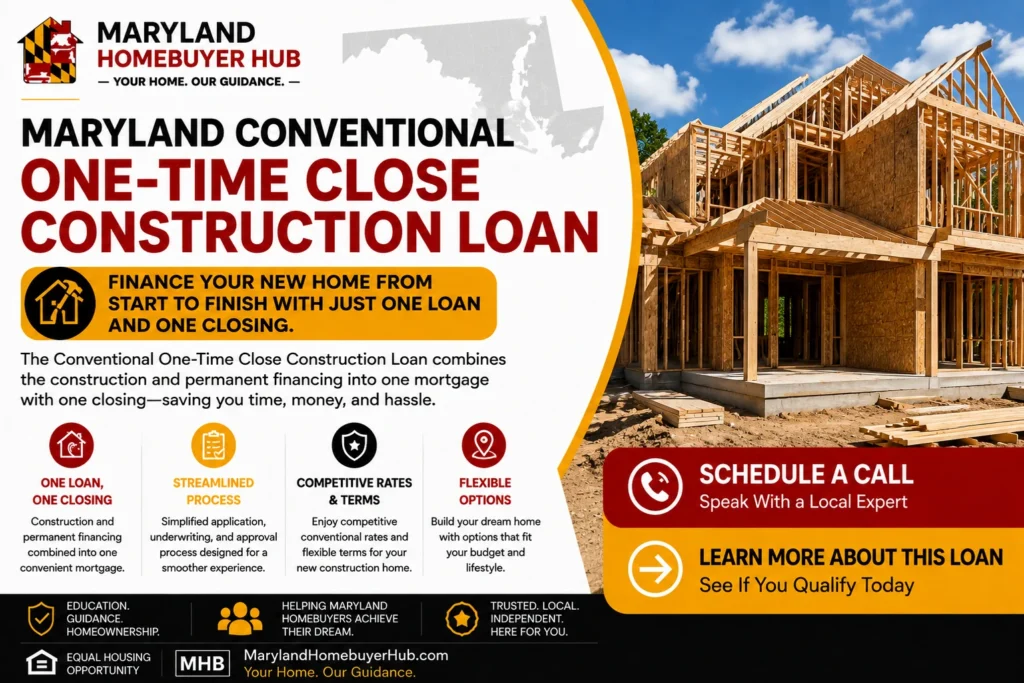
How one loan finances your land, your build and your mortgage
Close once, before the first shovel goes in the ground
A Conventional One-Time Close Construction Loan — also called a conventional single-close or construction-to-permanent loan — combines the lot, the construction and your permanent conventional mortgage into one loan with one closing.
You sign your closing documents before construction begins. When the home is finished and the certificate of occupancy is issued, the permanent mortgage is already in place. There is no second closing and no second loan application.
On this product you make no monthly mortgage payments during construction — the construction-phase interest is carried inside the build cost rather than billed to you month to month.
It follows Fannie Mae conventional guidelines rather than a government program, so it suits buyers with conventional-qualifying credit who want a conforming loan and mortgage insurance that can eventually come off.
The alternative most lenders offer is a two-time close: a short-term construction loan first, then a separate permanent mortgage you have to close — and requalify for — once the house is built. The one-time close collapses that into a single transaction, and that single difference drives most of what follows on this page.
You will also see it written as a Conventional One Time Close Construction Loan without hyphens, or simply as conventional OTC. Same product.
Where the rules on this page come from
Construction lending is layered, and knowing which layer a rule sits in tells you whether it is negotiable:
- Fannie Mae requirements — the construction-to-permanent framework itself: the 12- and 18-month limits, how loan-to-value is calculated, the completion report, and the certificate of occupancy.
- Product and investor requirements — the operating rules of this particular one-time close product: the credit floor, the minimum investment, which property types are offered, builder approval, and the owner-builder restriction.
- Construction administration — how draws, inspections and rate protection are handled in practice, which varies between lenders.
Where something sits in the second or third category, this page says so rather than presenting it as a federal rule.
One-time close vs two-time close
This is the comparison that matters most, and it is worth understanding before you talk to any lender about building.
| Feature | One-time close | Two-time close |
|---|---|---|
| Number of closings | One | Two |
| Sets of closing costs | Paid once | Paid twice |
| Permanent financing | Established at the original closing | Arranged separately after the build |
| Permanent rate | Capped before construction begins | Whatever the market offers at completion |
| Requalification after the build | Not required; employment is re-verified | Required — a new approval |
| Risk if your job or credit changes mid-build | Lower — the loan is already closed | Higher — you must qualify again |
| Appraisals | One | Often two |
| Payments during construction | None on this product | Typically interest payments |
| Conversion at completion | Automatic, with no second closing | A separate mortgage transaction |
The risk most first-time builders never price in
On a two-time close you have to qualify all over again after the house is built — typically nine to twelve months later.
If your income changed, if you switched employers, if your credit moved, if rates rose, or if guidelines tightened in the meantime, you may not qualify for the permanent loan. The house is finished, the construction loan is coming due, and you are re-applying from a weaker position.
A one-time close removes that scenario. You are already approved before anyone breaks ground.
How much down payment do you need?
The working minimum on this product is 5% down, to a maximum of 95% loan-to-value, for an eligible primary residence or second home.
How that percentage is measured depends on one question: do you already own the lot? Fannie Mae treats the two situations as different transaction types, and the calculation genuinely differs.
| Your situation | Transaction type | Loan-to-value is measured against |
|---|---|---|
| You are buying the lot as part of the deal | Purchase | The lesser of the construction cost plus the lot sales price, or the as-completed appraised value |
| You already own the lot | Limited cash-out refinance | The as-completed appraised value of the lot and improvements |
The classification turns on whether you own the lot before the first construction advance. That is not a technicality — it is the mechanism that makes existing land equity so valuable, which is the next section.
5% is the working figure, not a universal ceiling
The 5% minimum and 95% maximum describe this product. The maximum loan-to-value available in any specific scenario comes from Fannie Mae’s eligibility requirements for the applicable transaction type and occupancy, together with the automated underwriting decision on your file.
Closing costs can often be financed into the transaction where the numbers support it. Ask for your specific scenario to be run rather than working from a general figure.
How land equity can reduce the cash you need
This is the single most useful thing a Maryland lot owner can understand about building, and most do not know it going in.
There is an agency rule underneath this that changes the arithmetic. Under Fannie Mae’s single-closing guidance, if you hold legal title to the lot before the first construction advance, the transaction is treated as a limited cash-out refinance and the loan-to-value is measured against the “as completed” appraised value. If you do not yet own the lot, it is a purchase, and the loan-to-value is measured against the lesser of the as-completed appraised value or the sum of construction cost plus the lot’s sales price.
That distinction is why owning the land first can genuinely reduce what you bring to closing: appreciation in the lot, or a lot bought well below current value, counts toward the completed value rather than being capped by what you paid. It does not remove the requirement to qualify, and it does not help if the finished home does not appraise for what the project costs.
If you already own your lot, the transaction is treated as a limited cash-out refinance, and your loan-to-value is measured against the as-completed appraised value of the finished property — land and house together. The equity sitting in your land is already inside that value. It is doing work on the cash side of your transaction before you contribute a dollar.
A simple illustration
A buyer owns a Maryland lot free and clear. The builder’s contract to construct the home is $400,000.
The appraiser reviews the plans, the specifications and the lot, and sets the as-completed value at $520,000.
Because the borrower already owns the land, loan-to-value is measured against that $520,000 finished value. A loan of $400,000 against $520,000 is roughly 77% loan-to-value — comfortably inside the 95% ceiling, and below the 80% threshold where mortgage insurance would come into the picture.
In this illustration the land equity has covered the required investment entirely. This is an arithmetic illustration, not a quote, an approval, or a promise about your project.
That outcome is common for lot owners, but it is not automatic. It depends on the appraised as-completed value, the construction budget, any liens against the lot, the product requirements and full underwriting. A lot bought recently at market price, or one carrying a balance, produces very different maths from one owned outright for years in an appreciating area.
How different land situations are handled
- Buying the lot at closing. The land purchase is part of the transaction and the deal is a purchase; loan-to-value uses the lesser-of test above.
- Land you own outright. Its appraised contribution to the finished value works in your favour, often covering some or all of the required investment.
- Land you own with a balance owing. An existing lien on the lot is typically paid off through the transaction, which reduces the equity available to work with. Establish the payoff figure early.
- Land that was gifted to you. Gifted land can generally contribute in the same way as land you purchased, subject to documentation of the gift and the usual underwriting review.
Do not assume your land covers everything
“My lot is my down payment” is a reasonable starting hypothesis and a poor plan. Whether it covers all, some or none of your required investment is a scenario-by-scenario calculation driven by the appraisal and the build budget.
Have it run before you sign a builder contract. It is the number most likely to change what you can actually build, and it is far cheaper to establish now than to discover after you are committed.
Find out how much cash your build actually needs
If you already own a Maryland lot, the equity in it may cover more of the required investment than you expect — or less. Running your land value against the build budget takes one conversation.
This is not a commitment to lend. All loans subject to credit approval.
Credit, income and how underwriting works
The working minimum credit score on this product is 620. Below that, an FHA One-Time Close is usually the more realistic construction path.
That 620 is worth understanding for what it is. Fannie Mae’s construction-to-permanent sections do not impose a blanket credit score for this structure — conventional qualification runs through the automated underwriting decision and the eligibility requirements for your transaction type. The 620 floor comes from the product and its investors. It is a real number to plan around; it is simply not a federal rule.
Income and debt-to-income are evaluated by Desktop Underwriter rather than against a single published ceiling. That nuance matters on a construction file, because DU weighs the whole picture — credit depth, reserves, income stability, the loan-to-value and the occupancy — rather than testing one ratio in isolation. Two borrowers with the same score and the same ratio routinely get different answers.
There are no income limits
Unlike USDA financing, which restricts household income by county and household size, conventional construction financing has no income cap. Earning more does not disqualify you.
It also has no geographic restriction, which is the other place USDA construction financing is limited. You can build anywhere in Maryland that the property type and the appraisal support.
Reserves deserve a mention. Construction files often carry reserve expectations beyond a standard purchase, because the lender is underwriting a project rather than an existing house. What is required depends on the automated underwriting response and the product, so ask early rather than assuming your down payment is the whole cash requirement.
What you can build
This product finances a specific set of property types. The list below describes what the conventional one-time close offers — it is narrower than what Fannie Mae permits across all conventional lending, which is normal for a construction product.
| Type | Status |
|---|---|
| Single-family residence | Eligible |
| Detached PUD | Eligible |
| Double-wide manufactured home on a permanent foundation | Eligible |
| Owner-occupied primary residence | Eligible |
| Second home | Eligible |
| Condominium | Not eligible |
| Two- to four-unit property | Not eligible |
| Single-wide manufactured home | Not eligible |
| Investment property | Not eligible |
Second homes are eligible, which is worth knowing if you are building on Maryland’s Eastern Shore, in the western counties or anywhere else people build a second property. It is one of the places conventional construction financing is more flexible than the government programs.
Manufactured homes
A double-wide manufactured home on a permanent foundation can be financed on this product. Single-wide units cannot. Fannie Mae’s construction-to-permanent guidance requires that manufactured homes meet all applicable manufactured-housing requirements, and those are more prescriptive than for site-built construction — permanent foundation, real-property titling and the standard construction requirements all apply.
If a manufactured home is your plan, confirm eligibility on the specific unit early. Conventional manufactured-home financing is a distinct topic we cover separately.
Modular homes, and how they differ from manufactured
These two get used interchangeably in conversation and they are not the same thing to a lender.
A modular home is built in sections in a factory and assembled on a permanent foundation, and Fannie Mae requires modular homes to be built under the International Residential Code — the same code a site-built house follows. Fannie Mae sets no minimum width, size or roof pitch for modular homes, and an appraiser is not required to use factory-built comparables, though similar comparables generally produce a more reliable opinion of value.
A manufactured home is built to HUD’s federal construction and safety standards instead, carries its own set of financing requirements, and is a different transaction. If that is what you are considering, our Maryland conventional manufactured home loan guide covers it.
For construction financing the distinction matters because a modular build generally proceeds along the same path as a stick-built one — foundation, delivery and set, finishing work, inspections — while the schedule compresses once the sections arrive. Confirm with your lender how draws are structured for a modular build, since the factory deposit sits earlier in the timeline than a conventional stick-built draw schedule assumes.
Builder approval and contractor requirements
Read this before you sign a builder contract, because the order matters. Buyers routinely commit to a builder and then discover the builder cannot be approved — which puts them in the worst possible negotiating position.
Three gates apply and clearing one says nothing about the others. The agencies set the framework the loan has to fit. Your lender reviews that specific builder’s experience, financial standing, insurance and references before agreeing to administer draws to them, and this is where most builder problems actually surface. Maryland separately requires home builders doing business in the state to be registered, which is consumer-protection law rather than a lending rule. Our Maryland construction loans guide explains how to verify that registration before you sign anything.
Your builder must be a licensed, insured general contractor and must complete a registration and approval process before loan approval. That review typically covers:
- Construction experience and completed-project history
- Licensing, where required for the work and the jurisdiction
- Insurance coverage
- Financial standing
Alongside the builder, the lender reviews the construction contract together with the plans, specifications and a detailed budget. Those documents do double duty: they satisfy the lender, and they are what the appraiser uses to establish the as-completed value that determines your financing.
Confirm the builder is acceptable before you commit
A capable builder with a good local reputation is not automatically an approved builder. Registration takes time, and a builder who has never worked inside a one-time close may not have the documentation ready.
Ask your lender to start the builder review as early as possible — ideally before you sign, and certainly before you pay a deposit.
Can you be your own builder?
No. Owner-builder projects are not eligible on this product. An approved general contractor must act as the builder and complete the home, and the borrower cannot participate in the construction work.
That holds even if you are a licensed contractor yourself. If self-building is central to your plan, this is not the right financing and it is better to know now.
This restriction comes from the product and its investors rather than from Fannie Mae’s construction-to-permanent sections, which do not address whether the borrower may be the builder. In practice, that distinction does not help you much — owner-builder construction financing is genuinely difficult to find — but it is worth asking about rather than assuming every lender applies it identically.
The subject-to-completion appraisal
Here is the conceptual hurdle: the house does not exist when the loan closes. So what exactly is being appraised?
The appraiser establishes an as-completed value — an opinion of what the finished property will be worth — working from:
- The lot itself
- The plans and specifications
- The materials and features specified
- The construction contract and budget
- Comparable completed properties nearby
This is what “subject to completion” means: the value is valid on the condition that the home is actually built to the plans that were reviewed.
Why the appraisal decides more than you expect
The as-completed value sets your maximum financing, which in turn determines your down payment, whether mortgage insurance applies, and in some cases whether the project is feasible at all.
Two practical consequences: detailed plans produce better values, because an appraiser can only credit what is documented. And comparable sales govern — building well beyond what the surrounding area supports will not produce a value that carries the budget.
When construction is finished, a completion report confirms the home matches the approved plans. Fannie Mae requires the lender to retain a Form 1004D or an acceptable completion alternative for the completed property. Where the loan financed both the lot acquisition and the construction, a certificate of occupancy or equivalent from the applicable government authority is also required.
One more practical note: only one appraisal is needed on a one-time close. A two-time close often requires two.
How construction draws and inspections work
You do not receive the construction money and your builder is not paid up front. Funds are released to the builder in a series of draws tied to construction milestones, with each draw generally confirmed by an inspection before money moves.
The mechanics here are common to every construction program, and our Maryland construction loans guide walks through them in detail. What is worth holding onto for a conventional build is that the lender administers the money, each release follows completed and inspected work, and your builder is paid from those advances rather than from you directly.
A typical draw schedule runs something like:
- Foundation
- Framing
- Rough-ins — plumbing, electrical and mechanical
- Drywall
- Trim and interior finish
- Final, released after the completion inspection
Those milestones are illustrative rather than a fixed federal schedule. The actual draw schedule is set in your construction loan agreement and varies by lender and by project.
Alongside the inspections, the process typically involves title updates and lien checks before each release, lender approval of the draw request, and in many cases a retainage held back until completion. The purpose of all of it is the same: a builder cannot be paid for work that has not been done, and someone independent is verifying progress against the plan.
Do you make mortgage payments while the home is being built?
No — not on this product. You make no monthly mortgage payments during the construction phase. Your first payment comes after the home is complete.
That is genuinely valuable, because most people building a house are already paying rent or a mortgage somewhere else. Carrying both for a year is what puts construction out of reach for a lot of families.
The interest does not disappear — it is carried inside the build cost
Interest accrues during construction, because money is out the door and working. On this product the construction-phase interest is carried by the builder and built into the cost of the build rather than billed to you month to month.
So it is not free. It is financed as part of the project, which is what allows you to pay nothing out of pocket while the home goes up. Different construction products handle this differently — some fund an interest reserve inside the loan, some bill the borrower interest-only during the build — so confirm in writing how your specific transaction is structured.
Your first permanent mortgage payment begins once construction is complete and the loan has converted. On this product, amortization of the permanent mortgage begins no later than the first day of the month following 60 days from the final inspection or the issuance of the certificate of occupancy.
How long do you have to complete construction?
Fannie Mae is unusually firm here, and the limits are worth committing to memory before you agree a build schedule.
- The construction loan period may have no single period of more than 12 months
- The total period may not exceed 18 months
- A lender may extend the original period to reach the 18-month maximum, but no single period or extension may be written for more than 12 months
These limits are not negotiable
Fannie Mae states plainly that exceptions to the 12-month and 18-month periods will not be granted. This is one of the few genuinely hard deadlines in mortgage lending.
In practice this product runs a 12-month initial construction term with two three-month extensions available, reaching the 18-month ceiling. If a build is heading toward that limit, the loan generally has to be refinanced into a new permanent loan once the home is complete — which means new costs and new qualification.
Most Maryland builds finish comfortably inside the window — roughly six to twelve months depending on the home and the site. The projects that run long are usually the ones where permitting, site work or a change order stalled early and nobody flagged it. Raise delays as soon as they appear, not at the deadline.
Change orders and cost overruns
Almost every build changes somewhere. The question is whether the change goes through the process or around it.
The conventional-specific point is what a change does to the numbers the loan was approved against: a change order that raises cost without raising the “subject to completion” value pushes the difference onto you in cash, and a material change to the plans can require the appraiser to revisit the value. How draws, contingency reserves and change-order paperwork work in general is covered in our Maryland construction loans guide.
A significant change order or cost overrun generally requires lender approval, because it alters the budget the loan was underwritten against and the plans the appraisal was based on. Depending on scale, it may require additional borrower funds or draw on a contingency reserve if one was established.
- Upgrades you decide on after closing are the most common cause. A better kitchen package or an upgraded finish is a change order like any other.
- Genuine overruns — material price movement, site conditions, weather delays — work the same way.
- Large scope changes can affect the appraisal, because the as-completed value was set from the original plans and specifications.
Build a contingency into the budget from the start
Whether a contingency reserve is required, and at what level, depends on the project and the product rather than a single published percentage. This page does not quote one, because no universal figure applies.
What is universally true: a project budgeted with no headroom stalls the first time something unexpected turns up, and a mid-build change is slower and more expensive to resolve than a line item planned for in advance. Discuss the contingency approach with your lender and builder before closing.
How the loan converts to permanent financing
This is the part that makes a one-time close a one-time close, and it happens without you doing very much.
- Construction is completed to the approved plans and specifications.
- The completion report is obtained — a Form 1004D or acceptable completion alternative confirming the finished property.
- The certificate of occupancy is issued by the local authority, where the loan financed lot acquisition and construction.
- All liens are satisfied and the title position is clear.
- The loan converts to your permanent conventional mortgage — no second closing, no new set of closing costs.
- Amortization begins, no later than the first of the month following 60 days from the final inspection or issuance of the certificate of occupancy.
After conversion, the permanent loan term may not exceed 30 years, disregarding the construction period. The permanent mortgage is documented on Fannie Mae’s uniform mortgage instruments, which may not be altered to reference the construction.
Do you have to requalify after construction?
No full requalification is required on a one-time close, and this is one of the strongest arguments for the structure. There is no new mortgage application, no second underwriting approval and no new set of closing costs at completion.
But “no requalification” is not the same as “nothing is checked,” and it would be misleading to leave it there.
What is actually verified before conversion
- Employment is re-verified. A re-verification of employment is typically completed before the loan converts.
- The property must be complete to the approved plans, evidenced by the completion report.
- The certificate of occupancy must be issued where applicable.
- Liens must be cleared and the lender’s title position confirmed.
So the sensible reading is this: a one-time close removes the credit and income requalification risk that sinks two-close borrowers, and it protects you against rate movement and guideline changes. It does not mean your circumstances are irrelevant until you get the keys.
Practically, that means you should treat the construction period the way you would treat the period between a purchase contract and closing: do not change jobs unnecessarily, do not open new credit, and do not make large unexplained deposits or withdrawals.
How rate protection works on a one-time close
Because there is effectively no permanent loan in force while the home is being built, market rates can move in either direction during construction. A one-time close addresses that with a rate structure set at the original closing.
The concept works like this:
- A capped permanent rate is established at closing. That capped rate is what you qualify at, lock and close at.
- When construction is complete, as defined by your construction loan agreement, your permanent rate is set to the lower of the then-current offered rate for the program and pricing, or the capped rate you locked.
- In other words, between closing and completion your rate can stay the same or move down — it cannot rise above your cap.
Qualifying at the capped rate is deliberate: your approval already accounts for the higher number, so a rise in the market cannot undermine an approval you already have. If rates fall, you get the benefit.
The mechanics vary by lender — get yours in writing
Rate protection on a construction loan is a feature of the construction product and the lender’s rate-lock structure, not a Fannie Mae requirement. The details differ meaningfully between lenders:
- How far above the market rate the cap is set
- Whether the float-down is automatic or must be requested
- Whether a fee applies
- How “completion” is defined for the purposes of setting the final rate
This page deliberately does not publish a specific cap spread or a fee structure, because those are lender-specific and change. Ask any lender to put their exact structure in writing before you close.
No interest rates or rate examples appear on this page. Rates move daily and depend on the market, the program and your profile, so any figure published here would be misleading within weeks. What matters is understanding the structure before you choose a lender.
Private mortgage insurance
If your financing exceeds 80% of value, conventional private mortgage insurance generally applies. This is one of the clearest long-run advantages over FHA construction financing, where mortgage insurance often lasts the life of the loan.
Conventional PMI can come off. The rules under the federal Homeowners Protection Act are specific, and worth stating precisely rather than loosely:
| Route | When it happens |
|---|---|
| Borrower-requested cancellation | When the balance is scheduled to reach 80% of original value — you must request it in writing |
| Automatic termination | When the balance is scheduled to reach 78% of original value, provided you are current on payments |
| Final termination | The month after you reach the midpoint of the amortization schedule, regardless of balance |
Two details people get wrong
Cancellation at 80% is not automatic. You have to request it in writing, be current with a good payment history, certify there are no junior liens, and where required provide evidence the value has not declined. The automatic termination happens later, at 78%.
“Original value” is a defined term — generally the lower of the contract sales price or the appraised value at the time of purchase. It is not this year’s market value, so appreciation alone does not trigger these rules.
On a build that appraises well, borrowers who put down enough to stay at or below 80% of the as-completed value avoid PMI from the outset — which is one more reason the land-equity calculation earlier on this page matters.
2026 Maryland conforming loan limits
A conventional one-time close is a conforming loan, so the total permanent loan amount must fit within the conforming limit for the county where you are building. On a construction loan the total means land plus construction, not just the cost of the house.
Maryland is not a single-limit state. Nineteen of its twenty-four jurisdictions sit at the national baseline; five Washington-metro counties are designated high-cost with substantially higher limits.
| Jurisdiction | 2026 one-unit limit |
|---|---|
| Charles, Frederick, Montgomery and Prince George’s | $1,249,125 |
| Calvert | $1,209,750 |
| All other Maryland counties and Baltimore City | $832,750 |
The practical effect on a build is real. A land-plus-construction project that stays conforming in Frederick County could exceed the limit for the same house in Washington County. If your total project would push past the applicable limit, a jumbo construction option is the alternative route.
Limits are revised annually, so confirm the current figure for the specific county before you finalise a build budget.
Conventional OTC compared with FHA, VA and USDA
All four programs offer a one-time close structure. Which one fits is usually decided by your credit, your down payment, your service history and where you are building.
Each has its own Maryland guide: FHA One-Time Close when credit is the constraint, VA One-Time Close with entitlement, and USDA One-Time Close when the lot and household income both qualify. Maryland construction loans compares all four.
| Program | Best for | Down payment | Mortgage insurance |
|---|---|---|---|
| Conventional | Solid credit, wanting a conforming loan and PMI that can be removed | From 5%; land equity can count | PMI below 20% equity, removable under federal rules |
| FHA | Lower credit or a smaller down payment on a primary home | 3.5% minimum investment | FHA mortgage insurance, often for the life of the loan |
| VA | Eligible veterans and service members | None with full entitlement | None; a funding fee may apply |
| USDA | Building in an eligible area within the income limits | None | Guarantee fee and annual fee |
The practical hierarchy for a Maryland buyer: if you are a veteran, VA construction financing usually wins — no down payment, no monthly mortgage insurance, no income limit. If you are not, and the lot is in a USDA-eligible area and your household income fits, USDA is the only other no-money-down route. FHA is the fallback when credit or cash is tight. Conventional earns its place when you have solid credit, when you want mortgage insurance that eventually comes off, when your income exceeds USDA limits, or when you are building a second home — which the government programs do not finance.
Compare this option with other Maryland construction loan programs.
Our Maryland FHA loans guide covers FHA financing more generally if that looks like the likely path.
Find out which construction loan fits your build
Credit, your land situation, the county loan limit and whether you have VA eligibility decide this between them. Running your specific scenario across the programs takes one conversation.
This is not a commitment to lend. All loans subject to credit approval.
Building in Maryland: what actually affects a construction file
The mortgage rules on this page are national. What varies across Maryland is the ground you are building on, and it shows up in your timeline and your budget long before it shows up in your loan.
Those site realities — septic and perc approval, water supply, permits, Chesapeake Bay Critical Area review and flood zone — apply no matter which loan program you use, and a conventional approval does not make a lot buildable. Our Maryland construction loans guide covers each check, who issues it and what to confirm before you go under contract on a parcel.
Your lot needs to be build-ready
Before construction starts, the site generally needs clear title, local permits pulled, and utilities available — or an approved well-and-septic plan where public service is not available.
- Permits are issued by the county, or by the town or city inside an incorporated municipality, and review times vary substantially across Maryland’s twenty-four jurisdictions.
- Well and septic permits run through county health departments outside public service areas, and the septic permit depends on a passing percolation test. These gate everything.
- Site work — grading, driveway, utility runs, stormwater management and clearing — is routinely underestimated on a raw lot and belongs in the construction budget.
Appraisal comparables
The as-completed value depends on comparable finished homes nearby. In established Maryland suburbs that is straightforward. On a large rural parcel, or where the design is unusual for the area, supporting the value is harder — and that flows directly into how much you can finance.
Land values and the conforming limit
Maryland land values vary enormously between the Washington-metro counties, the Baltimore suburbs, Southern Maryland, the Eastern Shore and the western counties. Because the conforming limit applies to land plus construction combined, the same house plan can sit comfortably inside the limit in one county and exceed it in another where the lot costs far more.
Availability, and what this loan does not include
We currently offer Conventional One-Time Close construction financing. Fannie Mae and Freddie Mac permitting a single-closing structure is not the same as every conventional lender originating one: the product carries builder review, draw administration and inspection oversight that a standard purchase loan does not, so availability and product terms vary by lender.
Our current construction loan options do not include down payment assistance. Assistance programs are generally written around purchase transactions, and the Maryland Mortgage Program does not publish a construction-to-permanent product. That describes what we offer today rather than what every lender can do. If assistance is how you reach closing, a completed home purchase is the practical route — see Maryland down payment assistance. On a build, equity in land you already own usually does more work than assistance would have.
If you are still deciding whether this structure fits, start here or schedule a call before you commit to a lot or sign a builder contract.
When a Conventional OTC makes sense
It is a strong fit when:
- You want to build a primary residence or an eligible second home
- You have conventional-qualifying credit and income
- You already own a lot, or are purchasing one as part of the transaction
- You have at least the required investment, whether in cash, land equity or a combination
- You have an acceptable licensed builder lined up
- You want one closing and one set of closing costs
- You want to avoid qualifying for a second loan after construction
- You want mortgage insurance that eventually comes off
- Your project fits inside the conforming limit for the county
Another path is probably better when:
- Your credit is below about 620 — FHA construction financing has more flexible credit and debt-to-income guidelines
- You are an eligible veteran — VA construction financing offers no down payment and no monthly mortgage insurance
- You want to act as your own general contractor — owner-builder projects are not eligible
- Your total project exceeds the conforming limit — a jumbo construction option would apply
- Your builder cannot be approved
- The property type is ineligible — a condominium, a two- to four-unit building, a single-wide manufactured home, or an investment property
- Construction cannot realistically finish inside the 18-month ceiling
- You are renovating rather than building new — a conventional renovation loan is designed for improving an existing home
The process, step by step
- Get pre-qualified. Credit, income and your land situation reviewed, including how any existing lot equity maps to the required investment.
- Select a builder. Identify a licensed, insured general contractor and start the builder approval process early — ideally before you sign a contract.
- Plans, specifications and budget. The builder produces detailed plans, a materials specification and a cost breakdown. The construction contract goes to the lender for review.
- Subject-to-completion appraisal. The appraiser establishes the as-completed value from the lot, plans, specifications and budget, which sets your maximum financing.
- Underwriting. You and the project are reviewed together through automated underwriting. Both have to work.
- One closing, before construction. You close, your permanent rate cap is established, and the construction phase begins.
- Construction and draws. Funds release to the builder at verified milestones, with inspections and title updates along the way. You make no payments during this phase.
- Completion. Final inspection, the completion report, the certificate of occupancy, and clearance of all liens.
- Conversion. The loan becomes your permanent conventional mortgage, your final rate is set at the lower of the market rate or your cap, and amortization begins. No second closing.
What to have ready before your first conversation
- Your lot address or land contract, and whether you already own it
- Any balance owed on the land
- Your builder’s name and contact details
- The builder’s estimated cost to build
- Plans and specifications, if you have them
- An approximate down payment figure, including any land equity
- Basic income and asset documents
Common mistakes
- Signing a builder contract before the builder is approved. The most avoidable mistake on this page, and the one that costs the most leverage.
- Assuming your land equity covers the down payment. It often covers a lot. It is never automatic, and it depends on the appraisal and the build budget.
- Forgetting a lien on the lot. An existing land loan is typically paid off through the transaction, which reduces the equity available.
- Budgeting the house and forgetting the site. Grading, driveway, utilities, well and septic are real money on a raw Maryland lot.
- Ignoring the conforming limit. Land plus construction has to fit, and Maryland limits vary widely by county.
- Planning changes as you go. Change orders need lender approval and can affect the appraisal the loan was built on.
- Treating 18 months as generous. It is a hard ceiling with no exceptions, and permitting can consume months before anyone breaks ground.
- Expecting to do some of the work yourself. The borrower cannot participate in construction on this product.
- Assuming rate protection works the same everywhere. The cap and float-down mechanics differ by lender. Get yours in writing.
- Believing PMI cancels automatically at 80%. Cancellation at 80% must be requested; automatic termination happens at 78%.
- Changing jobs or opening credit mid-build. Employment is re-verified before conversion.
- Assuming every lender offers this. One-time close construction lending is specialised, and not every conventional lender does it.
Frequently asked questions
What credit score do I need?
620 is the working minimum for this product. It comes from the product and its investors rather than from Fannie Mae’s construction-to-permanent rules, and conventional qualification runs through automated underwriting on your whole profile. Below roughly 620, an FHA One-Time Close is usually the more realistic path.
Is there a maximum debt-to-income ratio?
There is no single published ceiling. Income and debt-to-income are evaluated through Desktop Underwriter, which weighs credit, reserves, income stability, loan-to-value and occupancy together. A strong file can support more than a thin one.
Are there income limits?
No. Unlike USDA financing, conventional construction financing has no household income cap and no geographic restriction.
What can I build?
Single-family residences, detached PUDs, and double-wide manufactured homes on permanent foundations, as an owner-occupied primary residence or a second home. Condominiums, two- to four-unit properties, single-wide manufactured homes and investment properties are not eligible on this product.
Can I build a second home?
Yes. Second homes are eligible, which is one of the places conventional construction financing is more flexible than the government one-time close programs.
Can I be my own builder?
No. Owner-builder projects are not eligible. An approved general contractor must act as the builder and complete the home, and the borrower cannot participate in the construction work — even if you hold a contractor licence yourself.
What does my builder have to provide?
The builder must be a licensed, insured general contractor and complete a registration process covering experience, licensing, insurance and financials before loan approval. The lender also reviews the construction contract along with the plans, specifications and detailed budget. Start this early — before you sign a builder contract if possible.
When does my first mortgage payment start?
Amortization of the permanent mortgage begins no later than the first of the month following 60 days from the final inspection or the issuance of the certificate of occupancy.
How long do I have to finish construction?
Fannie Mae limits the construction loan period to no single period of more than 12 months, with a total period not exceeding 18 months, and states that exceptions will not be granted. This product runs a 12-month initial term with two three-month extensions available to reach that ceiling.
What happens if the build runs past the limit?
The loan generally has to be refinanced into a new permanent loan once the home is complete, which means new costs and new qualification. Because the 18-month limit admits no exceptions, flag delays as early as they appear rather than at the deadline.
Can change orders affect my loan?
Yes. A significant change order or cost overrun generally needs lender approval, because it changes the budget the loan was underwritten on and the plans the appraisal was based on. It may require additional borrower funds or a contingency reserve.
Do I have to requalify when the house is finished?
No full requalification is required — no new application, no second underwriting approval and no second closing. A re-verification of employment is typically completed before conversion, and the property must be complete with the certificate of occupancy issued and all liens cleared.
How does the interest rate work?
A capped permanent rate is established at closing and is what you qualify and close at. At completion your permanent rate is set to the lower of the then-current offered rate for the program or your cap — so it can move down but not above the cap. The exact cap structure, whether the float-down is automatic and whether a fee applies vary by lender, so get the specifics in writing.
What is the loan limit in Maryland?
For 2026 the one-unit conforming limit is $832,750 in most of Maryland, $1,209,750 in Calvert County, and $1,249,125 in Charles, Frederick, Montgomery and Prince George’s counties. Your total loan — land plus construction — must fit within the limit for the county where you are building.
How many appraisals are required?
One. A two-time close often requires two, which is one of the cost advantages of the single-close structure.
Sources
- Fannie Mae Selling Guide B5-3.1-01 — construction-to-permanent financing overview, including the single-closing structure.
- Fannie Mae Selling Guide B5-3.1-02 — single-closing transactions: the treatment of a borrower who holds legal title to the lot before the first construction advance, the loan-to-value basis for purchase and limited cash-out transactions, the terms that may be modified at conversion, and the documentation age limits that apply when re-verification is required.
- Fannie Mae Selling Guide B4-1.4-02 — modular, prefabricated, panelized and sectional housing, including the requirement that modular homes be built under the International Residential Code and the absence of minimum width, size or roof-pitch requirements.
- Consumer Financial Protection Bureau — Homeowners Protection Act guidance on borrower-requested and automatic termination of private mortgage insurance.
- Federal Housing Finance Agency conforming loan limits — the calendar year 2026 county-level values, including the Maryland counties that carry a higher limit.
Agency sources verified August 25, 2026 and re-verified September 2, 2026. Minimum credit scores, down payment tiers below the agency floor, extended rate locks and private mortgage insurance pricing are lender product decisions rather than agency rules, and are described here as such.
This page explains how conventional one-time close construction financing generally works for Maryland homebuyers. It does not determine individual eligibility, is not a commitment to lend, and is not a Loan Estimate. Any figures shown are arithmetic illustrations, not quotes, and no interest rate is offered or implied. Program terms are set by Fannie Mae and are subject to change, and participating lenders may apply additional requirements that differ from lender to lender. Approval depends on a full underwriting review, program availability, borrower eligibility, builder approval, property type, the appraisal and the applicable conforming loan limit. Maryland Homebuyer Hub is not affiliated with, endorsed by, or acting on behalf of Fannie Mae, the Federal Housing Finance Agency, or any government agency.