
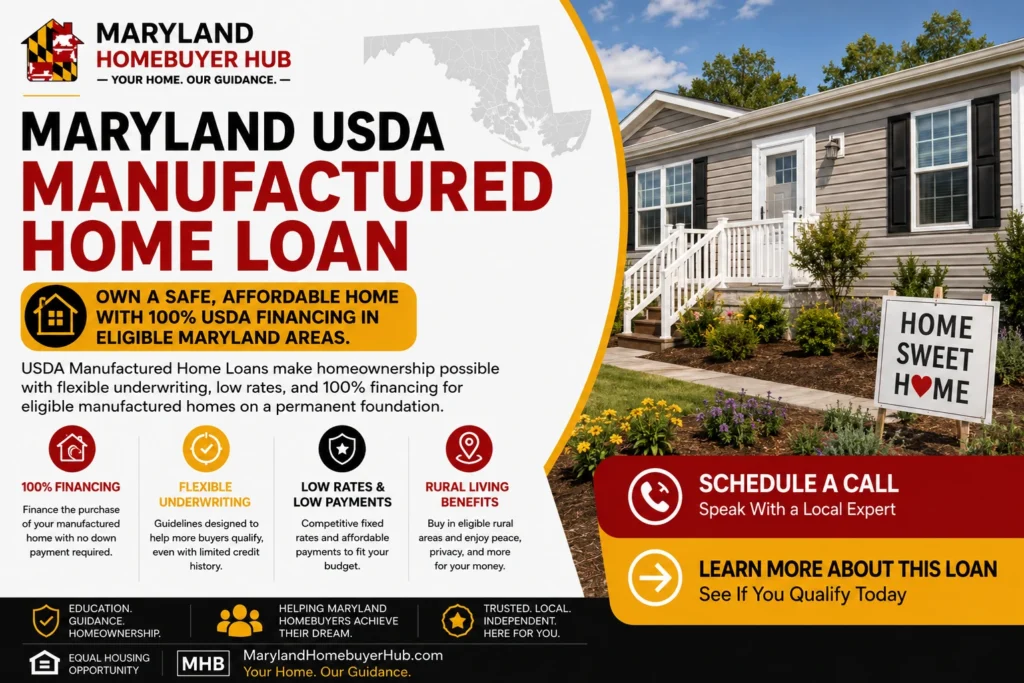
How USDA manufactured-home financing works
A real mortgage on a manufactured home, with no down payment
USDA manufactured-home financing is part of the USDA Rural Development Single Family Housing Guaranteed Loan Program — the same program used for site-built homes. Eligible buyers can finance 100% of the home and the land with no down payment.
The catch is not the borrower. It is the property. The home must be permanently affixed to land you own or are buying with the loan, and it must be legally treated as real property rather than as a vehicle.
A manufactured home on rented land in a community or park cannot be financed this way. That is a different kind of loan entirely. If your lot is leased, this page is probably not describing your situation — and it is better to know that now than three weeks into a contract.
Two further gates apply, as with any USDA loan: the property must sit in a USDA-eligible area, and your household income must fall within the limit for that location.
Everything that makes USDA financing attractive on a site-built house carries over: no down payment, no mortgage insurance, and a 30-year fixed rate. What gets added is a specific set of property rules covering the home’s construction standard, its foundation, its labels and its legal status.
Those rules are not difficult. They are, however, unforgiving — and almost every USDA manufactured-home transaction that falls apart falls apart on the property, not on the buyer.
Manufactured home or mobile home?
People use these words interchangeably. Lenders do not, and the difference decides whether a mortgage is possible at all.
- Manufactured home — built on or after June 15, 1976, to the federal HUD construction and safety standards, and identified by HUD labels. These can qualify for USDA, FHA, VA or conventional financing when the property requirements are met.
- Mobile home — the informal term for a unit built before June 15, 1976, ahead of the federal code. These are generally treated as personal property and are not eligible for USDA financing.
Why June 15, 1976 is the line
That is the date the federal Manufactured Home Construction and Safety Standards took effect. Homes built to that code carry a HUD certification label; homes built before it do not, and no amount of documentation can create one retrospectively.
The model year is usually right there in the listing. It is the fastest disqualifier there is, so check it before anything else.
We use “mobile home” on this page where that is genuinely how people search, but the technical distinction is the one that governs your financing.
Land ownership — and why a park changes everything
This is the single most important thing to establish, and it takes one question: who owns the ground the home sits on?
A USDA loan is a mortgage, and a mortgage attaches to real estate. USDA requires a perfected lien covering both the manufactured home and the land, with the security instrument recorded in the land records identifying both. That is only possible if you own the land, or are buying it in the same transaction.
| Factor | USDA mortgage | Chattel / personal property |
|---|---|---|
| Who owns the land | You do, or you buy it with the loan | Someone else — you rent the lot |
| Legal status of the home | Real property, taxed as real estate | Personal property, titled like a vehicle |
| Foundation | Permanent, with certification required | Often a temporary or pier-and-tie setup |
| What is financed | Home and land together, as one mortgage | The home only |
| USDA eligible? | Yes, when the property requirements are met | No — USDA cannot secure against leased land |
| Down payment | None required | Varies by lender and product |
| Term | 30-year fixed | Typically shorter |
Three situations, three answers:
- You already own the land. This works. Your equity in the lot counts toward the project, and the home is financed and affixed to ground you already hold.
- You are buying the home and the land together. This also works, and it is the most common arrangement. Both are financed in one loan.
- The home is in a community or park on leased land. This does not work — not because of a lender preference, but because there is no real estate for the mortgage to attach to. Personal-property financing is the path in that situation.
If the lot is rented, stop here
No amount of shopping around changes this one. A manufactured home on leased land cannot be converted to real property, because conversion requires that ownership of the home and the land be held by the same person.
It is worth confirming before you fall in love with a listing. A well-priced home in a land-lease community is a genuinely different financing conversation from the one this page describes.
New vs existing manufactured homes
USDA can finance both — but the rules diverge sharply, and this is where most confusion lives. A new home has to satisfy construction and installation standards. An existing home has to satisfy a much narrower eligibility gate.
| Requirement | New home | Existing home |
|---|---|---|
| Construction standard | Built to the federal HUD standards (FMHCSS) | Built on or after June 15, 1976 |
| Delivery and siting | Delivered from the manufacturer to the intended site | Must sit on its original installation site |
| Relocation history | No relocated units | Never moved from another site |
| Minimum size | At least 400 square feet | Same standard applies |
| Single or multi-wide | Both eligible | Both eligible |
| Foundation | Permanent, to HUD and manufacturer standards | Permanent, to HUD and manufacturer standards |
| Foundation certification | Required | Required |
| HUD label and Data Plate | Required | Required |
| Title and real property | Converted at or around closing | Title retired where State law requires |
| Energy standards | Must meet or exceed the IECC in effect at construction | Judged on condition and property standards |
| Land | Site may be purchased with the home | Land and home financed together |
| Age guideline | Not applicable | Investor guidelines often cap age — see below |
For a new home, USDA financing can cover the purchase of the unit, its transportation, the permanent foundation, the installation costs, and the purchase of an eligible site if you do not already own one. Site development work must be completed to HUD, state and local standards as well as the manufacturer’s installation requirements.
One rule catches people planning ahead: USDA will not finance the purchase of a site on its own unless a new unit is financed with it. Buying the lot this year and the home next year is not a USDA transaction.
For an existing home, the gate is narrower than most buyers realise, and it is worth stating precisely. USDA will guarantee the purchase of an existing manufactured home and site only where one of these is true:
- The unit and site are already financed with a USDA direct or guaranteed loan
- The unit and site are being sold by Rural Development as REO property
- The unit and site are being sold from a lender’s inventory where the prior loan was USDA-guaranteed
- The unit was installed on its initial installation site on a permanent foundation complying with the manufacturer’s and HUD installation standards
In practice, the fourth is the one that matters for a typical resale purchase — and it is why the relocation question below decides so many files.
How old can an existing manufactured home be?
This is one of the most-asked questions on the topic, and the honest answer has two layers.
USDA regulation contains no age limit
There is no maximum age for a manufactured home anywhere in USDA’s rules for this program. The federal requirements are the June 15, 1976 construction date, the original-installation-site condition, the permanent foundation, the labels and the property standards — not the model year.
You will nonetheless see a 20-year age limit quoted widely. That is a real constraint in practice, but it comes from investor and product guidelines layered on top of USDA financing, not from USDA itself.
What that means for you is practical rather than academic. A 25-year-old manufactured home that has never been moved, sits on a certified permanent foundation and is titled as real estate is not disqualified by USDA — but a particular lender or investor may still decline it under their own overlay.
So if you are looking at an older home, the question to ask is not “does USDA allow this?” but “does your program allow this, and does anyone else’s?” The answer varies between lenders, which is exactly the kind of question worth asking before you write an offer rather than after.
The other half of the age question is condition. An older home still has to meet USDA’s property standards and pass the appraisal, and on a manufactured home the roof, the skirting, the utility connections and the underside are where age shows first.
Can a manufactured home that has been moved qualify?
Generally no — and this one is federal.
USDA will not guarantee a loan for the purchase of an existing manufactured home that has been moved from another site. Separately, the eligibility gate for an existing unit requires that it was installed on its initial installation site.
The distinction that matters is between two very different journeys:
- Factory to its first permanent site. This is normal and expected — every manufactured home makes this trip. It does not count as having been “moved.”
- One permanent site to another. This is relocation, and it takes the home outside USDA eligibility for a purchase transaction.
Ask about move history before you make an offer
Sellers rarely volunteer it, and it is not always visible from the property. A home that was relocated ten years ago looks identical to one that never moved.
Because this is a federal rule rather than a lender preference, shopping lenders will not solve it. Establish it early — it is one of the few questions that can end a transaction outright.
The permanent foundation and foundation certification
The home must be properly installed on a permanent foundation according to HUD standards and the manufacturer’s requirements for permanent installation. A certification of proper foundation is required — in practice this is a licensed engineer’s report confirming the foundation complies.
Two related requirements travel with it:
- All wheels, axles, towing hitches and running gear must be removed. A home that can still be towed is not permanently affixed, whatever the skirting suggests.
- Site development, installation and set-up must conform to HUD requirements and the manufacturer’s instructions for a permanent installation.
Blocks and skirting are not a permanent foundation
This is the most common misunderstanding on the whole topic. A unit set on piers with skirting around the perimeter looks permanent from the street and will usually fail certification.
The certification is a structural judgement about anchoring and support, not an aesthetic one. On an existing home, remediation is possible but can be expensive — so get the foundation question answered before you are financially committed.
The HUD Certification Label and Data Plate
Every USDA manufactured-home file needs both. They are different documents, they live in different places, and they are constantly confused with one another.
- The HUD Certification Label — the metal “red tag” attached to the outside of each transportable section, at the tail-light end. A double-wide has two; a triple-wide has three. It certifies the home was built to the federal standards in effect on its manufacture date.
- The HUD Data Plate — a paper or laminated label inside the home, showing the manufacturer, the serial number, the date of manufacture, the certification label numbers, factory-installed equipment, and the roof and wind load zones the home was designed for.
The Data Plate is also where you confirm the manufacture date, which settles the June 15, 1976 question in seconds.
If either is missing, the file can usually still proceed — documentation is available through HUD’s label verification contractor to evidence that a label was issued — but it takes time. Establish it before the appraisal rather than after.
New homes carry a further layer: a HUD warranty identifying the unit by serial number, and certification that the home sustained no hidden damage in transport and that multi-section units were properly joined and sealed.
Why title and real-property status matter
A manufactured home starts life as personal property. It is built in a factory, transported on a chassis, and titled by a motor vehicle agency much like a vehicle. In that state, no mortgage can attach to it.
It becomes real property when it is permanently affixed to land held by the same owner and the personal-property title is formally surrendered. At that point it is legally part of the land, taxed as real estate, and financeable with a mortgage.
USDA’s requirements follow directly from that logic:
- A perfected lien on real property consisting of the manufactured home and the land
- The home taxed as real estate under applicable State law
- The security instrument recorded in the land records, identifying both the home and the land
- Any certificate of title surrendered to the appropriate State authority where State law permits — and where it cannot be surrendered, the lender must note its lien on the certificate
- A standard real property title insurance policy, plus any endorsement required locally confirming the home is part of the real property. In most jurisdictions that is the ALTA 7 manufactured housing endorsement.
- Your written acknowledgement that the unit is a fixture and part of the real estate securing the loan
None of this is bureaucratic box-ticking. Each item exists to establish that if the loan is ever foreclosed, the lender takes the house and the ground it stands on — and not a vehicle someone could drive away.
Converting to real property in Maryland
Maryland has a specific statutory process for this, set out in the Real Property Article. Understanding it before you make an offer is worthwhile, because a home that cannot complete it is a home USDA cannot finance.
Under Maryland law, a manufactured home is converted to real property when all three of the following have happened:
- The home is attached to a permanent foundation.
- Ownership of the home and the land is identical. The same person or people must own both — which is the legal reason a leased lot can never work.
- An affidavit of affixation is recorded with the clerk of the circuit court for the county where the land is located.
What the affidavit has to contain
- A description of the home — manufacturer, make, model name, model year and dimensions, and whether it is new or used
- The street address and legal description of the parcel
- A statement that ownership of the home and the land is, or will be, identical
- A statement that the home is, or will be, attached to that parcel
- The original Maryland MVA certificate of title, surrendered, together with a release from every lienholder shown on it
- Signature under penalty of perjury, and acknowledgement
If the owner genuinely cannot locate the certificate of title, Maryland law provides an alternative: a report from a Maryland-licensed attorney or title insurance producer who has searched both the county land records and the MVA’s records and identified every lien on the home.
Two Maryland details worth knowing
Recording the affidavit does not trigger transfer tax. Maryland law provides that recordation of an affidavit of affixation does not represent a sale or transfer of real property for the purpose of collecting any State, county or municipal tax or fee.
The MVA has to be notified. Immediately after the affidavit is filed with the clerk of the circuit court, a certified copy must be sent to the Motor Vehicle Administration, which records it. The clerk is required to accept the affidavit and may charge a reasonable recordation fee.
The most common Maryland blocker: an unreleased lien on the MVA title
If the home still carries an old chattel loan or another encumbrance on its MVA certificate of title, that lien must be released before conversion can happen. A seller who has forgotten a decades-old lien, or whose lender no longer exists, can stall a transaction for weeks.
Ask early whether the title has already been surrendered and the home already converted. On many Maryland properties it was done years ago and one search settles it.
In practice your title company and closing attorney handle the mechanics. What matters for you is knowing it has to happen, and finding out early whether anything stands in the way.
Have the property checked before you commit to it
Age, move history, the foundation, the labels and the land and title status decide whether USDA financing is possible at all. Most of it can be read from the listing and a title search in a single conversation.
This is not a commitment to lend. All loans subject to credit approval.
Single-wide, double-wide and minimum size
Single-wide homes are eligible. This surprises people, because several manufactured-home programs restrict financing to multi-section units.
USDA’s requirement is about floor space, not sections: the unit must have not less than 400 square feet. Single-wide, double-wide and larger multi-section homes are all eligible when the property requirements are met.
What actually decides eligibility is the same short list every time: built on or after June 15, 1976, on its original installation site, on a certified permanent foundation, titled as real property on land you own, and able to pass the appraisal.
Buying the home and land together
You do not need to own land already. USDA financing for a manufactured home can cover the purchase of the unit, its transportation, the permanent foundation, the installation costs, and the purchase of an eligible site if you do not already own one — all secured by a single mortgage over both.
If you do already own the land, that works too, and your equity in the lot works in your favour toward the overall project.
What the paperwork has to achieve either way is the same: ownership of the home and the land ending up identical, the title surrendered, the affidavit recorded, and the lien covering both.
If you are placing a brand-new home on land, ask about the construction route
Where a new manufactured home is being sited and installed, the transaction can sometimes be structured as USDA single-close construction financing rather than a straight purchase, rolling the land, the home and the installation into one loan.
The two have different appraisal and disbursement mechanics, so establish which path applies before you order anything. We cover USDA one-time close construction separately.
100% financing — and what it does not mean
USDA requires no down payment. For an eligible buyer that is the whole point of the program, and on a manufactured home it is genuinely transformative — these are among the most affordable homes in Maryland to begin with.
The maximum loan is the lesser of the market value of the property as appraised (plus the upfront guarantee fee if you finance it) or the total of the purchase price and eligible acquisition costs.
- The home and the land are financed together under one mortgage.
- Closing costs may be financed where the appraised value exceeds the purchase price and the total still fits within the maximum.
- The upfront guarantee fee may be financed on top of the appraised value — which is why USDA financing is sometimes described as reaching slightly beyond 100%.
- Seller and interested-party contributions are permitted up to 6% of the sales price toward your closing costs.
“No down payment” is not the same as “no money”
You may still need funds for earnest money, the appraisal, the foundation certification and inspections — several of which are paid before closing. On a manufactured home the foundation certification is an extra upfront cost that a site-built purchase would not carry.
Ask your lender for a realistic figure early, and remember that a seller credit within the 6% limit can be negotiated to cover much of it.
The USDA guarantee fee and annual fee
USDA loans do not carry mortgage insurance. They carry two fees, and getting the terminology right matters because the two work very differently from FHA’s premiums.
- An upfront guarantee fee, charged once. It is an eligible loan purpose, so it can be financed into the loan rather than paid in cash — even above the appraised value.
- An annual fee, calculated on the outstanding balance and collected monthly as part of your payment. It is not an eligible loan purpose and cannot be financed. It begins the month immediately following closing and continues for the life of the loan.
By statute the upfront guarantee fee may not exceed 3.5%, and the annual fee may not exceed 0.5% of the outstanding principal balance. USDA sets the actual rates each fiscal year, and they have long sat well below those ceilings — commonly 1% upfront and 0.35% annually.
Why this is not mortgage insurance
Practically, the annual fee behaves like a monthly insurance premium in your payment — but it is materially cheaper than FHA’s annual premium, and it is a guarantee fee paid to the government rather than a private insurance product.
Because USDA revises both rates annually, confirm the current figures with your lender before you finalise a budget rather than relying on any published number, including the ones above.
Location and household income eligibility
Two gates decide whether USDA financing is available to you at all, and neither has anything to do with the home itself.
Where in Maryland USDA financing works
“Rural” in USDA’s sense does not mean farmland or remote countryside. It is a designation applied to areas outside the major urbanised centres, and it covers far more of Maryland than most buyers assume — including plenty of established towns with schools, shops and public utilities.
Maryland’s population concentrates along the Baltimore–Washington corridor. Move outward toward the Eastern Shore, Southern Maryland, Western Maryland and the outer edges of the central counties, and eligible areas become common rather than exceptional. That matters here, because those are also the parts of Maryland where manufactured homes on owned land are most often found.
Check the address, not the town
Eligibility boundaries do not follow town limits, postal codes or county lines, and USDA revises the maps. Two lots on opposite sides of the same road can fall differently.
“Is this town eligible?” is not the same question as “is this parcel eligible?” Only the second decides your loan. Check the specific address on USDA’s property eligibility site and confirm it with your lender before you make an offer.
Household income
USDA is a moderate-income program. At loan approval, your household’s adjusted income must not exceed the applicable moderate income limit for the property’s location.
- It is household income, not borrower income. Income from adult household members counts even if they will not be on the loan.
- It is adjusted income. Certain deductions apply, so households that look over the limit on paper sometimes are not.
- The limit varies by location and household size. A larger household is allowed more income.
Because USDA revises these limits, this page does not publish a Maryland income table — a stale figure would do more harm than none. Limits are published by USDA and can be checked by address and household size in minutes.
You must also be a U.S. citizen or qualified permanent resident, and the home must be your owner-occupied primary residence. USDA will not guarantee loans for investment properties or short-term housing.
Credit, collections and debt ratios
Manufactured-home files are underwritten like any other USDA loan, with a few product standards layered on top. The table below separates what comes from federal regulation from what comes from the program and its investors — because the second kind varies between lenders and is worth asking about.
| Standard | What applies | Source |
|---|---|---|
| Credit score | 600 minimum | Product guideline — USDA sets no minimum |
| Open collections | Not permitted | Product guideline |
| Housing ratio | 29% of repayment income | USDA regulation |
| Total debt ratio | 41% of repayment income | USDA regulation |
| Ratio flexibility | Both exceedable with documented compensating factors | USDA regulation |
| Occupancy | Owner-occupied primary residence | USDA regulation |
| Household income | Within the moderate income limit for the area | USDA regulation |
| Down payment | None required | USDA regulation |
600 is the working minimum for this product. It is worth knowing that USDA’s own regulations name no credit score at all — automated underwriting weighs your whole profile — but 600 is the number to plan around, and lenders who apply higher floors exist.
The no-open-collections standard is similarly a product requirement rather than a federal rule. USDA’s broader framework allows collections to be addressed through documentation or payment arrangements in some circumstances, so if you have a collection account on your report it is a conversation rather than an automatic no.
The 29% and 41% ratios are genuinely USDA’s, set in regulation. They are benchmarks rather than absolute ceilings: both may be exceeded where compensating factors are documented, though USDA notes that compensating factors carry less weight when several layers of risk are stacked in one file.
As the source material puts it well: payment history often matters more than a perfect score. A clean recent record with a modest score frequently underwrites better than a higher score with recent problems.
Appraisal and inspection considerations
The appraisal does two jobs: it establishes the value the loan is measured against, and it confirms the property meets USDA’s condition standards — modest, decent, safe and sanitary.
On a manufactured home, the recurring issues are practical:
- Comparable sales. The appraiser needs sales of similar manufactured homes on similar owned land nearby. In parts of rural Maryland that is straightforward; where manufactured housing is uncommon, supporting the value is harder.
- Roof, siding and seals, particularly on older units.
- Skirting and the under-home enclosure, consistent with a permanent installation.
- Working mechanical systems and safe utilities — and on rural parcels that usually means a well and a septic system.
- Proper access to the property.
Alongside the appraisal you will have the foundation certification, and it is worth budgeting for both. Get a separate home inspection too — neither the appraisal nor the foundation certification is telling you whether the house is a good buy.
How USDA compares with the alternatives
Several routes exist for financing a manufactured home. Which one fits is usually decided by eligibility rather than preference.
| Program | Down payment | Who it suits | The main constraint |
|---|---|---|---|
| USDA | None | Buyers within the income limit, in an eligible area | Location and income both have to work |
| VA | None with full entitlement | Eligible veterans and service members | Requires VA eligibility |
| FHA | From 3.5% | Buyers generally, including lower credit profiles | Mortgage insurance and county loan limits |
| Conventional | Typically 5% or more | Stronger credit and available funds | The largest cash requirement |
| Chattel | Varies | Homes on leased land that cannot be real property | Not a mortgage; shorter terms |
The practical hierarchy: if you are a veteran, VA financing usually wins — no income limit and no location restriction. If you are not, and the property is in an eligible area and your income fits, USDA is normally the strongest of the rest, because it is the only remaining route with no down payment. FHA is the fallback when location or income rules USDA out. Chattel financing is not a competitor so much as a different category — it is what you use when the home cannot be real property at all.
Our Maryland FHA loans guide covers FHA financing more generally if that is the likely path.
USDA manufactured home vs USDA one-time close construction
Both can put a new manufactured home on land, and the difference is in the structure. A manufactured-home purchase finances a unit and its site as a purchase transaction. Single-close construction financing wraps the land, the home and the installation into one construction-to-permanent loan with escrowed disbursements.
Which applies depends on what is being built and when. If a new home is being sited and installed as part of your transaction, ask which structure your lender is using — the appraisal and disbursement mechanics differ.
Compare this option with other Maryland manufactured home loan programs.
Find out which financing path your property qualifies for
Land ownership, the home's age and move history, and your household income decide the answer before credit and budget come into it. All of it is quick to establish.
This is not a commitment to lend. All loans subject to credit approval.
When USDA manufactured-home financing makes sense
It is a strong fit when:
- You want an affordable home and have little or no down payment
- The property is in a USDA-eligible area and your household income fits the limit
- The home sits on land you own, or you are buying the land with it
- The home was built on or after June 15, 1976 and has never been moved
- The foundation is permanent, or can be brought up to a certifiable standard
- You want a 30-year fixed mortgage rather than shorter-term personal-property financing
- You are buying a new home and want the unit, foundation, installation and site in one loan
Another path is probably better when:
- You are a veteran — VA financing has no income limit or location restriction
- The home is in a community or park on leased land
- The home was built before June 15, 1976
- The home has been relocated from a previous site
- The property is not in an eligible area, or your income exceeds the limit
- The home cannot be titled as real property or placed on a certifiable foundation
- The property will not be your primary residence
The process, step by step
- Check the two gates. Confirm the property address is in a USDA-eligible area and that your household income fits the limit.
- Get pre-approved. Credit, income and the 29% and 41% ratios reviewed before you shop.
- Vet the home early. Manufacture date, move history, foundation, HUD label and Data Plate, land ownership and title status — all before you spend money.
- Structure the transaction. Purchase of an existing home, or purchase and installation of a new one, which may be handled as construction financing.
- Make the offer with the property questions already answered, and negotiate a seller credit within the 6% limit if closing costs are tight.
- Appraisal and foundation certification. Ordered together; allow time for both.
- Underwriting. You and the property are reviewed together. Both have to clear.
- Title conversion coordinated. The affidavit of affixation and MVA title surrender are arranged through your title company around closing.
- Close. Sign once, and the home is yours — as real estate.
Common problems that derail these transactions
- Leased land. The most common one by far, and it cannot be solved by shopping lenders.
- The home has been moved. A federal disqualifier for a purchase, and often invisible from the property.
- Built before June 15, 1976. Check the model year first; it takes seconds.
- Title never converted. If the MVA certificate was never surrendered, the home is still personal property and a mortgage cannot attach.
- An unreleased lien on the MVA title. A forgotten chattel loan can hold up conversion for weeks.
- Foundation will not certify. Blocks and skirting are not a permanent foundation.
- Running gear still attached. Wheels, axles and hitches have to come off.
- Missing HUD label or Data Plate. Usually solvable, but only if you start early.
- Age overlays. USDA sets no age limit, but your lender’s investor may — ask before you offer.
- Appraisal comps. Where manufactured homes on owned land are uncommon locally, value support can be difficult.
- Buying a lot now to place a home later. USDA will not finance a site without a new unit.
- Assuming your lender offers it. Not every USDA lender does manufactured homes. Confirm before you invest weeks.
Frequently asked questions
Can I use a USDA loan to buy a manufactured home in Maryland?
Yes, when the home qualifies. It must be permanently affixed to land you own or are buying with the loan, titled as real property, built on or after June 15, 1976, on a certified permanent foundation, in a USDA-eligible area, and within the household income limit.
Can I get a USDA loan for a manufactured home in a park?
No. USDA financing is a mortgage and must be secured by both the home and the land. If the lot is leased, the home cannot be converted to real property and personal-property (chattel) financing is the alternative.
How old can an existing manufactured home be?
USDA’s regulations contain no maximum age. The federal requirements are the June 15, 1976 construction date, that the home sits on its original installation site, the permanent foundation, the labels and the property standards. A widely quoted 20-year limit does exist, but it comes from investor and product guidelines rather than USDA, so it varies between lenders and is worth asking about directly.
Can a manufactured home that has been moved qualify?
Generally no. USDA will not guarantee the purchase of an existing manufactured home that has been moved from another site, and an existing unit must sit on its initial installation site. The original trip from the factory to that first site does not count as having been moved.
Can I finance a single-wide?
Yes. USDA’s requirement is a minimum of 400 square feet of floor space rather than a minimum number of sections, so single-wide, double-wide and larger homes are all eligible when the property requirements are met.
What credit score do I need?
600 is the minimum for this product. USDA’s own regulations name no credit score, so the figure is a product guideline rather than a federal rule, and some lenders set a higher floor. Payment history often matters more than the score itself.
Can I qualify with collections on my credit?
The product standard is no open collections, which is an investor guideline rather than a USDA rule. USDA’s broader framework can allow collections to be addressed through documentation or payment arrangements in some circumstances, so it is worth a conversation rather than assuming you are excluded.
What debt ratios apply?
USDA works to 29% for the housing payment and 41% for total debt. Both are set in regulation and both may be exceeded where compensating factors are documented.
Do I need a down payment?
No. USDA requires none, and the home and land are financed together. You may still need funds for earnest money, the appraisal, the foundation certification and inspections, and a seller credit of up to 6% of the sales price can be negotiated toward closing costs.
Does USDA charge mortgage insurance?
No. USDA charges an upfront guarantee fee, which can be financed into the loan, and an annual fee calculated on the balance and collected monthly, which cannot be financed. The annual fee behaves like a monthly premium in your payment but is materially cheaper than FHA’s, and USDA sets both rates annually.
Can closing costs be financed?
They can where the appraised value exceeds the purchase price and the total still fits within the maximum loan amount. The upfront guarantee fee can also be financed on top of the appraised value.
Does the home need a permanent foundation?
Yes, installed to HUD standards and the manufacturer’s requirements, with a certification of proper foundation. All wheels, axles, towing hitches and running gear must also be removed. Piers with skirting generally will not certify.
What are the HUD Certification Label and Data Plate?
The certification label is the metal tag on the outside of each transportable section confirming the home was built to federal standards. The Data Plate is a paper label inside the home showing the manufacturer, serial number, date of manufacture, label numbers and design load zones. Both are required, and the Data Plate is where you confirm the manufacture date.
How does a manufactured home become real property in Maryland?
Three things must happen: the home is attached to a permanent foundation, ownership of the home and the land is identical, and an affidavit of affixation is recorded with the clerk of the circuit court for the county where the land sits. The MVA certificate of title is surrendered with any liens released, and a certified copy of the affidavit goes to the Motor Vehicle Administration.
Does converting to real property trigger Maryland transfer tax?
No. Maryland law provides that recording an affidavit of affixation does not represent a sale or transfer of real property for the purpose of collecting any State, county or municipal tax or fee. The clerk may charge a reasonable recordation fee.
Can I buy the land now and put a home on it later?
Not with USDA. A loan will not be guaranteed to purchase a site without also financing a new unit, so the land and the home need to be part of the same transaction.
Can I buy a brand-new manufactured home?
Yes. USDA financing can cover the unit, its transportation, the permanent foundation, the installation costs and the purchase of an eligible site. Where a new home is being sited and installed, the transaction may instead be structured as single-close construction financing.
Does the home have to be my primary residence?
Yes. USDA will not guarantee loans for investment properties or temporary, short-term housing, and you must have the ability to occupy the home as your principal residence.
What title insurance is required?
A standard real property title insurance policy, plus any endorsement required in the jurisdiction confirming the manufactured home is part of the real property securing the loan. In most jurisdictions that is the ALTA 7 manufactured housing endorsement.
Why do some lenders say they cannot do this?
Not every USDA lender offers manufactured homes, and those that do apply their own overlays on age, credit and home type. Availability rather than eligibility is often the real constraint, so it is worth asking more than one lender.
Sources
- 7 CFR § 3555.208 — Special requirements for manufactured homes: eligible costs including the unit, transportation, permanent foundation, installation and site purchase; the restriction on purchasing a site without financing a new unit; the four circumstances in which an existing manufactured home and site may be financed, including installation on the initial installation site; the prohibition on financing an existing unit moved from another site; the 400 square foot minimum floor space; permanent foundation to HUD and manufacturer standards with a certification of proper foundation; removal of wheels, axles, towing hitches and running gear; FMHCSS compliance and HUD heating and cooling requirements for the State; IECC compliance; warranty and transportation-damage certifications; data plate and certification label placement; and the title, lien, real-estate taxation and title insurance endorsement requirements.
- USDA Rural Housing Service final rule, Updating Manufactured Housing Provisions (published January 3, 2025, effective March 4, 2025) — the amendment that governs which existing manufactured homes the guaranteed program may finance.
- 7 CFR § 3555.151 — Eligibility requirements: adjusted household income not exceeding the applicable moderate income limit; owner occupancy as a principal residence; citizenship or qualified alien status; and the 29% housing and 41% total debt ratios, exceedable with documented compensating factors. No minimum credit score appears in the regulation.
- 7 CFR § 3555.103 — Maximum loan amount: the lesser of market value plus the amount of the upfront guarantee fee financed, or purchase price plus eligible acquisition costs.
- 7 CFR § 3555.102 — Loan restrictions: the 6% cap on interested-party contributions.
- USDA Rural Development — Single Family Housing Guaranteed Loan Program: the upfront guarantee fee is an eligible loan purpose and may be included in the loan amount, while the annual fee premium is not an eligible loan purpose. USDA’s Upfront Guarantee and Annual Fee Calculator corroborates the commonly applied fee rates.
- Md. Code, Real Property Article, Title 8B (Manufactured Homes), §§ 8B-201 through 8B-203: the three conditions for conversion; the required contents of the affidavit of affixation; surrender of the MVA certificate of title with lien releases; the attorney or title insurance producer report where the title cannot be located; recordation with the clerk of the circuit court; the provision that recordation is not a sale or transfer for tax purposes; and the certified copy sent to the Motor Vehicle Administration.
- USDA property and income eligibility tools — eligibility is determined by the specific property address and the household rather than by county.
Verified August 25, 2026. The 600 credit score, the no-open-collections standard and any maximum age applied to an existing manufactured home are product and investor guidelines rather than USDA regulatory requirements, and they vary between lenders. USDA’s regulations contain no maximum age for a manufactured home and no minimum credit score. Upfront guarantee fee and annual fee rates are set by USDA each fiscal year and are subject to change; the figures shown are the commonly applied rates and should be confirmed before use. USDA income limits and property eligibility designations change periodically and are deliberately not published here. No interest rates are shown. Confirm all current figures and requirements with a lender that actively originates USDA manufactured home loans.
This page explains how USDA financing for manufactured homes generally works for Maryland homebuyers. It does not determine individual eligibility, is not a commitment to lend, and is not a Loan Estimate. Any figures shown are arithmetic illustrations, not quotes, and no interest rate is offered or implied. It is general information rather than legal or tax advice; Maryland titling, recording and tax questions should be confirmed with your title company, closing attorney, or the appropriate Maryland agency. Program terms are set by the United States Department of Agriculture, Rural Development, and participating lenders may apply additional requirements that differ from lender to lender. Property and income eligibility must be confirmed against USDA’s current resources for the specific address and household. Maryland Homebuyer Hub is not affiliated with, endorsed by, or acting on behalf of the United States Department of Agriculture, Rural Development, the U.S. Department of Housing and Urban Development, the Maryland Motor Vehicle Administration, or any government agency.