
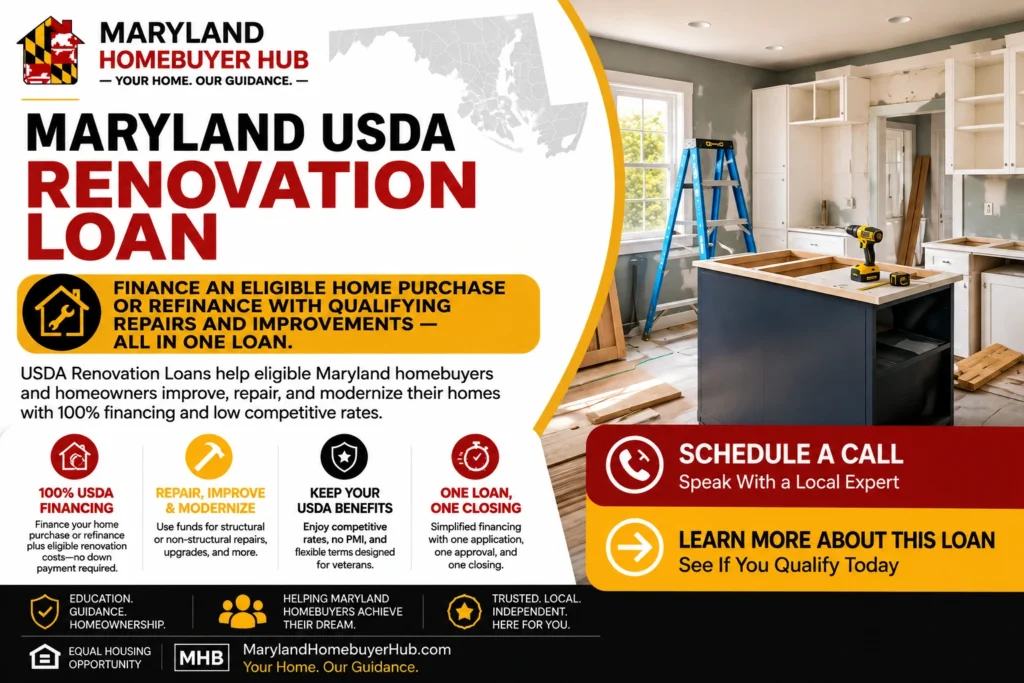
How USDA renovation financing works
One loan, one closing, one payment — house plus repairs
A USDA Renovation Loan lets you buy a home and finance the repairs it needs in a single loan, with one closing and one monthly payment at a 30-year fixed rate. You can also use it to refinance a home you already own and fund improvements at the same time.
One clarification before the detail. USDA does not publish a branded renovation program the way FHA publishes 203(k). What the regulations permit is financing the cost of repairs and rehabilitation as part of acquiring the home. The “Limited” and “Standard” structures described below, along with dollar thresholds, draw counts and consultant requirements, are how individual lenders package that permission — which is why they vary between lenders, and why the specifics should be confirmed with whoever is actually making the loan.
The renovation money does not come to you at closing. It goes into an escrow account and is released to your contractor in draws as verified work is completed.
There are two versions. Limited handles up to $35,000 of non-structural work on a home you can live in. Standard handles structural work and larger projects.
Because it is a USDA loan, the same two gates apply: the property must be in a USDA-eligible area, and your household income must fall within the limit for that location.
This solves a problem that otherwise stops a lot of Maryland purchases. The house you can afford needs work; the work needs money you do not have until after you own the house; and a lender will not lend against a property in poor condition. Renovation financing breaks that loop by underwriting the home as it will be rather than as it is.
It is worth being clear about what this is not. USDA renovation financing improves an existing dwelling. If you are buying a lot and building a new home from the ground up, that is USDA one-time close construction financing instead — a different product with different mechanics, covered separately.
Three kinds of rule appear on this page
Renovation lending is layered, and knowing which layer a rule comes from tells you whether it is negotiable:
- USDA program rules — federal, and the same in Maryland as anywhere else. Income limits, eligible areas, owner occupancy, and how draws must be approved.
- Renovation program guidelines — the operating rules of the renovation product itself: the $35,000 Limited threshold, draw counts, holdbacks, consultant and Work Write-Up requirements.
- Lender discretion — a small number of judgement calls, mainly around whether a consultant is required on a Standard file.
Where something falls into the third category, this page says so plainly rather than leaving you guessing.
USDA Limited vs USDA Standard Renovation
This is the first decision, and almost everything else follows from it. The dividing lines are the dollar amount and whether the work is structural.
| Feature | Limited | Standard |
|---|---|---|
| Repair amount | Up to $35,000 in eligible costs | No separate repair cap |
| Minimum repair amount | None | None |
| Structural work | Not permitted | Permitted |
| Habitability at closing | Home must be habitable | Home may be uninhabitable |
| PITI reserve during renovation | Not available | Up to six months when the home is not habitable |
| HUD Consultant | Optional; the fee may be financed if the loan-to-value allows | May be required, depending on the renovation review |
| Draws | An initial advance, then a single final draw on completion | Up to five draws |
| Typical use | Cosmetic and system updates — kitchens, baths, flooring, siding, mechanicals | Additions, structural alterations, reconstruction, major system replacement |
| Complexity | Lower — fewer moving parts and a faster path to closing | Higher — more documentation and administration throughout |
$35,000 is a ceiling, not a target
If your project comes in at $34,000 of non-structural work, Limited is the easier path by a wide margin. If it comes in at $36,000, or touches anything structural, you are on Standard — and Standard is a materially different process.
This is why getting a realistic contractor estimate before you make an offer matters so much. A project that drifts across the threshold mid-transaction can force a restructure.
One thing that does not change between the two: both are 30-year fixed-rate loans on owner-occupied, one-unit primary residences, and both use the same escrow-and-draw machinery. Standard simply has more of it.
How much renovation work can you finance?
On Limited, the answer is simple: up to $35,000 in eligible renovation and repair costs. There is no minimum, so a $6,000 project is as workable as a $34,000 one.
On Standard, there is no separate cap on the repair amount. That surprises people, and it is genuinely one of the program’s strengths — the renovation budget is not squeezed by an arbitrary repair ceiling.
What constrains a Standard project instead is the total loan amount, and that is governed by three things working together:
- The as-completed appraised value. USDA caps the loan at the lesser of the property’s market value or the purchase price plus eligible costs. The finished value has to support the whole number.
- Your repayment ability. USDA works to a 29% housing ratio and a 41% total debt ratio, measured against the finished payment. This is usually the real ceiling.
- Household income limits. USDA is a moderate-income program, so the income that qualifies you also bounds what you can borrow.
USDA does not publish a maximum loan amount
There is no dollar limit in USDA’s regulations the way FHA publishes county loan limits. The loan is bounded by value, by what you qualify to repay, and by the income limit.
Renovation products layered on top of USDA financing do sometimes carry their own maximum loan amount set by the investor, and that figure can change. If your project is large, ask your lender for the current ceiling in writing rather than working from a number you read somewhere — including here.
What repairs and improvements can you make?
The eligible list is broader than most buyers expect. It is not limited to fixing what is broken — genuine improvements qualify too.
- Accessibility improvements — making the home usable for a person with a disability. USDA specifically provides for special design features and equipment where a physical disability of the applicant or a household member makes them necessary.
- Health and safety repairs — the work that makes a house safe to live in.
- Septic systems and water wells — repair or installation. On rural Maryland properties this is frequently the single largest line item.
- Additions, structural alterations, or reconstruction of an existing dwelling (Standard only).
- A garage, attached or detached.
- Modernisation — kitchens, bathrooms, interior floor coverings, exterior siding and comparable updates.
- Energy conservation and weatherisation features.
- Repairs to an existing swimming pool, hot tub or sauna.
- Repairs to an accessory dwelling unit already on the property.
Two of these deserve a note for Maryland specifically. Well and septic work is a common reason a rural or semi-rural property fails a standard purchase — and it is exactly the kind of expense renovation financing exists to solve. And weatherisation on an older Maryland housing stock often pays for itself in a way cosmetic work does not.
What is not allowed
The exclusions matter as much as the eligible list, because this is where offers fall apart. Borrowers routinely assume renovation financing is a blank cheque for anything they want to do to a house. It is not.
- New in-ground swimming pools, hot tubs or saunas. Repairing an existing one is fine; installing a new one is not.
- Repairs to manufactured homes, new or existing.
- Repairs to condominiums. USDA regulation excludes condominiums from this financing structure — and the exclusion expressly covers detached and site condominiums, which can look exactly like ordinary houses on their own lots.
- Converting a non-residential structure into a single family home — barns, schoolhouses, churches and similar conversions.
- Alterations that create income-producing features.
- Luxury items such as exterior fireplaces and outdoor kitchens.
- Common-area improvements — community meeting rooms, playgrounds and shared facilities.
- Properties where the foundation has been demolished, or where only the footings remain. At that point it is new construction, not renovation.
The barn conversion question
This comes up more often in Maryland than you would think, particularly on the Eastern Shore and in the western counties. Converting a barn, an outbuilding or an old schoolhouse into a home is not eligible for USDA renovation financing, however charming the project.
The program improves an existing dwelling. A structure that was never a dwelling does not qualify, and neither does a house that has been stripped back past the point where a dwelling still exists.
Note also that the costs of energy-efficient mortgage products and solar energy systems are not included in the financeable repair and improvement budget. General energy conservation and weatherisation work is eligible — these are handled as separate matters rather than folded into the renovation escrow.
Find out whether your project actually qualifies
Whether the work is structural, whether it clears $35,000, and whether anything on your list is excluded all decide which program you are in. It is a short conversation, and it is far cheaper than discovering the answer under contract.
This is not a commitment to lend. All loans subject to credit approval.
Can structural repairs be financed?
Yes — on Standard. Structural work is the clearest dividing line between the two options. Limited is explicitly non-structural; Standard permits structural and non-structural improvements alike.
Structural work generally means anything affecting the building’s load-bearing elements or its footprint: foundation repair, load-bearing wall changes, roof structure, additions, and reconstruction of an existing dwelling.
There is a practical documentation consequence. For repairs of $35,000 or less, the contractor’s cost estimate must state that the work is non-structural — so the paperwork itself enforces the boundary. If your contractor cannot make that statement honestly, you are on Standard regardless of the dollar amount.
Can you live in the home during renovation?
On Limited, yes — and you have to be able to. The home must be habitable at closing, which is part of what makes Limited simpler: you are living in a working house while cosmetic and system work happens around you.
On Standard, the home does not have to be habitable, which is what makes serious rehabilitation possible. That raises an obvious problem: if you cannot live there, you are paying for somewhere else to live and a mortgage.
The PITI reserve solves the double-housing problem
On a Standard renovation where the property is not habitable, the loan may include a reserve of up to six months of mortgage payments — principal, interest, taxes and insurance — financed into the loan and drawn during the renovation period.
It is not available on Limited, and it is not automatic on Standard. If your project will make the house unlivable for a stretch, raise it early: it can be the difference between a feasible project and an unaffordable one.
How the as-completed appraisal works
This is the mechanism that makes renovation financing possible at all. An appraiser values the home as it will be once the work is finished, using the plans, the scope of work and the contractor’s cost estimate — not as the tired house standing there today.
That as-completed value is what the loan is measured against. USDA caps the loan at the lesser of that market value or the purchase price plus eligible costs, so the finished value has to support the total.
- A detailed scope produces a better value. The appraiser can only credit work that is documented.
- Comparable sales still govern. Renovating well beyond what the neighbourhood supports will not produce a value that carries the budget — the classic over-improvement trap.
- The appraisal takes longer than a standard one. Build the time into your contract dates.
The completed home must also meet USDA’s condition standards — modest, decent, safe and sanitary — which is generally the point of the renovation in the first place.
How renovation funds are held and released
At closing, the renovation money goes into a repair escrow account. You never receive it, and your contractor is not paid up front. Funds come out in draws as completed work is verified.
The rules governing that process are the most important operational detail on this page:
- Draws are advanced after work is complete and verified by inspection. Not before.
- No draws for incomplete work, or for materials that have not been installed.
- You must approve payment before each draw is released. This is federally required on USDA rehabilitation financing — you and the lender are jointly responsible for approving disbursements.
- Funds are issued by two-party check payable to you and the contractor together.
- Lien waivers or title insurance endorsements are required with each draw, protecting you against a subcontractor claim later.
- A 10% holdback applies to each draw, released only after final inspection and the final release documentation.
- The escrow account is interest-bearing, and any interest earned is applied as a reduction of your principal balance.
- Limited uses an initial advance followed by a single final draw of the balance once all work is complete. Standard allows up to five draws.
The draw approval is real leverage — use it
Your written approval is required before money moves, and the 10% holdback means your contractor has a financial stake in finishing properly rather than walking away at 90%.
Walk the site before you sign anything. Homeowners who treat the draw approval as a formality are the ones who discover problems after the money has gone.
There is also a protection worth knowing about that rarely gets mentioned: if an unplanned change with you or your contractor prevents the work from being completed, the lender remains responsible for completing the improvements to Rural Development’s satisfaction. Any money left in escrow at the end is applied to your principal rather than paid out.
Advancing money for materials at closing
Contractors frequently need to buy materials before they can start, and a program that pays only for installed work creates a cash-flow problem. There is a defined answer.
- Up to 50% of material costs may be advanced for items not yet paid for, where supplier documentation is provided.
- The advance cannot exceed the lesser of 50% of materials or $15,000. Exceptions may be available with the lender’s approval.
- The contractor’s estimate must itemise the exact materials and their costs for the advance to be made.
- Checks are made payable to you and the contractor jointly.
- A materials advance does not count toward the maximum number of draws.
That last point matters on a Standard project. With only five draws available, having the materials advance sit outside the count preserves your flexibility for the actual construction milestones.
What your contractor must provide
You need a detailed, fixed cost estimate — not a ballpark, and not a per-square-foot guess. It must describe the work being performed with itemised labour and materials, and it must include:
- Your name as the borrower
- The subject property address
- The contractor’s name, contact information and licence number where applicable
- Itemised costs for labour and materials
- For repairs of $35,000 or less, a statement that the work is non-structural
Choose a contractor who has done renovation-loan work before
These files have a rhythm: itemised fixed estimates, inspections before payment, lien waivers with every draw, two-party checks, and a 10% holdback until the very end.
A good contractor who has never worked inside a renovation loan can still make it work, but expect friction — particularly around the holdback and the no-payment-before-inspection rule. Ask directly whether they have done one.
Do you need a HUD Consultant?
Sometimes. It depends on the option and the scope of the work.
- Limited Renovation: a HUD Consultant is optional. If you use one, the fee may be financed into the loan where the loan-to-value allows.
- Standard Renovation: a consultant may be required, depending on the lender’s renovation review of your project. This is the one genuine area of lender discretion on this page.
Where a consultant is involved, there must be a written agreement setting out the services and fees. That agreement must disclose that the consultant’s inspection is not a home inspection — an important distinction, because the two are easy to confuse and only one of them is looking out for your interests as a buyer in the way you probably expect.
The consultant may perform a desk review or a physical inspection, and prepares the Work Write-Up described below.
Even when optional, a consultant is often worth it
On anything beyond straightforward cosmetic work, a consultant produces a properly structured scope, which tends to produce more accurate contractor bids and fewer mid-project surprises. The fee can usually be financed.
Still get a separate home inspection. The consultant’s role is defining and verifying the renovation scope, not telling you whether the house is a good buy.
The Work Write-Up
The Work Write-Up (WWU) is the document that turns “this house needs work” into a financeable scope. It is prepared by the HUD Consultant and governs everything downstream.
- Provided in the standardised HUD format, with the required categories and summary
- Used to obtain cost estimates from contractors and to confirm the scope of work
- The WWU and the contractor’s cost estimate must match in scope
- The total cost must match exactly, or fall within a $500 variance
That $500 tolerance is tighter than most borrowers expect, and it is a common source of delay. If your contractor’s number and the consultant’s write-up drift apart, the file stops until they are reconciled — so it is worth having the contractor bid from the write-up rather than producing an independent estimate and hoping the two align.
What renovation-related costs can be financed?
The renovation budget is not just the contractor’s number. Several associated costs can be financed into the loan, which meaningfully reduces what you need in cash:
- The rehabilitation and repair costs themselves
- Architectural and engineering professional fees
- The HUD Consultant fee, where one is used
- Inspection fees during the repair period, at reasonable and customary rates
- Title update fees
- Permits
- A feasibility study, where one is necessary
- A contingency reserve for the things that surface once walls are open
- Origination fee and discount points, where points are used to reduce the rate
- Standard only: up to six months of PITI reserve where the property is not habitable
Do not skip the contingency reserve
On an older Maryland house, opening a wall or lifting a floor reveals things nobody priced — knob-and-tube wiring, failed subfloor, plumbing that is not to code, or a roof deck in worse shape than it looked.
The contingency reserve absorbs the first of those discoveries. A project budgeted with no headroom is a project that stalls the first time something unexpected turns up, and mid-project change orders are slower and more expensive than planning for the possibility.
Can you use USDA renovation financing to refinance?
Yes. The program is not limited to purchases — you can refinance a home you already own and finance improvements in the same transaction, with the same one-closing, one-payment, 30-year fixed structure.
The same conditions apply either way: the property must be in a USDA-eligible area, your household income must fall within the limit, it must be your owner-occupied primary residence, and it must be a one-unit property. The improvements must come from the eligible list, and the escrow and draw process works identically.
For an existing owner, the practical appeal is that renovation costs go onto a 30-year fixed mortgage rather than onto a credit card, a personal loan or a second lien at a materially higher rate.
Income limits and Maryland property eligibility
Two gates decide whether USDA financing is available to you at all, and neither has anything to do with the house you want to renovate.
Household income
USDA is a moderate-income program. At loan approval, your household’s adjusted income must not exceed the applicable moderate income limit for the property’s location.
Three features of that rule catch people out:
- It is household income, not borrower income. Income from adult household members counts even if they will not be on the loan.
- It is adjusted income. Certain deductions apply, so households that look over the limit on paper sometimes are not.
- The limit varies by location and household size. A larger household is allowed more income.
Because USDA revises these limits, this page does not publish a Maryland income table — a stale figure would do more harm than none. Limits are published by USDA and can be checked by address and household size in a few minutes.
Where in Maryland USDA financing works
“Rural” in USDA’s sense does not mean farmland or remote countryside. It is a designation applied to areas outside the major urbanised centres, and it covers far more of Maryland than most buyers assume — including plenty of established towns with schools, shops and public utilities.
Maryland’s population concentrates along the Baltimore–Washington corridor. Move outward toward the Eastern Shore, Southern Maryland, Western Maryland and the outer edges of the central counties, and eligible areas become common rather than exceptional. This matters especially for renovation, because that is also where older housing stock in need of work tends to be.
Check the address, not the town
Eligibility boundaries do not follow town limits, postal codes or county lines, and USDA revises the maps. Two lots on opposite sides of the same road can fall differently.
“Is this town eligible?” is not the same question as “is this parcel eligible?” — and only the second one decides your loan. Check the specific address on USDA’s property eligibility site and confirm it with your lender before you make an offer.
Eligibility also requires that you are a U.S. citizen or a qualified permanent resident, and that the home will be your principal residence.
Credit score and core requirements
| Requirement | What applies |
|---|---|
| Credit score | 620 minimum for the renovation program |
| Occupancy | Owner-occupied primary residence only |
| Property type | One-unit properties only |
| Loan type | 30-year fixed rate only |
| Down payment | None required with USDA financing |
| Debt ratios | 29% housing and 41% total debt, exceedable with documented compensating factors |
| Not eligible | Manufactured homes and condominiums |
The 620 score is the working requirement for this renovation program. It is worth knowing that USDA’s own regulations do not name a credit score at all — the figure comes from the renovation product rather than from federal rule — but for practical purposes, 620 is the number to plan around.
The exclusions in that last row are absolute rather than preferences. Manufactured homes cannot be repaired under this program, and condominiums are excluded by USDA regulation — including detached and site condominiums, which is the exclusion most likely to surprise you because such a property can look like an ordinary single family house on its own lot. Check how a parcel is titled before you go under contract.
How USDA renovation compares with the alternatives
USDA renovation financing is excellent when you qualify for it, and unavailable when you do not. The comparison is usually decided by eligibility rather than preference.
| Program | Down payment | Who it suits | The main constraint |
|---|---|---|---|
| USDA renovation | None | Buyers within the income limit, in an eligible area | Location and household income both have to work |
| VA renovation | None with full entitlement | Eligible veterans and service members | Requires VA eligibility; fewer lenders offer it |
| FHA 203(k) | 3.5% minimum investment | Buyers generally, including lower credit profiles | Mortgage insurance and the county FHA loan limit |
| Conventional renovation | Typically 5% or more | Stronger credit and available funds | The largest cash requirement of the four |
The practical hierarchy: if you are a veteran, VA renovation financing usually wins, because it has no income limit and no location restriction. If you are not, and the property is in a USDA-eligible area and your income fits, USDA is normally the strongest of the rest — it is the only one of the four requiring no down payment. FHA 203(k) is the fallback when location or income rules USDA out, and it is also the more established product with wider lender availability. Conventional renovation makes sense when you have the credit and the funds to benefit from it.
Our Maryland FHA loans guide covers FHA financing more generally if that is the likely path.
USDA renovation vs USDA one-time close construction
These get confused constantly, and the distinction is simple:
- USDA renovation improves a dwelling that already exists. You are buying or refinancing a standing house and financing repairs to it.
- USDA one-time close construction builds a new home from the ground up on a lot, financing the land, the build and the permanent mortgage together.
The deciding question is whether there is a house on the lot. If yes and you are improving it, that is renovation. If no and you are building one, that is construction financing — a separate product we cover on its own page.
Compare this option with other Maryland renovation loan programs.
Find out which renovation path fits your property
Location, household income and the scope of the work decide the program before credit and budget ever come into it. Establishing all three early is what keeps a renovation purchase on schedule.
This is not a commitment to lend. All loans subject to credit approval.
When USDA renovation financing makes sense
It is a strong fit when:
- The home you can afford in the area you want needs real work
- The property is in a USDA-eligible area and your household income fits the limit
- You have little or no down payment — USDA is the only no-money-down renovation route open to non-veterans
- The house needs septic, well or system work that would fail a standard purchase
- You want the repairs on a 30-year fixed mortgage rather than a credit card or a second lien
- You already own an eligible home and want to fund improvements without a separate loan
- You want the accountability of inspections, lien waivers and a holdback protecting your money
Another path is probably better when:
- You are a veteran — VA renovation financing has no income limit or location restriction
- The property is not in an eligible area, or your income exceeds the limit
- The home is a condominium or a manufactured home
- You want to convert a barn, schoolhouse or other non-residential building into a home
- The project is really new construction — the foundation is gone or only footings remain
- You intend to do the work yourself, or want an income-producing conversion
- You need to close quickly and cannot accommodate a renovation file’s extra steps
The process, from pre-approval to final draw
- Check the two gates. Confirm the property address is in a USDA-eligible area and that your household income fits the limit.
- Get pre-approved. Credit, income and repayment ratios reviewed against the finished payment — before you make an offer.
- Identify the scope. Walk the property with your agent and, where useful, a HUD Consultant. Establish whether the work is structural and roughly what it will cost.
- Choose Limited or Standard. The dollar amount and whether the work is structural decide this, and it shapes everything that follows.
- Work Write-Up and contractor estimate. Where a consultant is used, the WWU is prepared and contractors bid from it. The estimate must be itemised, fixed, and match the write-up within $500.
- As-completed appraisal. The home is valued as it will be once the work is finished.
- Underwriting. You and the project are reviewed together. Both have to work.
- Closing. One closing. The renovation funds go into the repair escrow, and any material advance is released.
- Renovation and draws. Work proceeds, inspections verify it, you approve each draw in writing, lien waivers are collected and a 10% holdback is retained.
- Final inspection and release. Holdbacks are released after final inspection and the final release documentation. Escrow interest and any leftover funds reduce your principal.
Common mistakes
- Making an offer before checking USDA eligibility. The location gate cannot be argued with, and it applies address by address.
- Assuming you earn too much. USDA measures adjusted household income, and larger households get higher limits.
- Forgetting non-borrower household income. It counts, and it surprises people late.
- Guessing the repair budget. Drifting across $35,000, or discovering the work is structural, moves you from Limited to Standard mid-transaction.
- Assuming a detached condo is a house. It can look exactly like one and still be excluded.
- Planning work that is not eligible — a new pool, an outdoor kitchen, or a barn conversion.
- Budgeting with no contingency reserve. Older houses always produce a surprise.
- Letting the contractor bid independently of the Work Write-Up. The two must match within $500.
- Hiring a contractor who has never worked inside a renovation loan. The holdback and the no-payment-before-inspection rule cause friction.
- Expecting money at closing. Funds go into escrow and come out against verified work.
- Treating draw approvals as a formality. Your written approval is the leverage you have.
- Over-improving for the neighbourhood. The as-completed appraisal has to support the whole loan.
Frequently asked questions
Can I buy a fixer-upper with a USDA loan in Maryland?
Yes. A USDA Renovation Loan finances the purchase and the repairs in one 30-year fixed loan with a single closing, provided it is a one-unit property you will occupy as your primary residence, it is in a USDA-eligible area, and your household income is within the limit.
What is the difference between USDA Limited and Standard Renovation?
Limited covers up to $35,000 of non-structural work on a home that is habitable at closing, with an initial advance and one final draw. Standard permits structural work with no separate repair cap, allows up to five draws, and can include up to six months of PITI reserve when the home is not habitable.
Is there a limit on repair costs?
Yes and no. Limited is capped at $35,000. Standard has no separate repair cap — the constraint is the total loan amount, which is bounded by the as-completed appraised value, your repayment ability and the USDA income limit. Renovation products may also carry an investor maximum loan amount, so confirm the current figure with your lender.
Are structural repairs allowed?
Yes, under the Standard option. Limited is non-structural only, and for repairs of $35,000 or less the contractor’s estimate must state that the work is non-structural.
What credit score do I need?
620 is the minimum for the renovation program. USDA’s own regulations do not name a credit score, so the requirement comes from the renovation product rather than federal rule, but 620 is the practical number to plan around.
Can I live in the home while the work is done?
Yes if the home is safe and habitable, which Limited requires. If it is not habitable, Standard may allow up to six months of PITI reserve financed into the loan to cover your payments during the repair period.
Do I need a HUD Consultant?
Not always. A consultant is optional on Limited, and the fee can be financed if the loan-to-value allows. On Standard a consultant may be required depending on the lender’s renovation review of your project.
What is a Work Write-Up?
A detailed scope of work in standardised HUD format prepared by the HUD Consultant. Contractors bid from it, and the contractor’s estimate must match it in scope with a total that matches exactly or falls within a $500 variance.
How do renovation draws work?
Funds sit in an interest-bearing repair escrow and are released after work is completed and verified by inspection. You approve each draw in writing, funds are issued by two-party check to you and the contractor, lien waivers or title endorsements are required with each draw, and a 10% holdback is retained until final inspection.
Can my contractor get money for materials up front?
Yes, within limits. Up to 50% of material costs may be advanced for items not yet paid for, capped at the lesser of 50% of materials or $15,000, with supplier documentation and an itemised contractor estimate. A materials advance does not count toward the maximum number of draws.
What repairs are not allowed?
New in-ground pools, hot tubs or saunas; repairs to manufactured homes or condominiums; converting a non-residential structure such as a barn into a home; income-producing alterations; luxury items like outdoor kitchens and exterior fireplaces; common-area improvements; and properties where the foundation has been demolished or only the footings remain.
Can I finance a new swimming pool?
No. Repairs to an existing pool, hot tub or sauna are eligible, but installing a new one is not.
Can I use this on a condominium or manufactured home?
No to both. Condominiums are excluded by USDA regulation, and the exclusion covers detached and site condominiums as well. Repairs to manufactured homes are also not eligible.
Can I refinance with a USDA Renovation Loan?
Yes. You can refinance a home you already own and finance improvements in the same transaction, on the same 30-year fixed structure, subject to the same eligibility, occupancy and property requirements.
What costs besides the repairs can I finance?
Architectural and engineering fees, the HUD Consultant fee, inspection fees during the repair period, title update fees, permits, a feasibility study where necessary, a contingency reserve, origination fee and discount points used to reduce the rate, and on Standard the PITI reserve where the home is not habitable.
How do I know whether a Maryland property is USDA eligible?
Check the specific address on USDA’s property eligibility site and confirm it with your lender. Eligibility does not follow town limits or postal codes, and USDA revises the maps, so the parcel is what matters rather than the town.
Do I need a down payment?
No. USDA financing requires no down payment, which is what makes it the strongest renovation option for eligible buyers who are not veterans.
How is this different from building a new home with USDA?
Renovation financing improves a dwelling that already exists. Building a new home on a lot uses USDA one-time close construction financing instead, which finances the land, the build and the permanent mortgage together. The deciding question is whether there is already a house on the property.
What happens to money left in escrow at the end?
It is applied as a reduction of your principal balance, along with any interest the escrow account earned. Leftover renovation funds are not paid out to you.
What if my contractor does not finish?
The 10% holdback and the rule against paying for incomplete work limit your exposure. Beyond that, if an unplanned change prevents completion, the lender remains responsible for completing the improvements to Rural Development’s satisfaction.
Sources
- 7 CFR § 3555.101 — Loan purposes: loan funds used to acquire a dwelling for use as a principal residence; the cost of repairs associated with the acquisition of an existing dwelling as an eligible purpose; energy-saving measures; site preparation; and special design features or equipment necessary because of a physical disability of the applicant or a household member.
- 7 CFR § 3555.105 — Combination construction and permanent loans, which covers the purchase and required rehabilitation of an existing single family dwelling: the borrower’s written approval required before each draw and joint borrower and lender responsibility for approving disbursements; the lender confirming work is complete before releasing each draw; contingency reserves; a PITI reserve; financed interim interest; funds remaining after full disbursement applied as a principal payment; issuance of the Loan Note Guarantee after closing; the lender remaining responsible for completing improvements where an unplanned change prevents completion; and the ineligibility of condominiums including detached and site condominiums.
- 7 CFR § 3555.103 — Maximum loan amount: the loan is limited to the lesser of market value plus any financed upfront guarantee fee, or the purchase price plus eligible acquisition costs. USDA publishes no dollar maximum loan amount.
- 7 CFR § 3555.151 — Eligibility requirements: adjusted household income not exceeding the applicable moderate income limit; owner occupancy as a principal residence; citizenship or qualified alien status; and the 29% housing and 41% total debt ratios, exceedable with documented compensating factors. No minimum credit score appears in the regulation.
- 7 CFR § 3555.208 — Special requirements for manufactured homes: the restriction on guaranteeing loans for repairs to an existing manufactured home.
- USDA Rural Development property and income eligibility tools — eligibility is determined by the specific property address and the household, not by county.
- USDA Rural Development — Single Family Housing Guaranteed Loan Program — program overview. USDA does not publish a separately branded renovation product; the Limited and Standard structures described on this page are lender product designs built on the loan purposes the regulations permit.
Verified August 25, 2026. The $35,000 Limited threshold, the 620 credit score, draw counts, the 10% holdback, material advance limits, the $500 Work Write-Up variance and consultant requirements are renovation program guidelines rather than USDA regulatory rules, and whether a consultant is required on a Standard file is a lender determination. Any maximum loan amount applied to a renovation product is set by the investor, not by USDA, and can change. USDA income limits and property eligibility designations are set by USDA, change periodically, and are deliberately not published here; confirm each against USDA’s current resources for the specific address and household. No interest rates are shown. Confirm all current figures and requirements with a lender that actively originates USDA renovation loans.
This page explains how USDA renovation financing generally works for Maryland homebuyers and homeowners. It does not determine individual eligibility, is not a commitment to lend, and is not a Loan Estimate. Any figures shown are arithmetic illustrations, not quotes, and no interest rate is offered or implied. Program terms are set by the United States Department of Agriculture, Rural Development, and participating lenders may apply additional requirements that differ from lender to lender. Property and income eligibility must be confirmed against USDA’s current resources for the specific address and household. Maryland Homebuyer Hub is not affiliated with, endorsed by, or acting on behalf of the United States Department of Agriculture, Rural Development, the U.S. Department of Housing and Urban Development, or any government agency.