
How a USDA construction-to-permanent loan works
One loan, one closing, and no down payment
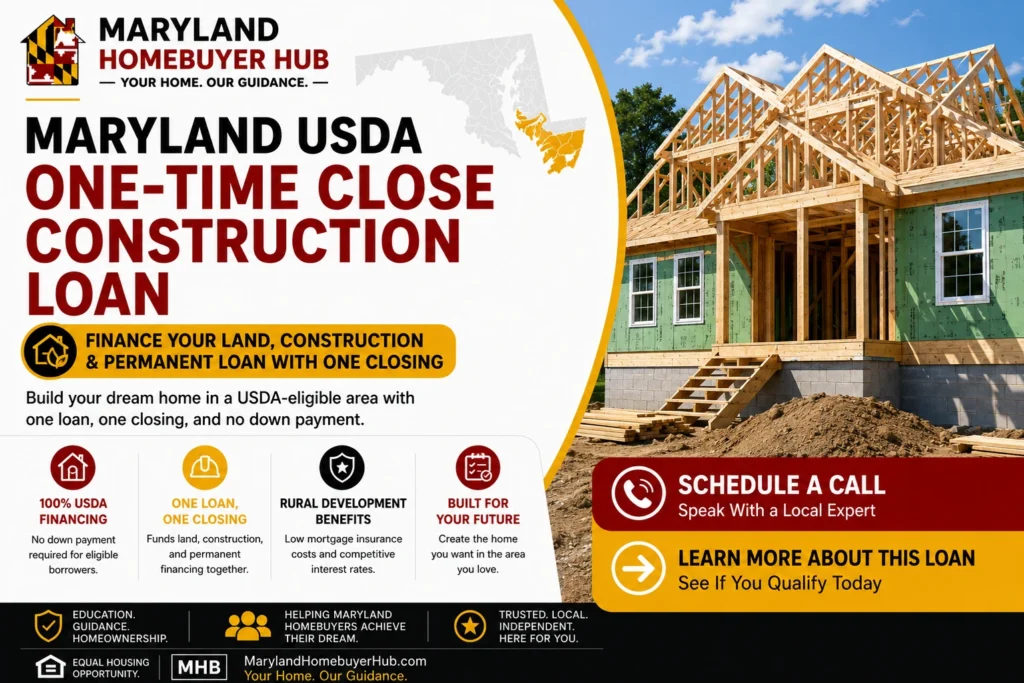
A USDA One-Time Close Construction Loan finances the land, the construction of the home, and the permanent USDA mortgage in a single loan with one closing — and that closing happens before construction begins.
You qualify once and sign once. There is no second application, no second underwriting review and no second set of closing costs. And because it is a USDA loan, eligible buyers can finance 100% of the project with no down payment.
Two things decide whether you can use it: the property has to be in a USDA-eligible area, and your household income has to fall within the limit for that location. Neither is about the house you want to build — both are about where you build it and who you are.
USDA calls this a combination construction and permanent loan. The mechanics are set out in federal regulation, which makes this one of the more precisely defined construction products available — a genuine advantage when you are trying to work out what is a real rule and what is simply one lender’s preference.
The single most distinctive feature is easy to miss and worth understanding early: the loan is guaranteed by USDA after closing, without waiting for the house to be finished. The government backing is in place from day one, not at the end.
Can USDA really finance 100% of a new construction home?
Yes — and this is the reason the program exists. USDA is the only widely available construction financing that requires no down payment from a buyer who is not a veteran.
The maximum loan is the lesser of two figures: the market value of the completed property as determined by the appraisal (plus the upfront guarantee fee, if you finance it), or the total of the purchase price and eligible acquisition costs.
What the loan can actually include
- The price of the lot
- Construction costs, including architectural and engineering fees, building permits and fees, surveys and title updates
- A contingency reserve for cost overruns, up to a percentage USDA sets
- Draw control and inspection fees, and builder’s risk insurance
- Landscaping costs
- Reasonable and customary closing costs
- Interim construction interest, and a reserve for principal, interest, taxes and insurance
That list is unusually generous. Site work, permits and the professional fees that quietly consume a construction budget are financeable rather than out-of-pocket.
“100% financing” is not the same as “no money needed”
USDA can finance the full purchase price, but you may still need funds for reserves, closing costs or a minimum contribution depending on how your file is structured and what your lender requires.
There is also a hard ceiling worth knowing: a newly constructed dwelling that cannot meet USDA’s inspection and warranty requirements is limited to 90% of market value. Meeting those requirements is what preserves 100% financing.
One more requirement that catches people by surprise: the home must meet or exceed the International Energy Conservation Code in effect at the time of construction. Any competent Maryland builder will already be building to code, but it is worth confirming in writing rather than assuming.
Can the loan include the land — and what if you already own it?
Both work, and this flexibility is one of the program’s real strengths.
- Buying the lot as part of the transaction. The loan closes, and proceeds cover the purchase of the land with the balance going into a construction escrow.
- Paying off land you are still financing. If you bought a lot with a land loan, the balance owed can be covered at closing and wrapped into the construction loan.
- Building on land you already own outright. Your equity in the lot works in your favour toward the overall project.
- Land that was gifted to you, within USDA’s gift rules.
Whichever applies, the lender must document the acquisition, transfer of ownership, or your existing ownership of the land as part of the file. If a family member is deeding you a piece of ground, start that paperwork early rather than treating it as a formality.
Where in Maryland can you use a USDA construction loan?
This is the first gate, and the most misunderstood one. “Rural” in USDA’s sense does not mean farmland or the middle of nowhere. It is a designation applied to areas outside the state’s major urbanised centres, and it covers a great deal more of Maryland than most buyers assume.
How to think about Maryland eligibility
Maryland’s population is concentrated along the Baltimore–Washington corridor. Move outward — toward the Eastern Shore, Southern Maryland, Western Maryland, and the outer edges of the central counties — and eligible areas become common rather than exceptional.
Plenty of established small towns with schools, shops and public water qualify. Eligibility is about designation, not about how remote a place feels.
What matters practically is that eligibility is determined address by address. Two lots on opposite sides of the same road can fall differently. A designation that applied five years ago may not apply now, because USDA revises the maps.
For that reason this page does not publish a list of eligible Maryland towns. Any such list would be out of date before it was useful, and an inaccurate one could send you to a lot that cannot be financed. Check the specific address on USDA’s property eligibility site, and confirm it with your lender before you commit to a parcel.
Check the exact address, not the town
Eligibility boundaries do not follow town limits, postal codes or county lines. Checking “is this town eligible” is not the same question as “is this parcel eligible,” and only the second one matters.
How USDA income limits work
The second gate. USDA is a moderate-income program: at the time of loan approval, your household’s adjusted income must not exceed the applicable moderate income limit for the area.
Three features of that sentence do most of the work, and each one trips someone up:
- It is household income, not borrower income. USDA counts income from adult members of the household, including people who will not be on the loan.
- It is adjusted income. Certain deductions apply, so the figure USDA measures is not simply your gross pay. Households that look over the limit on paper sometimes are not.
- The limit varies by location and household size. A larger household is allowed more income, and the threshold differs across Maryland.
Because these limits are revised periodically, this page deliberately does not publish a Maryland income table. A stale figure would do more harm than no figure. Current limits are published by USDA and can be checked by address and household size, and any lender who originates these loans can run yours in a few minutes.
What types of homes can you build?
The program finances an owner-occupied, single-unit primary residence. Investment properties, second homes and multi-unit buildings are outside the program entirely, as are temporary or short-term housing arrangements.
Within that, three construction types are eligible:
- Site-built (stick-built) single family homes — the standard path
- Modular homes, built in sections to state and local building codes and assembled on a permanent foundation
- New manufactured homes, subject to the additional requirements below
Condominiums are ineligible — all of them
USDA regulation excludes condominiums from combination construction and permanent loans, and that exclusion expressly includes detached condominiums and site condominiums.
This catches people out because a detached site condo can look exactly like an ordinary single family house on its own lot. The legal form is what disqualifies it, not the appearance. Check how the parcel is titled before you go under contract.
The dwelling must also be modest, decent, safe and sanitary — USDA’s general standard for the homes it guarantees.
Manufactured and modular homes
A new manufactured home can be built and financed on this program, but it carries a distinct rule set. Most of it is federal regulation rather than lender preference, which is unusual and useful to know.
If a manufactured home is what you are actually considering, our Maryland USDA manufactured home loan guide covers that route in full, including the rules that apply to the unit itself.
| Requirement | What applies |
|---|---|
| Age and history | New units only. An existing manufactured home moved from another site cannot be financed. |
| Minimum size | Floor space of not less than 400 square feet |
| Foundation | Permanent foundation meeting HUD standards and the manufacturer’s installation requirements, with a certification of proper foundation |
| Running gear | All wheels, axles, towing hitches and running gear must be removed |
| Construction standard | Must conform to the Federal Manufactured Home Construction and Safety Standards and HUD heating and cooling requirements for Maryland |
| Energy code | Must meet or exceed the IECC in effect at the time of construction |
| Labels | A data plate inside the unit and a certification label on each transportable section |
| Warranty | HUD warranty identifying the unit by serial number, plus certification of no hidden transportation damage and that sections were properly joined and sealed |
| Titling | Taxed as real estate, with a perfected lien covering both the home and the land and the certificate of title surrendered where State law permits |
| Title insurance | Standard real property policy plus any endorsement required locally confirming the home is part of the real property |
| Leasehold or condominium | Not eligible — the loan must be secured by both the home and the land you own |
One widely quoted rule that is a lender standard, not a USDA rule
You will often see that USDA construction financing requires a multi-wide unit and excludes single-wides. USDA’s regulation sets a 400 square foot minimum and does not itself prohibit single-section homes.
In practice most lenders and investors do require multi-wide, so treat it as a real constraint when shopping — but ask, rather than assuming it is federally mandated. It is one of the places where lenders genuinely differ.
Modular homes are simpler. Because they are built to the same state and local codes as site-built construction and set on a permanent foundation, they are generally treated much like a stick-built house once assembled, without the manufactured-home-specific requirements above.
What happens during construction
The closing happens before construction starts. At that closing, loan proceeds cover the land, and the remaining funds go into a construction escrow. Nothing is handed to you and nothing is handed to the builder in a lump sum.
Two USDA-specific details are worth knowing. Interest accruing during the build is paid monthly, either by you directly or from an interest reserve established for that purpose, and the lender may fund reserves covering up to twelve months of principal, interest, taxes and insurance after completion. When the house is finished, the lender obtains certification of completion and any money left in the construction escrow or reserve accounts is applied to your loan as a principal curtailment rather than returned as cash.
The mechanics common to every construction loan — how draws are requested and inspected, how contingency reserves and change orders work — are covered in our Maryland construction loans guide.
From there, money is released in draws as work is verified complete. The regulation is specific about how that works, and one provision deserves your attention more than any other.
You must approve every draw in writing
USDA requires the lender to obtain your written approval before each draw payment is provided to the builder. You and the lender are jointly responsible for approving disbursements during construction, and the lender must confirm the appropriate work has been completed before releasing each draw.
This is real leverage, and it is federally required rather than a courtesy. Walk the site before you sign. The homeowners who run into trouble are usually the ones who treated the draw approval as a formality.
USDA may also require the lender to produce a draw and disbursement ledger for any guaranteed loan on request, so the paper trail is genuinely maintained rather than nominal.
If something goes wrong mid-build
This is a meaningful protection that construction borrowers rarely know about. If an unplanned change with you or the contractor prevents the home from being completed, the lender remains responsible for completing the improvements to Rural Development’s satisfaction. You are not simply left with a half-built house and a loan.
Do you make mortgage payments while the home is being built?
Usually not — but the reason is worth understanding, because it is a structuring choice rather than an automatic feature.
USDA’s regulation states that interest on the construction loan is payable monthly either directly from the borrower or indirectly drawn from an established interest reserve. Both are permitted. When your lender funds an interest reserve, the reserve pays the construction-period interest and you pay nothing out of pocket.
Two further provisions support the same outcome:
- The first regularly scheduled amortised principal and interest payment may be postponed up to one year, based on the construction period.
- Lenders may fund a reserve for up to 12 months of principal, interest, taxes and insurance.
Real estate taxes and property insurance falling due during construction can be paid through the same draw process.
Ask how your lender is structuring it
“No payments during construction” is the normal outcome, not a guarantee written into the program. Because USDA permits the borrower to pay construction interest directly, confirm in writing that an interest reserve is being funded and how many months it covers.
That single question separates a comfortable build from an unwelcome monthly bill on top of your existing rent or mortgage.
How construction interest and the guarantee fee are handled
Interim construction interest is an eligible loan purpose — it can be financed into the loan rather than paid from savings. So can a PITI reserve.
The guarantee fee works differently from what most buyers expect, and the timing surprises people:
- There is a one-time upfront guarantee fee, which can generally be financed into the loan.
- There is an annual fee collected monthly for the life of the loan. By regulation it may not exceed 0.5% of the outstanding principal balance; USDA sets the actual rate, which is lower, and revises it periodically.
- The annual fee begins the month immediately following loan closing — that is, during construction, not when you move in — and is not affected by the re-amortisation that happens when construction finishes.
Because the fee percentages are set by USDA and change, this page does not publish current figures. Ask your lender for the current upfront and annual fee before you finalise a budget.
How the interest rate works
USDA’s rule here is short and important: the interest rate for the construction and the permanent loan is established at the time the rate is locked, and the lock must occur before closing. One rate, set at the outset, covering both phases.
That is genuinely valuable. You are not exposed to a year of rate movement and then handed whatever the market offers when the house is finished, which is exactly what happens on a two-close construction loan.
Rate protection beyond that is a lender product, not a USDA feature
Some construction lenders offer additional protection — extended locks, or an option to move to a lower rate if the market falls before completion. USDA neither requires nor provides any of this. Availability, cost, and whether any adjustment is automatic or must be requested all vary by lender.
If rate protection matters to you, ask each lender to put their specific structure in writing. Treat a float-down as something to verify, never as a program benefit you are entitled to.
This page does not publish interest rates or rate examples. Any figure would be stale within weeks, and the structure — not the number — is what you actually need to understand before choosing a lender.
How the appraisal works before the house exists
A licensed or certified appraiser establishes the fair market value of the completed home from your plans, specifications and cost breakdown, compared against similar finished properties nearby. That value sets the maximum loan amount.
Three consequences follow, and they are the same ones that decide every construction file:
- Detailed plans produce better values. An appraiser can only value what is documented.
- Comparable sales govern. If nothing similar has sold nearby, supporting the value is harder — a real consideration on unusual designs and in thinly traded rural markets.
- Proposed-construction appraisals take longer than appraising an existing house. Build the time into your schedule.
Inspections and warranties matter here too, and not only for quality. A newly built home that cannot meet USDA’s inspection and warranty requirements is capped at 90% of market value instead of 100% — so the documentation is directly tied to your down payment.
What the builder has to do
On a USDA construction loan the builder is vetted as carefully as the borrower, and the standards are set in regulation rather than left to each lender.
USDA sets a floor here that is unusually specific. Under 7 CFR § 3555.105 the contractor must have at least two years of experience building all aspects of single family dwellings and must carry commercial general liability coverage of at least $500,000.
Three separate gates apply, and clearing one says nothing about the others: USDA sets the program floor above, your lender reviews that specific builder’s experience, finances, insurance and references before agreeing to administer draws, and Maryland separately requires home builders doing business in the state to be registered as a consumer-protection matter. Our Maryland construction loans guide explains how to verify state registration and what to confirm before you sign a builder contract.
| Applies to | Requirement |
|---|---|
| Builder experience | At least two years building all aspects of single family dwellings similar to the proposed project |
| Builder licensing | State-issued construction or contractor licences, as required by State or local law |
| Builder insurance | Commercial general liability of at least $500,000 |
| Builder’s own home | Contractors or builders constructing their own residence are ineligible |
| Lender experience | The lender must have two or more years of experience making and administering construction loans |
| Construction contract | An executed construction contract must be submitted with the loan application package |
| Builder approval | The lender must review and approve the builder and conduct due diligence, with evidence available to USDA on request |
The lender-experience requirement is the quiet reason this loan is harder to find than an FHA or conventional construction loan. A lender cannot simply decide to offer it — they need a genuine track record in construction lending. Availability, rather than eligibility, is often the binding constraint.
Can you build the house yourself?
No. Self-help and sweat-equity arrangements do not fit this program. You must contract with a qualified third-party builder, and the borrower is not the one performing the work.
USDA’s regulation is explicit at one end of this: a contractor or builder constructing their own residence is ineligible. So even a licensed Maryland builder who wants to build their own home on this financing has to hire someone else to do it.
Why the rule exists
The lender is responsible for completing the improvements if the project stalls, and every draw is tied to verified work by an approved contractor carrying insurance. Owner-built work has no licensed party standing behind it, no commercial liability coverage, and no independent completion path.
If sweat equity is central to your plan, a USDA one-time close is not the right product — and it is far better to establish that now than after you own the land.
Credit and qualifying requirements
Beyond the location and income gates, you must qualify the way you would for any USDA loan — this is a regular USDA Guaranteed loan that happens to build the house first.
Debt ratios. USDA works to two benchmarks: the housing payment should not exceed 29% of repayment income, and total debt should not exceed 41%. Both are set in regulation.
Those are benchmarks rather than absolute ceilings. Ratios may be exceeded where documented compensating factors exist, and USDA’s automated underwriting system weighs those factors. On a manually underwritten file the lender must document the compensating factors, and a debt ratio waiver may be granted — commonly discussed in terms of ratios up to 32% and 44%. USDA sets the acceptable factors and maximum thresholds in its handbook, and notes that compensating factors do not strengthen an exception when several layers of risk are stacked in one application.
USDA does not publish a minimum credit score
There is no credit score minimum in USDA’s regulation. What exists in practice is a layered set of thresholds: automated underwriting treats files differently depending on credit profile, and individual lenders apply their own floors — 620 is a common one, and some set it higher.
Because the floor is a lender decision, it varies, and it is worth asking directly rather than assuming you have been ruled out.
Other qualifying points that come straight from regulation:
- Primary residence only, with the ability to occupy the home
- Citizenship or qualified alien status evidenced to USDA’s satisfaction
- Legal capacity to incur the obligation
- Applicants suspended or debarred from federal programs are ineligible
- Certain items are excluded from the total debt ratio, including retirement contributions, savings, commuting costs, union dues and childcare
- Gift funds are allowable within USDA’s rules, and interested-party contributions are capped at 6% of the sales price
Current homeowners are not automatically excluded either, though the conditions are specific — broadly, that the existing home no longer meets your needs and you will occupy the new one.
USDA rule or lender rule?
This distinction saves more time than anything else on this page. When a lender tells you something is impossible, the useful follow-up question is “is that USDA, or is that you?” — because if it is the lender, another lender may answer differently.
| Item | USDA position | What varies by lender |
|---|---|---|
| Minimum credit score | None in regulation | The floor itself — commonly 620, sometimes higher |
| Debt ratios | 29% housing and 41% total debt, exceedable with documented compensating factors | Appetite for waivers and how aggressively they are pursued |
| Builder qualifications | Two years experience, State licensing, $500,000 liability insurance | Additional vetting, references and financial review |
| Draw approvals | Your written approval required before every draw | Draw schedule design and inspection logistics |
| Payments during construction | Interest payable by the borrower or from an interest reserve | Whether a reserve is funded, and for how many months |
| Contingency reserve | Permitted, up to a percentage USDA specifies | Whether one is required, and the percentage applied |
| Interest rate | Locked once, before closing, covering both phases | Lock length, cost, and any float-down or cap product |
| Manufactured homes | 400 sq ft minimum; new units only; no relocated units | Multi-wide requirements and home-type restrictions |
| Construction period | First amortised payment may be deferred up to one year | The completion deadline written into your contract |
| Self-build | Builders may not construct their own residence | Little — third-party builders are required throughout |
| Condominiums | Ineligible, including detached and site condos | Nothing — this is absolute |
What happens when construction is finished
Completion triggers a defined sequence rather than a new application:
- Final inspection. The property is inspected at 100% completion, and the lender obtains documentation confirming construction is complete.
- Certification and clear title. The file must evidence that construction costs were fully drawn and that the property is free and clear of all other liens after conversion to the permanent loan.
- Leftover funds go to principal. Anything remaining in the construction escrow or PITI reserve is applied as a principal curtailment — it reduces your balance rather than being paid out to you.
- Modification and re-amortisation. The loan is modified and re-amortised so it fully repays within its remaining term, and you begin making regular principal and interest payments.
The one exception worth asking about
If your lender funded a reserve covering up to 12 months of principal, interest, taxes and insurance, USDA does not require a loan modification after construction is complete. The payment is settled from the outset.
The two structures feel quite different to live through, so ask which one your lender uses before you close.
What does not happen at completion is just as important: no requalification, no second closing, and no new interest rate. Your rate was locked before construction began.
USDA compared with FHA, VA and conventional construction
Four single-close construction paths exist in Maryland. The right one is usually decided by eligibility rather than preference — most buyers do not qualify for all four.
The full guides sit alongside this one: FHA One-Time Close when credit is the limiting factor, VA One-Time Close if you have entitlement, and Conventional One-Time Close when the lot falls outside a USDA-eligible area or household income runs over the limit. Maryland construction loans compares all four.
| Program | Down payment | Who can use it | The main constraint |
|---|---|---|---|
| USDA | None | Buyers within the income limit, building in an eligible area | Location and household income both have to work |
| VA | None with full entitlement | Eligible veterans and service members | Requires VA eligibility; fewer lenders offer it |
| FHA | 3.5% minimum investment | Open to buyers generally, including lower credit profiles | Mortgage insurance, and the county FHA loan limit |
| Conventional | Typically 5% or more | Buyers with stronger credit and available funds | The largest cash requirement of the four |
The practical hierarchy for most Maryland buyers is straightforward. If you are a veteran, VA is usually the strongest option. If you are not, and the lot is in a USDA-eligible area and your household income fits, USDA is normally the best of the remaining three because it is the only one requiring no down payment. FHA is the fallback when location or income rules USDA out, and conventional makes sense when you have the funds and the credit to benefit from it.
Compare this option with other Maryland construction loan programs.
Our Maryland FHA loans guide covers FHA financing more generally if that is the likely path.
Find out which construction path you actually qualify for
Location, household income and eligibility decide this before credit and budget ever come into it. All three are quick to check, and knowing them changes how you shop for a lot.
This is not a commitment to lend. All loans subject to credit approval.
Availability, and what this loan does not include
We currently offer USDA One-Time Close. That is worth saying plainly, because construction-to-permanent lending is more specialized than ordinary USDA purchase financing: it adds builder review, draw administration and inspection oversight, and participation among lenders is narrower as a result. If you are comparing lenders, ask whether they originate USDA combination construction to permanent loans specifically.
Our current construction loan options do not include down payment assistance. Assistance programs are generally built around purchase transactions, and the Maryland Mortgage Program does not publish a construction-to-permanent product. If assistance is central to your plan, a completed home purchase is the practical route — our Maryland down payment assistance guide covers those options. On a USDA build the more useful lever is usually the land itself, since a lot you already own contributes value to the completed property rather than cost you have to finance.
If you are weighing whether this is the right structure at all, start here or schedule a call before you commit to a parcel or sign a builder contract.
When USDA construction financing makes sense
It is a strong fit when:
- You want to build rather than buy, and you have little or no down payment
- The lot you want is in a USDA-eligible area, or you are still choosing where to build
- Your household income falls within the limit for that location
- You cannot find the house you want in the Maryland market you want to live in
- You already own land, or a family member is deeding you a parcel
- You cannot afford to pay rent and a construction payment at the same time
- You want the rate settled before construction rather than a year later
- You have a licensed, experienced builder willing to work on a draw schedule
Another path is probably better when:
- You are a veteran — VA construction financing has no income limit and no location restriction
- The lot is not in an eligible area, and you are not willing to move your search
- Your household income exceeds the limit — FHA or conventional construction has no income cap
- You want to do some of the work yourself
- You are building a second home or an investment property
- The parcel is a detached or site condominium
- You need to close quickly and cannot wait for a construction file to be assembled
Before you buy the lot — the USDA angle
Land is the hardest part of a build to undo. A house can be redesigned and a builder replaced; a lot that does not work cannot be moved. On USDA the risk is sharper than on other programs, because two things have to be true about the parcel before financing is even a conversation.
The USDA questions belong to this page: is the exact address in an eligible area, does your household income fall within the applicable limit, will the completed home appraise for enough to support the loan, and will your builder meet USDA’s requirements. Confirm eligibility on the specific parcel through USDA’s eligibility tool before you write an offer, not after.
The site questions are answered locally and have nothing to do with USDA: septic and percolation approval, water supply, permits, Chesapeake Bay Critical Area review where the parcel sits near tidal water, and flood zone. USDA eligibility does not make a Maryland lot buildable. Our Maryland construction loans guide covers each of those checks and who to ask about them.
The order that protects you: confirm USDA eligibility and your budget, then put the lot under contract with contingencies for septic and permits, then commit.
The process, from pre-approval to move-in
- Check the two gates. Confirm the property address is in a USDA-eligible area and that your household income fits the limit. Everything else depends on these.
- Get pre-approved. Credit, income and repayment ratios reviewed against the estimated finished payment — before land, before plans, before a builder deposit.
- Choose the lot and the builder. Confirm zoning, water and sewer, and that the builder meets USDA’s experience, licensing and insurance requirements.
- Plans, specifications and the construction contract. The builder produces detailed plans, a materials specification and a cost breakdown, and the executed construction contract goes in with the application package.
- Appraisal. The proposed completed home is valued against comparable finished properties, setting the maximum loan amount.
- Underwriting. You and the project are reviewed together. Both have to work.
- One closing, before construction begins. Proceeds cover the land, the balance goes into construction escrow, and your rate is already locked.
- The guarantee is issued. USDA issues the Loan Note Guarantee after closing, without waiting for the home to be finished.
- Construction and draws. Funds release to the builder at verified milestones. You approve each draw in writing — walk the site before you sign.
- Final inspection at 100% completion, with documentation confirming construction is complete and the property free of other liens.
- Conversion. Leftover escrow is applied to principal, the loan is modified and re-amortised if required, and regular payments begin. Move in.
Common mistakes
- Buying the lot before checking eligibility. The single most expensive mistake available on this program, because the location gate cannot be argued with.
- Checking the town instead of the address. Eligibility boundaries do not follow town limits or postal codes.
- Assuming “rural” means remote. Buyers rule themselves out of established Maryland towns that actually qualify.
- Assuming you earn too much. USDA measures adjusted household income, and larger households get higher limits.
- Forgetting the non-borrower household income. It counts, and it surprises people late in the process.
- Not asking how construction interest is being handled. USDA allows the borrower to pay it directly; assume nothing.
- Missing that the annual fee starts during construction, not at move-in.
- Budgeting the house and forgetting the site. Well, septic, grading, driveway and utility runs are real money on a raw Maryland lot.
- Buying a detached or site condominium. It can look like an ordinary house and still be ineligible.
- Treating draw approvals as a formality. Your written approval is federally required leverage. Use it.
- Assuming your lender offers it. USDA requires two years of construction lending experience, so many lenders simply cannot.
- Planning on sweat equity. The program does not accommodate it at all.
Frequently asked questions
When does the annual guarantee fee start?
The month immediately following loan closing — during construction, not when you move in. It is also unaffected by the re-amortisation that happens at completion.
Is my interest rate locked before construction?
Yes. USDA requires the rate for the construction and permanent loan to be established at lock, which must happen before closing. Additional protection such as an extended lock or a float-down is a lender product rather than a USDA feature, so ask each lender to describe theirs in writing.
Can I act as my own builder or do some of the work myself?
No. The program requires a qualified third-party builder, and USDA regulation makes contractors building their own residence ineligible. Sweat equity does not fit this loan.
What does my builder have to prove?
At minimum, two or more years of experience building comparable single family homes, State-issued licensing where required, and commercial general liability insurance of at least $500,000. Your lender must review and approve them and keep the evidence on file.
Can I build a manufactured home?
Yes, if it is new. It must be at least 400 square feet, set on a permanent foundation meeting HUD and manufacturer standards with a foundation certification, have wheels and running gear removed, carry a data plate and a certification label on each section, and end up taxed as real estate with the lien covering both home and land. Existing units moved from another site are not eligible.
Does USDA require a multi-wide manufactured home?
USDA’s regulation sets a 400 square foot minimum and does not itself prohibit single-section homes. Most lenders and investors do require multi-wide, so treat it as a practical constraint and ask the specific lender rather than assuming it is a federal rule.
Can I build a condominium or a detached condo?
No. USDA regulation excludes condominiums from combination construction and permanent loans, and the exclusion expressly covers detached and site condominiums. Check how the parcel is titled before you go under contract.
What credit score do I need?
USDA does not publish a minimum in its regulation. Lenders set their own floors — 620 is common and some require more — and automated underwriting weighs your whole profile. Because the floor is a lender decision, it varies and is worth asking about directly.
What debt ratios apply?
USDA works to 29% for the housing payment and 41% for total debt. Both can be exceeded with documented compensating factors, and a debt ratio waiver may be granted — commonly discussed in terms of 32% and 44%. Compensating factors carry less weight when multiple layers of risk are present.
Do I have to requalify when the house is finished?
No. You qualify once, before construction. At completion the loan is modified and re-amortised, or settled without modification if a 12-month PITI reserve was funded. There is no second underwriting review, no second closing and no new rate.
What happens to money left over in escrow?
It is applied as a principal curtailment, reducing your loan balance. Borrowers do not receive funds after closing, apart from certain unused prepaid expenses paid with personal funds.
What if my builder cannot finish the house?
If an unplanned change with the borrower or contractor prevents completion, the lender remains responsible for completing the improvements to Rural Development’s satisfaction. It is a meaningful protection and one most construction borrowers do not know they have.
Can I use down payment assistance or a Mortgage Credit Certificate?
Not with our USDA construction loan. Our current construction loan options do not include down payment assistance. Assistance programs are generally written around purchase transactions, and the Maryland Mortgage Program does not publish a construction-to-permanent product. That is a statement about what we offer today rather than about every lender everywhere. If assistance is what gets you to closing, a completed home is the workable route — see Maryland down payment assistance.
How easy is this loan to find?
Harder than an ordinary USDA purchase loan. Construction-to-permanent lending adds builder review, draw administration and inspection oversight, so participation among USDA lenders is narrower than for standard purchase financing. We currently offer USDA One-Time Close. If you are shopping elsewhere, ask specifically whether the lender originates USDA combination construction to permanent loans rather than whether they “do USDA.”
Does the home have to be my primary residence?
Yes. USDA will not guarantee loans for investment properties or temporary, short-term housing, and you must have the ability to occupy the home as your principal residence.
Sources
- 7 CFR § 3555.105, Combination construction and permanent loans — the appraised market value basis for the maximum loan, the price of the lot as an eligible cost, interest paid monthly or drawn from an interest reserve, lender-funded reserves of up to 12 months of principal, interest, taxes and insurance after completion, the contractor’s minimum two years of experience building single family dwellings and commercial general liability coverage of at least $500,000, certification of construction completion, and the application of leftover escrow funds as a principal curtailment.
- 7 CFR §§ 3555.102, 3555.103, 3555.151 and 3555.208 — loan restrictions including existing manufactured homes, the maximum loan amount, the adjusted household income limit, and the special requirements that apply to manufactured housing.
- USDA Rural Development Handbook HB-1-3555, the Single Family Housing Guaranteed Loan Program technical handbook — the operating guidance lenders follow, including the combination construction to permanent chapter.
- USDA property and income eligibility — the official tools for checking whether a specific address sits in an eligible area and whether household income falls within the applicable limit.
- USDA Single Family Housing Guaranteed Loan Program — program overview, including the upfront guarantee fee and annual fee that USDA sets and publishes.
Regulatory sources verified August 24, 2026 and re-verified September 2, 2026. Current guarantee fee percentages, minimum credit scores and multi-wide manufactured housing details are deliberately omitted here because USDA revises them and lenders apply their own overlays; confirm both with a lender before you plan around them.
This page explains how USDA single-close construction financing generally works for Maryland homebuyers. It does not determine individual eligibility, is not a commitment to lend, and is not a Loan Estimate. Any figures shown are arithmetic illustrations, not quotes, and no interest rate is offered or implied. Program terms are set by the United States Department of Agriculture, Rural Development, and participating lenders may apply additional requirements that differ from lender to lender. Property and income eligibility must be confirmed against USDA’s current resources for the specific address and household. Maryland Homebuyer Hub is not affiliated with, endorsed by, or acting on behalf of the United States Department of Agriculture, Rural Development, or any government agency.