
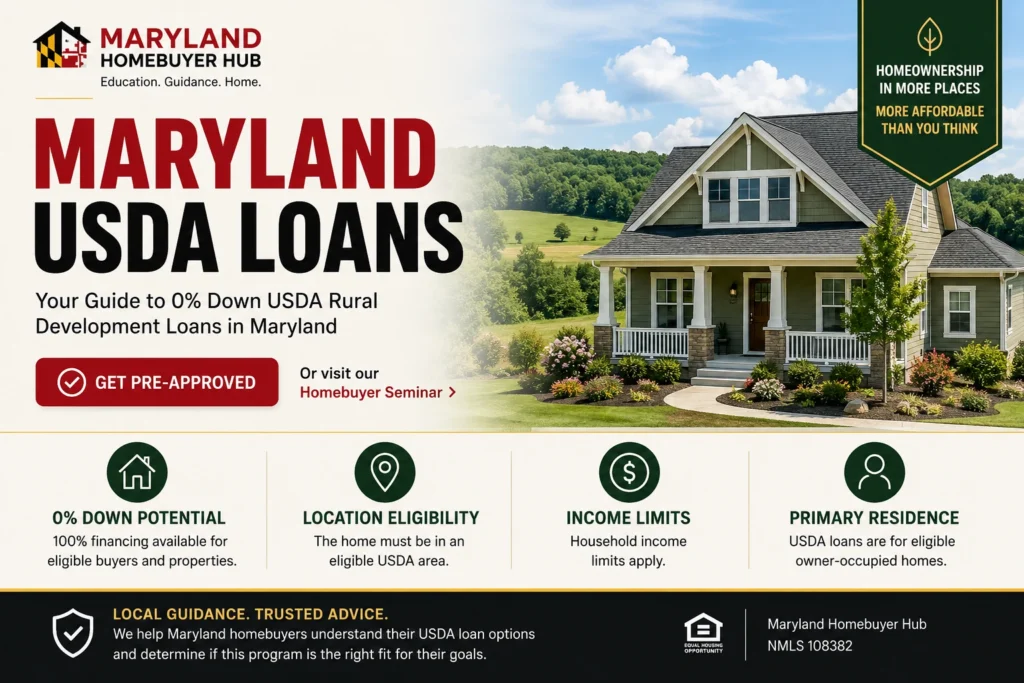
What is a USDA loan in Maryland?
Short answer: a USDA loan is a mortgage made by an approved lender and backed by the U.S. Department of Agriculture, which lets eligible buyers finance 100% of the purchase price on a primary residence located in an area USDA has designated as rural. There is no down payment requirement for buyers who qualify.
The full name is the Section 502 Guaranteed Loan Program, run by USDA Rural Development. USDA does not lend the money and does not set your rate. An approved lender does both. What USDA provides is a guarantee to the lender covering a portion of any loss, and that backing is what makes zero-down lending possible on ordinary terms.
Two things a USDA loan is not
It is not a farm loan. You do not need to farm, and you do not need agricultural experience. In fact the opposite is closer to the truth: USDA rules specifically make property used primarily for farming, agriculture or commercial enterprise ineligible. This program finances ordinary owner-occupied houses.
It is not limited to first-time buyers. USDA regulations expressly contemplate current homeowners qualifying, provided certain conditions are met. Having owned a home before does not disqualify you.
Guaranteed vs. Direct: which one this page covers
USDA runs two different Section 502 programs, and they are routinely confused:
- Section 502 Guaranteed — you apply through a regular approved mortgage lender, and USDA guarantees the loan. This is the program almost every Maryland buyer means when they say “USDA loan,” and it is what this page covers.
- Section 502 Direct — USDA itself is the lender, and it is aimed at low- and very-low-income households. It has its own separate income limits, its own application process through a USDA office, and features such as payment assistance that the Guaranteed program does not have.
If a lender is talking to you about a USDA loan, it is almost certainly the Guaranteed program.
The two questions that decide whether USDA is even possible
Before anything else, USDA asks two yes-or-no questions
Most mortgage programs start with you — your credit, your income, your savings. USDA starts with two gates that have nothing to do with how strong a borrower you are:
- 1. Is the property in an area USDA has designated as rural? This is decided by the address, not by the county, the town or your impression of the neighbourhood.
- 2. Is the household’s adjusted income at or below the applicable limit? USDA counts the income of everyone in the household, not just the people on the loan.
If either answer is no, USDA is off the table no matter how well you would otherwise qualify. If both are yes, then the normal mortgage questions begin — credit, debt ratios, repayment ability and the property’s condition.
This is the single most useful thing to understand about USDA, because it saves people from either dismissing the program too early or falling in love with a house that can never be financed this way. Work the two gates first. Everything else is the second conversation.
The rest of this guide follows that order: property first, household income second, then qualification, cost and process.
What areas of Maryland qualify for a USDA loan?
Short answer: USDA maintains official maps of designated rural areas, and eligibility is determined by the specific property address. No Maryland county, city, town or ZIP code is uniformly eligible or ineligible, so the only reliable answer comes from looking up the address.
“Rural” does not mean remote
The word does a lot of damage here. USDA’s designation is a mapping decision, not a description of how isolated a place feels. Plenty of designated areas contain subdivisions, paved roads, schools and shopping. Buyers regularly discover that a house they assumed was far too ordinary sits inside an eligible area — and equally, that a genuinely countrified-looking property just outside a growing town does not.
How this tends to play out in Maryland
Maryland’s population is heavily concentrated in the Baltimore–Washington corridor, and dense, built-up areas are generally less likely to carry a rural designation. Move outward — toward the Eastern Shore, Western Maryland, and parts of Southern Maryland and the northern and outer edges of the state — and designated areas become considerably more common.
Why we will not publish a list of “USDA eligible Maryland towns”
You will find pages that name Maryland counties or ZIP codes as USDA eligible. Treat them carefully. Designations are drawn to boundaries that do not follow county or postal lines, so a single town can contain both eligible and ineligible addresses — sometimes on opposite sides of the same road.
Boundaries also change. USDA reviews designations periodically, and areas can be removed. The regulation does provide protection once you are far enough along: if an area’s designation changes to nonrural, existing conditional commitments are honoured, and loan requests where the application and purchase contract were already complete before the change may still be approved.
How to check an address
USDA publishes the authoritative lookup. Enter the exact address rather than browsing the map by eye, because the boundaries are finer than they appear at a distance:
- Use USDA’s official property eligibility lookup and enter the full street address.
- Check before you write an offer, not after.
- Re-check if a property has been sitting since a previous map update.
- Have your lender confirm the result on the actual subject property.
If you are still narrowing down where in the state to look, our Maryland counties guide covers what each part of the state is like to buy in.
What are the Maryland USDA income limits?
Short answer: a household’s adjusted income must not exceed the applicable moderate income limit at the time of loan approval. USDA sets those limits by area and household size, and Maryland’s vary by county and metropolitan area.
USDA describes the program as serving low- and moderate-income households, with income eligibility generally capped at 115% of the area’s median household income. Because that is a percentage of a local median, the dollar figure in Worcester County is not the dollar figure in Montgomery County.
Why there is no income table on this page
USDA’s income limits change, and they are published through USDA’s own tools rather than as a simple statewide figure. Rather than print numbers that may be out of date by the time you read this, we would rather send you to the source: USDA’s income eligibility tool asks for your county, household size and household composition and applies the current limit.
What USDA actually counts
The calculation surprises people, so it is worth being precise. USDA’s income test looks at the whole household, then subtracts specific deductions:
- Annual income is the income of all household members, whether or not they will be on the loan. Lenders verify each adult household member’s income and project the next twelve months.
- Certain income is excluded, including the earned income of household members under 18 who are not an applicant or spouse.
- Adjusted annual income is annual income minus verified deductions, and this is the number tested against the limit. Deductions may include an allowance for each dependent under 18, for household members who are full-time students or have a disability, certain childcare costs for a child aged 12 or under, certain disability-related care expenses, and an elderly family deduction.
That deduction structure matters. A household that looks slightly over the limit on gross income can land under it once dependents and eligible expenses are accounted for. This is a calculation worth having done properly rather than estimating.
Household income vs. qualifying income: the distinction that trips people up
USDA uses two different income figures for two different purposes
They are not the same number, and confusing them is the most common reason a USDA conversation goes sideways.
- Program eligibility uses adjusted annual income — everyone in the household, minus deductions. This decides whether USDA will back the loan at all.
- Mortgage qualification uses repayment income — only the stable, verifiable income of the people actually signing the note. This decides how much you can borrow.
So an adult relative living with you can push you over the program limit without adding a dollar to what you can qualify for. And income that counts against eligibility may not count toward affordability.
| Figure | Whose income | Used to decide |
|---|---|---|
| Annual income | All household members, on the loan or not | The starting point for the eligibility calculation |
| Adjusted annual income | Annual income minus allowed deductions | Whether the household is within the USDA limit |
| Repayment income | Only the parties signing the note | Debt ratios and how much you can borrow |
Repayment income has its own standard: it must be adequate, stable and verifiable, supported by roughly two years of history, and reasonably expected to continue. Income that cannot be verified or is not likely to continue is not used in the ratios.
Find out whether your household and the property actually fit USDA
Property designation and the household income calculation are both worth checking properly before you shop. A short call can tell you where you stand.
This is not a commitment to lend. All loans subject to credit approval.
What are the benefits of a USDA loan?
For a buyer who clears both gates, the terms are hard to beat:
- 100% financing. No down payment is required. USDA is one of only two mainstream zero-down programs, and unlike VA it is not limited to those with military service.
- Fixed rate, by rule. USDA guaranteed loans must carry a fixed rate for the life of the loan. Adjustable-rate and balloon structures are not eligible.
- No prepayment penalty. Loans requiring one are ineligible for the guarantee.
- Terms up to 30 years, with ordinary monthly amortisation and no negative amortisation.
- No first-time buyer requirement.
- No monthly private mortgage insurance. USDA charges its own fees instead — which is not the same thing, as explained below.
- The upfront guarantee fee may be financed rather than paid in cash, and the seller may contribute toward costs within USDA’s limits.
What credit score do you need for a USDA loan?
Short answer: USDA’s regulation does not set a single universal minimum credit score. It requires a verifiable credit history showing a reasonable ability and willingness to repay, evidenced by an acceptable credit score and a credit report meeting recognised agency standards. Any specific minimum you are quoted comes from the lender, not from USDA.
How USDA files are actually underwritten
Approved lenders must run USDA loans through USDA’s automated underwriting system. The regulation is careful to describe it as a tool that helps evaluate credit risk rather than a substitute for underwriter judgement, and it is explicitly not the sole determinant of whether credit is extended. Files come back with one of a few recommendations:
- Accept — the lender is generally permitted to submit minimal documentation, and does not have to separately document the credit decision.
- Refer or Refer with Caution — the file requires further review and manual underwriting to determine whether USDA’s requirements are met.
A referral is not a decline. It means a human underwrites the file, documents the credit decision and validates the credit scores used.
What counts as significant derogatory credit
For manually underwritten files, USDA names indicators that require further review and documentation, including a foreclosure completed within the 36 months before application, and a bankruptcy discharged within the 36 months before application. These trigger scrutiny rather than an automatic no.
Debt-to-income ratios
USDA uses two ratios against repayment income. A borrower is considered to have adequate repayment ability when housing costs — principal, interest, taxes, insurance, homeowners association dues, the monthly portion of the annual fee and other real estate assessments — do not exceed 29% of repayment income, and total debt including recurring monthly obligations does not exceed 41%.
Two practical notes. First, those thresholds are the benchmark for adequate repayment ability, not an absolute ceiling in every case; the automated system, documented compensating factors and the lender’s own standards all bear on the outcome. Second, several things people expect to count against them are specifically excluded from the total debt ratio, including personal income taxes, retirement contributions, savings, commuting costs, union dues and childcare.
A Maryland-specific note on a non-purchasing spouse
USDA requires the debts of a non-purchasing spouse to be counted in the applicant’s ratios if the applicant lives in a community property state. Maryland is not a community property state, so that particular rule does not apply to a Maryland purchase. If you have been told your spouse’s debts must be counted purely because you are married, ask which rule is being applied.
Does a USDA loan have mortgage insurance?
Short answer: not private mortgage insurance. USDA charges two of its own fees — a one-time upfront guarantee fee and an ongoing annual fee — and calling them PMI is inaccurate in a way that matters.
The upfront guarantee fee
A nonrefundable fee paid at closing, which the lender is permitted to pass on to the borrower and which may be financed into the loan rather than paid in cash. USDA’s regulation caps it at 3.5% of the principal obligation, and the actual rate charged is set by USDA and changes periodically. Once the guarantee has been issued the fee is not refunded.
The annual fee
An ongoing fee that USDA’s regulation caps at 0.5% of the average annual scheduled unpaid principal balance, charged for the life of the loan, applicable to both purchase and refinance transactions, and payable monthly as part of your payment.
Why we have not printed the current percentages
The figures above are the ceilings written into USDA’s regulation. The rates USDA actually charges sit below those ceilings and are reset periodically, typically with the federal fiscal year, through notices we could not retrieve from an authoritative source at the time of writing. Rather than publish a number we cannot stand behind, we would rather you get the current rate from your lender or USDA directly — it takes one question and it will be right.
Why this is not PMI
Conventional private mortgage insurance is a private insurance product tied to your equity position, and it generally comes off once you reach a set amount of equity. USDA’s annual fee is a government guarantee fee, calculated on the average scheduled unpaid balance and charged for the life of the loan. Building equity does not remove it — refinancing into a different program is what ends it. That distinction changes the long-run maths, and it is worth modelling rather than assuming.
Zero down does not mean zero cash
Short answer: USDA removes the down payment, not the closing costs. You should still plan for lender fees, title work, recording, appraisal, prepaid homeowners insurance and property tax escrows, and in Maryland the state and county transfer and recordation taxes.
There are, however, several legitimate ways USDA buyers reduce the cash required:
- Financing the guarantee fee into the loan rather than paying it at closing.
- Seller contributions toward closing costs, which USDA permits subject to its own limits and the appraised value. Ask your lender for the current cap before you negotiate.
- Gift funds from an acceptable source, with documentation.
- Maryland assistance layered on top, where the household qualifies.
Maryland homebuyer tip: the first-time buyer transfer tax break
Maryland charges a state transfer tax of 0.5% of the consideration. On a sale of improved residential property to a first-time Maryland home buyer who will occupy it as a principal residence, the rate drops to 0.25% and the transfer tax is paid entirely by the seller.
The definition is Maryland-specific: someone who has never owned residential real property in Maryland that was their principal residence. Note how this interacts with USDA — USDA has no first-time buyer requirement at all, so a repeat buyer can use USDA financing while simply not qualifying for this particular tax treatment. They are separate tests. County transfer and recordation taxes are set by each county and are unaffected.
Using USDA with Maryland assistance
The Maryland Mortgage Program can pair with a USDA first mortgage, and because USDA already requires no down payment, assistance is usually most valuable for closing costs rather than the down payment. MMP’s own income limits, purchase price limits, homebuyer education requirement and credit standards all apply on top of USDA’s rules, so it is worth pricing both routes. Our Maryland down payment assistance guide covers the state and local programs in detail.
What kind of property can you buy with a USDA loan?
USDA finances a modest, decent, safe and sanitary dwelling that you will occupy as your principal residence. Investment properties and temporary or short-term housing are not eligible.
Beyond the dwelling itself, USDA sets standards for the site:
- Site size must be typical for the area. Extra acreage is not automatically fatal, but an atypically large parcel invites scrutiny.
- No income-producing land or buildings intended principally for income production. Vacant land without eligible residential improvements, and property used primarily for agriculture, farming or commercial enterprise, is ineligible.
- Road access must be direct from a street, road or driveway, hard-surfaced or all-weather, with enforceable arrangements for maintenance where relevant.
- Adequate utilities, water and wastewater. Private systems can be acceptable where the lender determines they are adequate, safe and code-compliant and connecting to a public system is not reasonable. USDA may require inspections.
Wells and septic are common in the parts of Maryland where USDA applies
The areas of Maryland most likely to carry a rural designation are also the areas where private wells and septic systems are most common — much of the Eastern Shore, Western Maryland and outlying Southern Maryland. That is not an obstacle; USDA contemplates private systems directly. It does mean water testing and septic inspection deserve a place in your timeline and your budget, and that you should not treat them as afterthoughts in a competitive offer.
What the USDA appraisal looks at
The appraisal establishes value and also flags condition. Appraisals are performed under the Uniform Standards of Professional Appraisal Practice, and USDA requires the appraiser to report readily observable property deficiencies, potential environmental hazards and any adverse conditions found while completing the appraisal. USDA reviews appraisals before issuing its conditional commitment, and an appraisal is valid for 120 days unless USDA provides otherwise.
As with any program, the appraisal is not a home inspection and does not protect you. Get an independent inspection regardless.
What about building or renovating a home?
USDA financing can also apply to certain situations beyond purchasing a move-in-ready home. A USDA One-Time Close construction loan may be an option for an eligible borrower building a qualifying primary residence in a USDA-eligible area.
Buyers considering a home that needs improvements may also want to explore USDA renovation financing, which can provide a way to finance eligible improvements as part of the mortgage.
USDA vs. FHA vs. VA vs. conventional in Maryland
USDA is excellent when it fits and irrelevant when it does not, which makes the comparison unusually clear-cut.
| Feature | USDA | FHA | VA | Conventional |
|---|---|---|---|---|
| Minimum down | 0% | 3.5% | 0% | 3% to 5% |
| Location restriction | Yes, designated areas | None | None | None |
| Household income cap | Yes | None | None | None |
| Who can use it | Anyone who qualifies | Anyone who qualifies | Eligible military only | Anyone who qualifies |
| Ongoing fee or MI | Annual fee, life of loan | Usually life of loan | None | Below 20% down, removable |
| Rate structure | Fixed only | Fixed or adjustable | Fixed or adjustable | Fixed or adjustable |
| Occupancy | Primary only | Primary only | Primary only | Primary, second or investment |
When USDA wins
- You have little or no down payment saved and the property is in a designated area.
- Your household income is within the limit but your savings are the constraint.
- You are comparing against FHA and want to avoid a 3.5% down payment.
When USDA loses
- You are an eligible veteran or service member. VA is usually stronger — also zero down, no ongoing fee at all, no income cap and no location restriction. Our Maryland VA loans guide covers it.
- You have a solid down payment. Conventional financing may cost less over time, and its mortgage insurance can be removed.
- The house you want is outside a designated area, which is simply the end of the conversation for USDA.
- Your household income is over the limit, including income from household members who will not be on the loan.
- The property has condition or site issues that USDA’s standards will not accept.
For the wider picture, see our Maryland loan programs overview, or the Maryland FHA loans guide if a low-down-payment alternative is the realistic comparison.
See what you qualify for on a Maryland USDA purchase
Getting pre-approved gives you a real number, a real payment, and confirmation of whether the property and household both clear USDA's gates.
This is not a commitment to lend. All loans subject to credit approval.
When a USDA loan may not be the right choice
It is worth naming the situations where a different program simply serves you better, because being steered into USDA when it does not fit costs real money:
- You want a second home or an investment property. USDA cannot be used.
- You expect to move within a few years, where the life-of-loan annual fee is less easily offset.
- You want an adjustable rate. USDA guaranteed loans must be fixed.
- You are buying land, a farm, or a property with a genuine commercial use.
- You need to close on a very compressed timeline and the property has well, septic or condition items that will require inspections.
How does the USDA loan process work?
- Check both gates first. Household income against the USDA limit, and the address against the eligibility map.
- Get pre-approved. Credit, income and assets are reviewed, and your lender confirms the household income calculation as well as repayment income.
- Shop with an agent who has closed USDA deals, particularly one who will check property eligibility before you write.
- Go under contract, negotiating seller contributions toward closing costs deliberately.
- Appraisal and inspections, including water and septic testing where applicable.
- Underwriting, through USDA’s automated system and, where the file is referred, manual review.
- USDA issues its conditional commitment after reviewing the lender’s package and the appraisal.
- Closing, after which the lender requests the loan note guarantee.
The extra step compared with other programs is USDA’s own review before closing. Build a little schedule margin for it rather than promising a seller an aggressive settlement date.
One timing quirk worth knowing
USDA’s guarantee authority is funded by fiscal year. The regulation provides that if funds run short, USDA may limit loans to first-time homebuyers and veterans, served in the order applications are received. This does not happen every year, but it is a reason not to leave a USDA purchase until the last weeks of a fiscal year if you have a choice.
For the whole Maryland buying process from planning through settlement, see Buying a Home in Maryland. If you are earlier than that, Start Here covers the basics, and the free Maryland first-time homebuyer workshop walks through financing and the buying process end to end.
Maryland USDA loan FAQ
Can you really buy a house in Maryland with no money down?
With USDA, yes — the program provides 100% financing for eligible buyers purchasing in a designated area, so no down payment is required. You will still have closing costs, which is a separate question from the down payment.
How do I check whether a Maryland address is USDA eligible?
Use USDA’s official property eligibility lookup and enter the full street address. Eligibility follows mapped boundaries rather than county or ZIP code lines, so only an address-level check is reliable.
Do I have to be a first-time homebuyer?
No. USDA’s regulations expressly allow current homeowners to qualify where certain conditions are met. There is no first-time buyer requirement.
Do I have to farm or buy farmland?
No. The opposite, in fact: property used primarily for agriculture, farming or commercial enterprise is ineligible, as is vacant land without eligible residential improvements. USDA finances ordinary owner-occupied homes.
What credit score do you need for a USDA loan?
USDA’s regulation does not set a single universal minimum. It requires a verifiable credit history showing reasonable ability and willingness to repay. Any specific minimum you are quoted is that lender’s own standard, and standards differ between lenders.
Does a USDA loan have PMI?
No. It has a one-time upfront guarantee fee and an ongoing annual fee, both charged by USDA rather than a private insurer. Unlike conventional mortgage insurance, the annual fee runs for the life of the loan rather than dropping off once you build equity.
Can the USDA guarantee fee be financed?
Yes. The upfront guarantee fee may be financed into the loan rather than paid in cash at closing, which is what most buyers do.
Can a seller pay closing costs on a USDA loan?
Sellers may contribute toward a buyer’s closing costs, subject to USDA’s limits and the appraised value. Confirm the current cap with your lender before negotiating, since it affects how you structure the offer.
Does everyone in my house count toward the income limit?
For program eligibility, yes — USDA counts the income of all household members whether or not they are on the loan, then applies deductions to reach adjusted annual income. Mortgage qualification is different and uses only the income of the people signing the note.
Can I use a USDA loan for a manufactured home?
USDA does finance certain manufactured housing, but additional property conditions apply and not every lender offers it. Treat it as a question for a lender that actively does USDA manufactured housing rather than assuming either way.
Can veterans use a USDA loan?
Yes, if the property and household qualify. But an eligible veteran should compare carefully: VA financing is also zero down, has no ongoing monthly fee, no household income cap and no location restriction, so it is often the stronger option.
Can I use USDA for a home with a well and septic system?
Yes. USDA’s rules contemplate privately owned water and wastewater systems where the lender determines they are adequate, safe and code-compliant. USDA may require inspections, so build testing into your timeline.
How long does a USDA loan take to close?
Timelines depend on the file and the transaction rather than the program itself, with one caveat: USDA performs its own review before issuing a conditional commitment, which is a step other programs do not have. Allow schedule margin for it.
Sources
- USDA Rural Development — Single Family Housing Guaranteed Loan Program Single Family Housing Guaranteed Loan Program overview (100% financing, 90% loan note guarantee, income eligibility not exceeding 115% of median household income, primary residence occupancy, citizenship status).
- 7 CFR § 3555.104 — Loan terms(fixed interest rate required, maximum 30-year term, adjustable-rate, balloon and prepayment-penalty loans ineligible, no negative amortisation).
- 7 CFR § 3555.107 — Application and issuance of the loan guarantee(automated and manual underwriting, Accept and Refer recommendations, appraisal standards and 120-day validity, upfront guarantee fee capped at 3.5%, annual fee capped at 0.5% for the life of the loan, fiscal-year funding shortage provision).
- 7 CFR § 3555.151 — Eligibility requirements(adjusted income against the moderate income limit, principal residence, no investment or short-term housing, modest decent safe and sanitary dwelling, eligibility of current homeowners, 29% and 41% repayment ratios, credit qualifications and derogatory credit indicators).
- 7 CFR § 3555.152 — Calculation of income and assets(repayment income, annual income, adjusted annual income and the allowable deductions).
- 7 CFR § 3555.201 — Site requirements(rural area designation and what happens when a designation changes, site size, income-producing property exclusions, road access, water and wastewater systems).
- USDA Rural Development — property eligibility and income eligibility lookup tools, which determine eligibility for a specific address and household rather than by county.
- Maryland Code, Tax-Property § 13-203 state transfer tax rate, the reduced first-time Maryland home buyer rate, who pays it, and the statutory definition of a first-time Maryland home buyer.
- Maryland Department of Housing and Community Development — Maryland Mortgage Program eligible first-mortgage types.
Figures verified August 22, 2026. USDA program rules, fee rates, income limits and area designations all change. Re-check before relying on any figure here.
This page explains how the USDA Section 502 Guaranteed Loan Program generally works for Maryland buyers. It does not determine individual eligibility, is not a commitment to lend, and is not a Loan Estimate. Property and income eligibility are determined by the U.S. Department of Agriculture. Maryland Homebuyer Hub is not affiliated with, endorsed by, or acting on behalf of the U.S. Department of Agriculture or any government agency.